An official website of the Commonwealth of Massachusetts Here's how you knowHere's how you know

Simplified Reporting – Recertification
Overview
SNAP clients are required to recertify periodically to redetermine eligibility. This involves the completion of the Recertification form or a telephonically signed recertification, an interview (if applicable), and verification of eligibility factors.
Steps in the Recertification Process
- The Recertification form is mailed to the head of household 45 days before the end of the certification period. Households with a phone number in BEACON will also be sent a recertification reminder via text and e-mail if they are not opted out.
- The client may return the Recertification form to the Document Processing Center or to a TAO, submit the Recertification electronically via DTAConnect.com or via DTA Connect mobile application, call the DTA Assistance Line to recertify telephonically, or completes one in person with staff at a TAO.
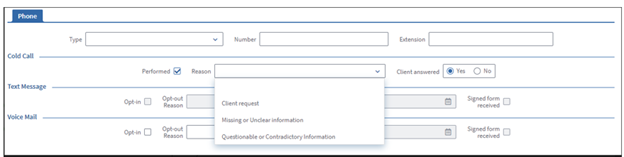
- If the household is certified as EDSAP but not eligible for the recertification interview waiver, attempt two cold calls. If both cold calls are unsuccessful:
- In the Phone page: Check the Performed box and indicate No in the Client answered field. View/Hide.View/Hide.

- Schedule and send a recertification interview appointment letter.
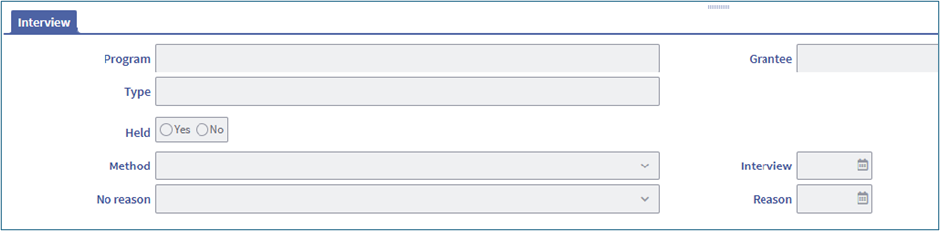
- Do not complete the Interview page if the cold calls are unsuccessful.
- In the Phone page: Check the Performed box and indicate No in the Client answered field. View/Hide.View/Hide.
- The “Perform Cold Call Recertification” action requires staff to complete two cold calls. Please be sure to conduct both cold calls and note the outcome in the narrative.
- An interview is conducted to discuss household circumstances, available resources and outstanding verifications.
- If the client is not available at the time of a scheduled interview, a NOMI is sent by batch for SNAP-only cases. When the cash case manager reschedules the first missed interview, this satisfies the role of a NOMI. If the case manager does not reschedule the missed interview, a NOMI must be sent manually.
- The case manager reviews all available data sources.
- The case manager sends a Verification Checklist (VC-1) for any outstanding item(s). View/Hide.View/Hide.
- The case manager sends a Verification Checklist (VC-1) for any outstanding item(s). View/Hide.View/Hide.
- If all mandatory verifications are received and procedures for optional verifications (see below for more details) are followed, the case is authorized and, if still eligible, is approved for a new certification period.
- If a Recertification form is submitted, but the client does not complete the recertification process, they will receive a Notice of Benefits Ending.
The BEACON Recertification Process
Staff will receive Recertifications through the Process Online Recertification Action, the Process Scanned Recertification Action, or the Available/Reviewed Scanned Documents View.
The Reevaluation workflow must be used to initiate, complete and submit a recertification.
You must start/initiate the Recertification process in the following situations:
- You are speaking with a client within the 45-day recertification period and able to complete the interview and workflow.
- A signed form is returned to the Department: This will be assigned to FAW staff as a Process Scanned Recertification Action. Economic Assistance case managers will see the form availability on the Available/Reviewed Scanned Documents View.
- A client uploads a photo of a signed recertification form through DTA Connect, which gets scanned into the client’s Electronic Case File (ECF). The FAW who gets the Action to review this document must also initiate the recertification process.
- The Recertification process is completed online (BEACON will initiate this automatically): This will be assigned to FAW staff as a Process Online Recertification Action. Economic Assistance case managers will see the form availability on the Reevaluations Due View.
When Recertification Occurs Before the Last Cyclical Month of the Current Certification Period
If a client completes the recertification process before the release date of their last month of benefits, BEACON will take the following steps:
- apply all verified changes reported at recertification to the case; and
- recalculate the household’s benefits.
Note: BEACON will not assign the household a new eligibility period until the end of the current certification period.
Verifications
Income must be verified at recertification. The client must also verify expenses to continue getting credited for the applicable deductions. If the household has any members who are subject to the ABAWD Work Rules, the client must verify participation or exemption to avoid getting strikes.
Before you send a VC-1, you must determine whether the item(s) requiring verification:
- is a permanent verification that was already provided;
- is available through a verified-upon-receipt source or the Work Number;
- can be verified by a scanned document in the Electronic Case Folder; or
- was already self-declared on the Recertification form or another written/typed statement, or verified with a telephonic self-declaration, when applicable. For example, mileage for dependent care or medical expenses.
If you cannot verify an item(s) based on the information available, you must issue the client a VC-1. If you send a VC-1, you must ensure that the outstanding item(s) is listed on the Verification tab. Verified items must be marked by selecting the appropriate Documents of Evidence on the Verification tab. An item must not be marked as verified before the corresponding verification is received.
Note: In rare circumstances, clients may submit verification of income that indicates that their income never changes. An example of this is a pension letter indicating that the client receives a specific amount and it is not subject to any cost of living or other adjustment. In those limited circumstances, clients do not need to re-verify that the income source, amount or frequency has not changed. However, at Recertification, BEACON will still generate a new verification element for this income. You must disposition this verification element as verified and write a detailed narrative stating that this income was verified using previous documentary evidence as the income never changes.
Staff must review all information available in the case record to determine what verifications are necessary. Staff must be sure to check the income on record and request updates of the income situation at Recertification if they were not already provided or available.
Addressing Terminated Income at Recertification
If a client reports that an existing income source has been terminated, it must be ended in BEACON.
Important: If a client reports that they are not terminated from their job, but currently have no hours/pay, the income source must remain, but the gross pay and hours must be zeroed out and prospected accordingly.
If it is unclear whether they are still employed, you must address this information with the client during the interview.
DTA must obtain verification that the job ended and explore if the client is receiving another form of income, such as wages from a new job, unemployment compensation, PFML, disability benefits, etc. If there is a Work Number Match that is active and displaying wages within 30 days of the case manager reviewing the case, and the client reports that they are unemployed, they must provide documentary evidence for proof of termination from the employer. If the client reports having trouble obtaining this verification, you must offer to obtain the verification via collateral contact to assist the client. Each attempt at collateral contact must be recorded in the narrative. As a last resort, a written self-declaration that the client is no longer employed may be accepted.
For more information, see Terminated Income.
Addressing Work Rules at Recertification
At recertification, you must screen all household members for exemptions from the General and ABAWD Work Rules. The exemptions are as follows:
| General Work Rules | ABAWD Work Rules |
|---|---|
|
|
During the recertification interview, you must use the SNAP Work Rules Screening Page to screen for exemptions and/or give the Work Rules Explanation. The recertification workflow will automatically direct you to this page.
You must screen for exemptions at recertification even if the client was already screened during their certification period. The SNAP Work Rules Screening page will reset the screening questions at every recertification.
For General Work Rules: If anyone in the household is exempt, you must ask the client to verify the exemption. The rules for verifying General Work Rules exemptions are detailed in The General Work Rules page.
The rules for verifying ABAWD Work Rules exemption are detailed in ABAWD Work Rules Exemptions.
During the recertification interview, you must ask clients who are subject to the General Work Rules if they have voluntarily quit a job or reduced their work hours at any time during their certification period.
Additionally, clients who are not exempt from the ABAWD Work Rules must verify ABAWD Work Rules participation. The procedures for verifying participation are detailed in ABAWD Work Rules Participation.
For certification purposes, General/ABAWD Work Rules exemptions and ABAWD Work Rules participation are considered optional verifications (unless they are tied to SNAP eligibility, such as wages). If no other verification is missing, you must follow the rules for Processing a Recertification with Optional Verifications Outstanding.
Reminder: If a recertifying household includes a member who is currently disqualified for not meeting the General Work Rules due to voluntary quit rules, you must check whether they are currently meeting an exemption from the General Work Rules. For more information, please see SNAP Voluntary Quit and Reduction of Work Hours.
Action: DTA Connect – Reported Change
If a client uses DTA Connect to report a change to their residential address during their 45-day recertification period, BEACON will create the Action: DTA Connect – Reported Change. When this occurs, BEACON will add a pencil to re-visit the page(s) pertinent to what the client reported on DTA Connect.
If you receive this Action, you must review the change(s) and send a VC-1 for the updated shelter and utility expenses by following the procedures outlined in Verifying Optional Verifications at Recertification which is outlined below on this page.
Note: If the pertinent item is not displayed on the Verification tab, it is likely because the client went back into DTA Connect and removed the item that they originally reported. If this occurs, just write a detailed narrative and disposition the Action. To find out what the client originally reported, open the Client Communication tab in BEACON and review the DTA Connect datasheet.
After taking the appropriate steps, you must disposition the DTA Connect – Reported Change action using the normal Business Process procedures.
If a Client Reports Veteran’s Income on DTA Connect Recertification
When a client reports veterans’ benefits as unearned income through DTA Connect, it will appear on the Other Income Status page as “Veterans’ Benefits” and cannot be edited.
To properly record the income, you must review the verification on file to determine whether the benefits are VA State or VA Federal Service-Related. This is a mandatory verification item.
If you cannot determine the VA income type from the verification, you must ask the client. You can ask this during the recertification interview or a cold call if no interview is required. If you do not have verification at the time of interview, you can ask the client before sending them the mandatory VC-1 for the veterans’ benefits.
Once you have this information, you must end the existing “Veterans’ Benefits” record and create a new record using the correct VA income type. You must also follow the existing procedures for clients who report state or federal veterans’ benefits at recertification. For these procedures, see State Veterans’ Benefits and Federal Veterans’ Benefits.
Do not send a VC-1 just to request proof of the VA income type. If you are unable to determine the type (after making the effort to do so) and you can otherwise process the recertification, you must process the recertification with the income entered as “Veterans’ Benefits.” You must also write a narrative saying that staff must attempt to find out this income type at the client’s next review period.
Verifying Optional Verifications at Recertification
Remember, all expenses must be reverified at Recertification, even if the expense amount has not changed.
Reminder: If you determine that the client is not reasonably able to provide documentary evidence (and the client has no one who can provide verification via collateral contact), you must accept a written self-declaration.
If the client does have documentary evidence that they can send, you must send a VC-1. If the client is only missing optional verification(s), you must do the following:
- For shelter expenses, medical expenses and dependent care expenses:
- If a Recertification is submitted via DTA Connect: BEACON will end the existing expense record and enter the new expense record (if any) as unverified once the Recertification is submitted.
- If a paper Recertification is submitted (including uploading a picture of the form via DTA Connect): End the existing expense record and enter a new expense record with the type and amount stated by the client. This will create a new unverified expense record.
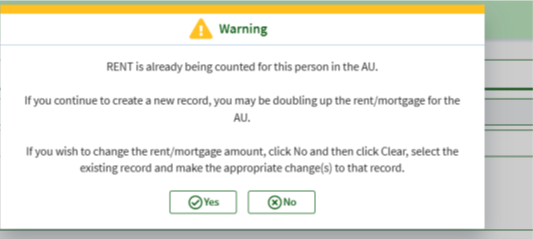
Important: When adding a new expense record after ending the old record, a pop-up message will appear to warn that a duplicate expense item is being entered.
- Send the VC-1 that generates with the new expense record. Do not verify the verification item.
- For SUA:
- If a Recertification is submitted via DTA Connect: BEACON will remove the old SUA record and enter the client’s newly reported utility selections (if any) as unverified.
If the client did not respond regarding their utility costs, BEACON will automatically set all SUA questions to “No” and end the old SUA record.- If you obtain a response during the Recertification interview, you must review and update the SUA window again based on what the client states during the interview and send the VC-1 accordingly.
- If the Recertification interview is waived, you must send a VC-1 by using the User-Entered Verification section. You must select:
- Utility Costs in the Element section and
- the Heat SUA value (the VC-1 language is the same for all utility costs - Heat, Nonheat, Phone)
- If a paper Recertification is submitted (including uploading a picture of the form via DTA Connect): BEACON will remove the old SUA record upon initiating the Recertification workflow and leave the SUA questions blank.
You must review and update the SUA window based on the client’s responses on the form and/or during the interview and send the VC-1 accordingly.
If the Recertification interview is waived, or the client did not respond regarding their utility costs on the form and you were still unable to obtain a response from the client, you must set all SUA questions to “No.” Additionally, you must send a VC-1 by using the User-Entered Verification section. You must select:- Utility Costs in the Element section and
- the Heat SUA value (the VC-1 language is the same for all utility costs - Heat, Nonheat, Phone)
- If a Recertification is submitted via DTA Connect: BEACON will remove the old SUA record and enter the client’s newly reported utility selections (if any) as unverified.
- Wrap and authorize the case without crediting the expense(s). Review the EBC calculation to make sure the SNAP benefits are accurate.
Once verification is received, regardless if the Recertification was submitted via DTA Connect or as a paper form and:
- the verification is subsequently received, enter it into BEACON, verify on the Verification tab, and wrap/authorize the SNAP case to credit the household with the expense.
- Assess whether a related benefit is owed for SNAP based on when the verification was received and when the change will take effect.
Note: A client may submit a completed paper Recertification by photographing the form and uploading the image through the DTA Connect document-upload function. The uploaded form is considered a paper Recertification and must be processed using paper Recertification procedures. For the purposes of this guidance, “Recertification submitted through DTA Connect” refers only to an Recertification initiated and completed electronically through the DTA Connect Recertification workflow—not an uploaded image of a paper Recertification.
When to Process a Recertification with Optional Verifications Outstanding
Recertifications must be processed without delay if:
- the only outstanding verification(s) is optional; and
- the case will not be denied or reduced to a $0 benefit level if the optional verification(s) is not credited.
If a VC-1 issued at Recertification is only for an optional verification(s), you must review what the household’s benefit level will be if the expense(s) is not credited. Complete the reevaluation workflow without entering the unverified expense(s) and wrap up the case. If not counting the expense(s) results in a benefit level that is greater than zero, you must immediately process the Recertification. If the verification(s) is subsequently provided, a supplement may be owed.
If not counting the expense(s) results in a $0 benefit level or the case being denied for over-income, the recertification must not be processed at this time. You must follow these steps:
- remove the authorization to process the case
- create an Action to process the case on the BEACON Release Date that occurs right before the reevaluation end date
- for more information on creating an Action, see Creating Follow-up Actions
- if the optional verification(s) is received on or before the BEACON Release Date, enter the expense(s) and approve the Recertification
- if verification is not received by the BEACON Release Date, process the case without entering the expense(s).
John, whose SSN ends in 3, submits their Recertification for October 2025 on September 17, 2025. With the Recertification, John includes pay stubs to verify their earnings. However, John also reported that they are now paying legally obligated child support expenses but did not submit verification that they're currently making the payments and that the payments are legally obligated. You send a VC-1 for the child support payments and obligation and wraps up the case without crediting these expenses. But when the child support expenses are not credited, John’s SNAP benefits are denied. Since John’s SSN ends in 3 and his Recertification is for October 2025, you create an Action to process the case on the BEACON Release Date, September 30, if the optional verification is not received. On September 30, because John did not follow up with the requested verification, you process the case and it is subsequently denied.
Interview
A Recertification interview is required for all households certified as Simplified Reporting. The interview is an important opportunity to ask clients questions about their household circumstances, and to determine which verifications may be required and to make an accurate eligibility determination. Interviews can identify additional supports the client may need, such as an ADA Accommodation or an Assisting Person. The interview is also a valuable opportunity to address other services and options available to the client, such as Domestic Violence, Voter Registration, SNAP Path to Work, DTA Connect, and whether they wish to block access to online services.
For more information, see The Recertification Interview.
Waived Interview for Elderly/Disabled Households
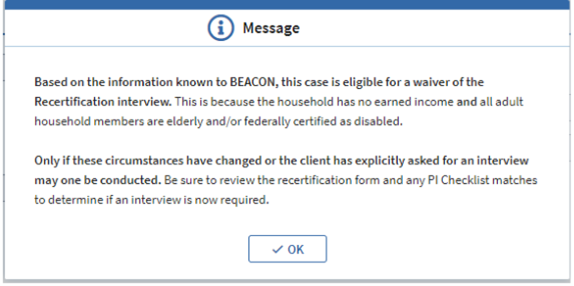
The Recertification interview is waived for households on EDSAP reporting due to all adult members being either 65 years or older (the definition of elderly for EDSAP) or federally certified as disabled and there is no earned income. Households with minor children are still eligible for this waiver as long as the previous conditions are met. The option to waive a recertification interview does not apply to cases assigned to TBA.
When a recertification is initiated, BEACON will determine if it is eligible for an interview waiver based on the information on file. If the household meets the waiver criteria, the following message will display: View/HideView/Hide
The Interview page will also reflect this waived status. View/HideView/Hide
Notice of Missed Interview (NOMI)
A NOMI must be sent to a client who does not keep a scheduled interview. It is considered a negative error or an invalid case action for Quality Control purposes if the NOMI is not sent and the household is subsequently closed or denied.
The DTA Assistance Line places outbound calls to SNAP clients at the time of their scheduled telephonic interviews. When a SNAP-only client does not answer for their scheduled telephonic interview after two attempts, BEACON will update the Interview page with the status of Missed Interview, and send a NOMI centrally. A batch narrative will be entered on the case that evening.
Important: When a combo client misses their interview, and the cash case manager reschedules the appointment, a NOMI does not need to be sent. If the cash case manager does not reschedule the appointment, they must send a NOMI. BEACON will not automatically generate a NOMI for combo cases.
Reminder: SNAP-only clients can automatically reschedule their telephonic interviews and appointments using the DTA Connect mobile app and DTAConnect.com platforms. See Clients to Reschedule Appointments - SNAP.
Contacting Households Eligible for a Waived Recertification Interview
If a household is eligible for a waived Recertification interview, you must contact them if:
- they return a signed Recertification form with missing pages, incomplete sections or contains questionable or contradictory information (that cannot be verified using available resources); or
- the household includes a member who must be screened for exemptions from the ABAWD Work Rules. These are individuals on EDSAP who are under age 65 and have no other exemption on record.
If either of these two conditions are met, you must attempt two cold calls. The cold calls are used to clarify information but does not necessarily mean an interview has been held or is needed. You must identify the reason for the cold call in the Phone page.
Reminder: You do not have to screen EDSAP clients who already have an exemption on file. Example: 30-year-old EDSAP client receives SSI due to federal disability.
Cold Call Due to Incomplete/Questionable Form
If you successfully cold call a client whose recertification interview was waived but who had incomplete/questionable information on their recertification, you must discuss the areas requiring clarification and send a VC-1 (if necessary) based on the conversation. Do not update the Interview page just because contact with the client is made.
- If the client verbally indicates that they do not have any changes to report, you must document this in the Narrative. You do not need to send a VC-1 or return the Recertification form to the client in this instance.
- If the client verbally indicates that they have changes to report, you must obtain a telephonic self-declaration if the change involves an item for which a telephonic self-declaration is acceptable (per Self-Declarations). You must send a VC-1 if verification of the item is not acceptable via telephonic self-declaration, verbal self-declaration, available through a trusted source, or already verified in the ECF. This is applicable for all sections that have a change verbally reported, regardless of whether the outstanding component is optional or mandatory.
If the client cannot be reached, you must send a VC-1 for clarification of the section that is incomplete, questionable or contradictory. The VC-1 must request items that would otherwise be discussed.
Use Additional Verification and copy the following language:
“We received your Recertification form, but it is missing information that we need to process your case. You may call us to let us know what your current circumstances are, you may complete the highlighted sections of this form, or you may submit verification of any changes.”
- If any of the missing/contradictory sections involve mandatory elements, such as earned/unearned income, the Additional Verification must be coded as Mandatory.
- If the only missing/contradictory sections are for optional verifications, such as a rent expense, the Additional Verification must be coded as Optional.
You must not attempt contact at Recertification if:
- no change is reported;
- the information reported is consistent with what is known to the Department; and
- the change reported is clear but proof has not been provided. In this situation, a Verification Checklist (VC-1) must be sent if the change is not available to the Department though a data source, documentary evidence already in the case record, or self-declaration.
The option to update the interview status/schedule an appointment will only be allowed if the cold call is unsuccessful and an appropriate cold call reason is selected. If an interview must be conducted or scheduled, you must annotate a justification reason in the Interview page.
If a household eligible for this waiver submits a Recertification form and subsequently contacts the Department to confirm receipt of the form, an interview must not be held simply because the client is on the phone. However, an interview that would otherwise be waived must be held:
- if the household requests an interview;
- when the Simplified Reporting Recertification form contains information that is unclear, questionable or contradictory; or
- before closing the household at recertification.
Reviewing Data Sources at Recertification
SVES
You must only run a SVES request at recertification/reevaluation for:
- new household members, and
- existing household members who are receiving or presumed to be receiving RSDI and/or SSI when either income has not been updated within the last year.
You can determine if the income has been updated within the last year by clicking on the External Agency – Other Income button in the selected client’s Other Income Status page. The Current Effective date will have the most recent date the income was updated. Use the income listed in the External Agency – Other Income screen if it has been updated within the last year. BENDEX and/or SDX will batch in new data as it becomes available.
Do not run a SVES request for Bay State CAP clients. SSA updates a Bay State client’s case as new information is reported to SSA. In addition, DTA cannot make income changes to Bay State CAP cases.
Work Number
When a recertification is initiated, BEACON will be prompted to check for Work Number matches. If there is a Work Number match a PI Checklist match will be created.
Work Number for SIMP-12 and Former EDSAP Recertifications
For SIMP-12 Simplified Reporting and Former EDSAP recertifications: You must review wages available from Work Number with the client to confirm for accuracy and that the income is reasonably expected to continue over the certification period.
Work Number for EDSAP Recertifications
If an EDSAP client initiates the recertification process and signs the recertification over the phone, and Work Number shows earned income, you must review the Work Number information with the client during the call. If the client confirms the information is correct, enter the wages in BEACON, mark the earned income as Verified, and disposition the match. If the client disputes the Work Number information, send a VC-1 for earned income (or termination of employment, if applicable).
For EDSAP clients that do not submit the recertification telephonically: When there is a Work Number match showing active employment and wages within the last 30 days, you only need to contact the client if the match information conflicts with what the client reported on the recertification.
If the client reports on the recertification that they are working and the employer listed in the Work Number matches the employer that the client reported on the recertification, use the most recent wages in Work Number when processing the recertification. You do not have to send a VC-1 or cold call the client to confirm the information.
If the client did not report that they are working or reported a job that is different from the one that appeared in the Work Number, you must:
- Attempt to cold call the client two times.
- If both cold calls are unsuccessful, send a VC-1 for earned income.
- If one of the calls is successful, ask the client if the match information is accurate.
- If the client confirms the match information, disposition the match and mark earned income as Verified. Use the most recent wages in the Work Number when processing the recertification.
- If the client disputes the match information, send a VC-1 for earned income.
Once you process the EDSAP recertification with the earned income on file, the household will be taken off EDSAP Reporting.
Other Data Sources
Applicable data sources must be reviewed before processing a recertification. For Recertification examples, see External Databases.
Sources include the EMT, RAPID, and SAVE (if applicable). The results from SAVE, if applicable, are the only results that are to be attached to the ECF. You must detail all data sources that were reviewed in the case narrative.
Notice of Benefits Ending
A Notice of Benefits Ending is sent to SNAP households when their Recertification form is returned but a timely case closing occurs at the end of the certification period because the recertification process was not completed. A SNAP client would receive one of the following, based on the applicable situation:
- Recertification Form Returned but Mandatory Verifications are Missing.
The household submitted a Recertification form timely, and was interviewed, but the recertification is not authorized due to outstanding mandatory verifications. A VC-1 was sent with a due date on or before the closing date. - Recertification Form Returned but No Interview Completed.
The household submitted a Recertification form timely, had a cold call attempted, and an interview scheduled, but the household missed the scheduled interview. - Recertification Form Is Returned Too Close to the Closing Date.
The household submitted a Recertification form after the apply-by-date, but before the closing date. The notice acknowledges receipt of the Recertification form and informs the client that other requirements in the recertification process need to be completed.
Reinstating Untimely or Incomplete Recertifications
BEACON will close a case if the recertification process is not complete by the BEACON release date (a few days prior to the end of the certification period). If a client submits a Recertification form after the BEACON release date but before the certification end date, you must:
- reinstate case and enter the Form Received date to initiate the recertification. If the client comes to the TAO, and does not provide a form but signs the form that is generated from BEACON based on the interview, the Form Received date would be the date of that in-office interview
- click Save
- complete all required pages and follow procedures for a timely recertification.
Note: If a Recertification form is returned after the certification end date, but within 30 days of the certification end date, you must use the form to create a Request for Assistance (RFA). If the Recertification form is returned more than 30 days after the certification end date, the client must reapply through the normal application process.
If verifications are received prior to closing, the Benefit Effective Date field will be blank on the Interview Wrap up page. Fault will not be determined because although late, the recertification requirements were met by the closing date. Enter the client’s next cyclical issuance date (day after closing date) as the Benefit Effective Date and wrap up the case. If verifications are received after the closing, the Benefit Effective Date field on the Interview Wrap up page will be set based on the BEACON fault reason. The Fault Reason and Classification will be displayed in Interview Wrap up.
The Verification Received field will be enabled only for reinstatement of cases closed/denied for one of the following reasons:
- Failed to keep appointment for review
- Your certification period has ended
- Initiated but Failed to Recertify
- Fail to submit the required verifications
Extended Reinstatement Period
In limited and extenuating circumstances, a case can be reinstated up to 3 months after the recertification closing date if one of the following is true:
- A scanned SNAP prefilled Recertification form with a DTA received date between the SNAP notice sent date and the recertification closing date is available to be processed; or
- A scanned verification with a DTA received date between the SNAP notice sent date and the recertification closing date plus 30 days is available to be processed.
Denying a Reinstated Recertification
If a reinstated recertification is not dispositioned by the 30th day following the closing date, BEACON will generate a notice to the client and deny for one of the following reasons:
- You Did Not Complete the SNAP Recertification Process after Reinstatement.
- You Did Not Submit the Required Verifications for Recertification after Reinstatement.
The case will not be eligible to be reinstated again. The client must reapply through the normal application process.
Last Update: August 10, 2026
|
|
|
||
| Digital Accessibility Statement | Privacy Policy | Site Policies | Public Records Requests |
|
© 2026 Commonwealth of Massachusetts. Mass.gov is a registered service mark of the Commonwealth of Massachusetts. |
|||