An official website of the Commonwealth of Massachusetts Here's how you knowHere's how you know

The Recertification Interview
Overview
Most SNAP households must complete a recertification interview. This interview is a chance for staff to ask questions, figure out what is needed to determine if the household can continue getting SNAP and ensure accuracy when SNAP benefits are calculated.
An interview at recertification is required for all SNAP households unless eligible to be waived due to having only elderly and/or disabled adults.
To learn about the recertification procedures for EDSAP or Bay State CAP households, see Simplified Reporting – Recertification or Bay State CAP – Recertification.
Cold Call Attempts
If you get a recertification and an interview is required, you must cold call the client for the interview. You must try calling the client at least two times before scheduling an interview. This is crucial because DTA has a limited number of interview slots and this is more efficient than scheduling an interview.
If a cold call is unsuccessful, you must leave the following voicemail message:
“This is the Department of Transitional Assistance calling regarding your recertification, we will be calling back in the next minute or so to complete your interview. If you are available, please pick-up. If we do not reach you, we will send you an appointment for an interview. To complete the interview earlier, you can call the Assistance Line at 877-382-2363 (or your case manager at XXX-XXX-XXXX). Thank you.”
You must also write a narrative summarizing the results of the cold calls attempted.
Scheduling Interviews
You must schedule an interview if both calls are unsuccessful. The interview must be scheduled at least 4 calendar days (but not more than 7) from the date that you send the appointment letter. This helps ensure that the case is processed on time and benefits are not delayed.
If you do not complete or schedule an interview, a batch will schedule one (provided the case was initiated). The batch will schedule the interview at least 4 calendar days ahead. This is limited to pending/active cases in the FAW model. For more information, see Scheduling/Cancelling Interviews. The client will get a reminder call 24 hours before their scheduled appointment.
To schedule an interview:
- click the Schedule Appointment icon in the BEACON Tools tab:
 . The Client field will be prefilled with the client’s name
 - select the type of appointment (recertification) you are scheduling from the drop-down box
- for Additional Free Form Narrative, you may enter any notes pertinent to the upcoming interview
- in the Start field, enter or select the date of the interview from the calendar pop-up icon
- for Start time, enter the start time for the interview
- for End time, enter the time the interview will end
- for Print location, select Local or Central; and
- click Save.
When a Client Misses a Scheduled Interview
A Notice of Missed Interview (NOMI) must be sent to any client who misses their scheduled interview. If the NOMI is not sent and the case is later closed or denied, it will be marked as an error.
The DTA Assistance Line calls SNAP clients at the time of their phone interview. If the client doesn’t answer after two calls, the system (BEACON) will mark the interview as missed and send a NOMI automatically. A narrative will be added to the case that night.
SNAP-only clients can reschedule their phone interviews and appointments using the DTA Connect app or the DTAConnect.com website.
Reminder: If a combo client misses their interview and the cash case manager reschedules it, a NOMI does not need to be sent. However, if the case manager does not reschedule the interview, they must send a NOMI. BEACON will not send a NOMI automatically for combo cases.
Conducting the SNAP Recertification Interview
When doing the interview, you must:
- Start by telling the client what to expect, like how long the interview will take and that you will ask questions about their household and situation.
- Look at past info in BEACON. Check the narratives to see if anything might affect their eligibility, like past issues or matches with other systems that could not be fully addressed until recertification.
- Update BEACON and resolve any differences between what the client says, what’s in their recertification form, or any older info.
- Talk about any incomplete sections of the recertification, and explain any hard-to-understand rules (like the ABAWD Work Rules).
At the end of the interview, you must:
- Go over what was talked about to make sure you and the client both understand what happened and what will happen next.
- Explain how important it is to turn in any required verification on time, the different types of proof they can provide, and explain the different ways they can send it in.
- Write a clear and detailed narrative about the interview, which data sources you checked and next steps. For more information on narratives see Completed BEACON Narratives section of the OLG.
Important Things to Remember as you Complete the Interview
Below are some other important things to remember as you complete an interview:
Gather Demographic Information
To make sure you’re talking to the right person and that the info on the recertification is correct, you need to ask for:
- the client’s first and last name, and last four digits of their SSN;
- the client’s address and phone number; and
- if applicable, demographic information of all other household members, including each person’s:
- name,
- date of birth, and
- last four digits of SSN if they are known to the system, or full SSN if they are not known to the system.
Check Household Composition
When someone recertifies for SNAP, they may not list everyone who lives with them. The reason is that someone may have moved in or they are not sure who is required to be a part of their SNAP household. To prevent errors and correctly determine SNAP benefits, you must ask if anyone else lives in the home, even if no one else is listed on the recertification.
If the client says that other people live in the home, ask about each person’s:
- Relationship to the client
- If they buy and cook food together
- If they have any income or expenses
Ask Open-Ended Questions
When you ask the client questions during the interview, use open-ended questions instead of yes-or-no questions.
Yes-or-no questions can lead to quick or careless answers that might be incorrect.
Open-ended questions let the client explain more and give better, more accurate information.
Examples of Open-Ended Questions
- How much are you responsible to pay in rent?
- What utilities are you responsible for paying?
- Who lives in your household?
- What sources of income do you have?
- What kinds of medical expenses are you responsible for paying?
Examples of Leading Questions (avoid)
- Is your rent still $750?
- You pay for heat, correct?
- I have you, Joey, and Susan listed in the house, correct?
- You have no income?
- Do you have any medical expenses?
Ask Follow-Up Questions
Along with asking open-ended questions, it is also important to ask follow-up questions if something the client says is unclear or doesn’t seem right.
Clients do not always know SNAP rules, and they might explain their situation in a way that does not match what DTA needs. For example, if someone says they earn $200 a week, you must ask, “Is that before or after taxes?” They might give the amount they take home (net pay), but DTA usually counts the full amount before taxes (gross pay).
Follow-up questions help clear up confusion. They’re usually more specific than open-ended questions. Here are a few examples:
- If the client did not list anyone else on the recertification but says someone else lives with them, ask:
- “What is your relationship to that person?”
- “Do you buy and cook food together?”
- If the client says their rent is subsidized, but the amount on the recertification seems too high, ask:
- “How much of the rent do you have to pay?”
- If a mother adds a baby to her household, and the birth record shows the baby’s father lives with them, ask:
- “The birth record says the father lives at your address. Is that still true?”
Engage in Client-Friendly Communication
When talking with the client, make sure they have a chance to ask questions, provide clarity and give feedback. Ask if they understood what you just explained. If you do not understand something they said, ask them to explain it again. Repeating what they said help to ensure that you understood it correctly—try to use their words as much as possible without adding anything new.
While they are talking, show that you’re listening by saying things like “I see” or “Go on.” Do not judge what they say.
Avoid using DTA terms or acronyms that only DTA workers would know. While you may know a lot about DTA rules and programs, most clients do not.
As a case manager, it can help to use a clear script and plan what you want to say to make the recertification process easier for the client. Be sure to ask open ended questions.
If the client has limited English proficiency, you must offer the assistance of an interpreter in their primary language. If they have a communication-related disability, take extra time to ensure they fully understand and are able take part in the recertification process.
Notify Clients About Other Resources
During the interview, you may learn that the client will benefit from other resources besides DTA benefits. Below is a list of some resources that might be helpful:
The Recertification Interview Workflow
To help you do the interview, BEACON will guide you to certain pages in the SNAP recertification workflow. Some pages will always need to be reviewed or updated. Others will need review or updates depending on past data, or what the client indicates on the form or says during the interview. The pages you must visit will display a pencil icon. Most pages without a pencil for reedit will still be available for you to review or update if needed. Staff are to use the Next button to navigate from page to page.
Do not overlook a BEACON page just because it does not have a pencil for reedit. If the page has information that applies to the client, you still need to visit it and make updates if needed.
Other Indicators for Items to Review
In addition to the pencils in the BEACON workflow, you must use the client’s recertification form for reference on what you must discuss during the interview. If the client submitted their recertification online, you must use the Recertification datasheet available in the Electronic Case Folder (ECF) in the Client Communications tab.
Important: Most data elements from a recertification submitted online will transfer into BEACON; however, some data may only be available on the Recertification Datasheet and/or need further review to be processed. For example, the DTA Connect Recertification workflow includes a set of questions on student status and student eligibility for all household members who may be subject to the student rules; however, all student data recorded from the client online does not directly transfer into or update the Education page in BEACON.
Staff must review the entire Recertification Datasheet when a client submits their Recertification online and take necessary actions to complete processing.
A useful practice is to download the scanned recertification form or datasheet from the Client Communications tab, and then tile it (or snap it to the side of your screen) so you have the datasheet side by side with BEACON. See example View/HideView/Hide
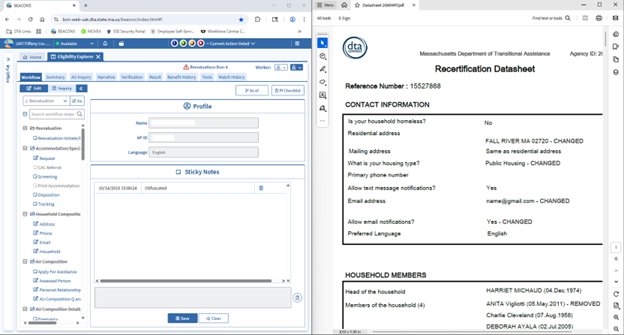
Reviewing the form/datasheet concurrently with BEACON helps ensure that you will not forget to discuss any pertinent items during the recertification interview.
Note: EDSAP Reporting and Simplified Reporting (Former EDSAP) households are subject to the same timeframes for processing timely and untimely/incomplete recertifications as other Simplified Reporting households.
Last update: August 10, 2026
|
|
|
||
| Digital Accessibility Statement | Privacy Policy | Site Policies | Public Records Requests |
|
© 2026 Commonwealth of Massachusetts. Mass.gov is a registered service mark of the Commonwealth of Massachusetts. |
|||