An official website of the Commonwealth of Massachusetts Here's how you knowHere's how you know

ABAWD Work Rules Regaining Process
Overview
SNAP clients must follow the ABAWD Work Rules unless they are exempt. Non-exempt clients are disqualified from SNAP if they do not meet the rules for three months in a 36-month period (aka “the ABAWD Clock”). Each month in which a client does not comply will result in a strike.
Clients with three strikes are ineligible for SNAP for the rest of the ABAWD Clock unless they regain eligibility.
Criteria for Regaining
Clients with three strikes can regain eligibility for SNAP if:
- they become exempt;
- they start meeting or verify that they will meet the Work Rules (within the 30 days subsequent to the application date);
- the ABAWD Clock resets;
- you determine that one or more strikes are incorrect; or
- they previously met the rules for 30 consecutive days while disqualified.
Regaining by Becoming Exempt
Clients with three strikes can regain eligibility if they become exempt. This includes (but is not limited to) the client:
- becoming exempt from the General Work Rules for reasons other than age;
- turning age 65;
- becoming unable to work at least 30 hours per week due to a physical or mental health problem;
- starting to live with someone under age 14 (even if that person is disqualified due to being a non-household member);
- becoming pregnant;
- moving to a waived area.
This is true even if no exemptions applied to the client when DTA issued the strike(s).
See ABAWD Work Rules Exemptions for more details on exemptions.
Regaining by Meeting the Work Rules
Clients with three strikes can regain eligibility if they start or verify that they will meet the ABAWD Work Rules (within the 30 days subsequent to the application date) due to:
- working an average of 20 hours per week;
- participating in a qualified employment and training program (E&T) 20 hours per week;
- doing a combination of work and E&T totaling 20 hours per week; or
- doing community service for a certain number of hours each month.
See ABAWD Work Rules Participation for more details on meeting the rules.
Regaining When the ABAWD Clock Resets
Clients with three strikes can regain eligibility if the ABAWD Clock resets. The ABAWD Clock is the same for all SNAP clients. It is displayed at the top of the ABAWD Clock page.
After the Clock resets, a client may reapply for SNAP benefits, and you must reinstate the client if they were disqualified for non-compliance. You may also notice a disqualified household member during a reporting period or while reviewing the case during case maintenance. In these situations, if the disqualified client is not the grantee, you must make a cold call to confirm that the member is still in the household.
Regaining Due to Incorrect Strikes
Clients with three strikes can regain eligibility if one or more of the strikes are incorrect. This means you must remove the strike(s) if:
- the client verifies that they were exempt during a strike month(s);
- the client verifies that they met the rules for a strike month(s); or
- you find that DTA issued the strike(s) due to administrative error.
Note: When discussing possible incorrect strikes with the client, staff are to use specific dates. This will help them remember what was going on in their lives. Example Example
This (incorrect strikes) is the only scenario where you would remove a strike after reinstating the client. In all other regaining scenarios, the strikes would remain on record even after you reinstate the client. The steps for removing strikes are detailed in the ABAWD Clock Page.
Verifying Incorrect Strikes Due to Exemption
To verify exemption during a strike month, clients must verify the past exemption.
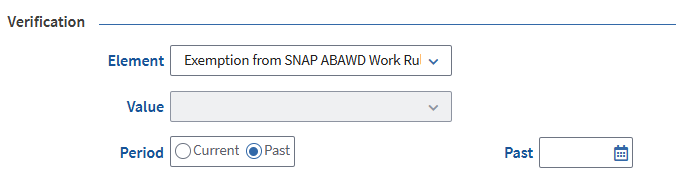
If verification is not available, you must send a VC-1 for Past Exemption from SNAP ABAWD Work Rules. Follow these steps:
- Open the Verification tab
- Click on +New to open the User Entered Verification page
- For Element, select Past Exemption from SNAP ABAWD Work Rules
- For Value, select the applicable exemption for the past period. You can choose from the following options:
- ABAWD: Indian per IHCIA
- ABAWD: Unable to Work – DTA Determination
- General Work Rules: Caretaker
- General Work Rules: Certified Disability
- General Work Rules: Student
- General Work Rules: Substance Use Treatment
- General Work Rules: UC Applicant/Recipient
- General Work Rules: Unable to Work – Temporary Illness or Disability
- Period will default to “Past”
- For Past date, enter the month and year of the strike month for which the client is claiming a past exemption. View/HideView/Hide
Verifying Incorrect Strikes Due to Participation
To verify participation during a strike month, clients must give proof that they met the rules at that time. Below are some examples of acceptable verification:
|
Participation Type |
Examples of Acceptable Verification |
|---|---|
|
Working |
|
|
Employment and Training (E&T) |
Letter from E&T site confirming:
|
|
Community Service |
|
If a client says that they met the rules during a strike month (and did not already give proof), you must send a VC-1 for SNAP ABAWD Work Rules Participation. Make sure you ask the client specifically how they met. For Value, you must select the item that matches how the client met the rules during the strike month: View/HideView/Hide
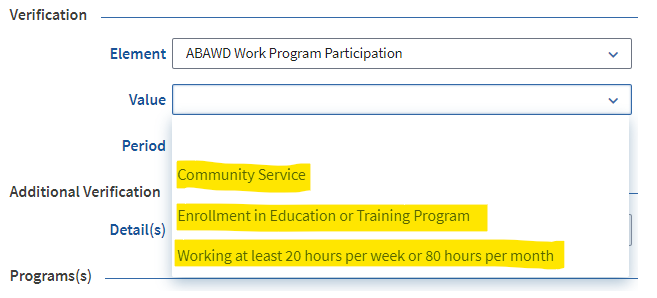
You must also add Additional Verification (coded as Optional) and copy the following language:
“We need you to prove that you met the work rules in {STRIKE MONTH: WRITE MONTH AND YEAR}. Please make sure the proof says how many hours you participated during this month. We cannot accept the proof if it is missing this information.”
Regaining Due to Past Participation
Disqualified clients can also regain eligibility if they met the ABAWD Work Rules while they were off SNAP. These clients can regain if they meet the rules for 30 consecutive days, as long as:
- the 30 days were within the current ABAWD Clock, and
- the client was not already credited for meeting the rules during that 30-day period.
Example 1
Ellie (she/her) has been getting SNAP with her husband Marco (he/him). In June 2025, Ellie is removed from case due to getting three strikes. The case remains open with just Marco. Ellie reports in January 2026 that she was working from 09/15/2025 to 11/01/2025. The ABAWD Clock is 01/01/2024 through 12/31/2026. Ellie has regained eligibility due to meeting the rules. Ellie is added back to the case for February 2026.
Example 2
Walter (he/him) gets SNAP as a household of 1. Walter meets the work rules from January 2025 through April 2025. However, he does not meet from May through July. Walter’s case closes in August 2025 for getting three strikes. Walter files a new SNAP application the next month. He asks that DTA approve his case because he met the rules from April 1 through April 30, 2025. However, he cannot claim those months to regain eligibility because DTA already credited Walter for meeting in April 2025.
Verifying Past Participation
If a client claims past participation (and did not already give proof), you must send a VC-1 for ABAWD Work Rules Participation. Select the Value that matches how the client says they met the rules: Community Service, Enrollment in Education or Training Program, or Working at least 20 hours per week or 80 hours per month. Then add Additional Verification (coded as Optional) and copy the following language:
“We need you to prove that you met the work rules from {FIRST DAY} to {LAST DAY}. Please make sure the proof says how many hours you participated during that period. We cannot accept the proof if it is missing this information.”
If a Disqualified Client Reapplies, Can I Approve them Before they Verify that they Regained?
You cannot approve a SNAP application for a disqualified client before they verify that they have regained. This applies to both ongoing and expedited benefits. Even if the client says they have regained, they cannot get expedited benefits before they follow the appropriate verification steps.
If the client does not verify that they have regained, they must stay disqualified for non-compliance: View/Hide.View/Hide.
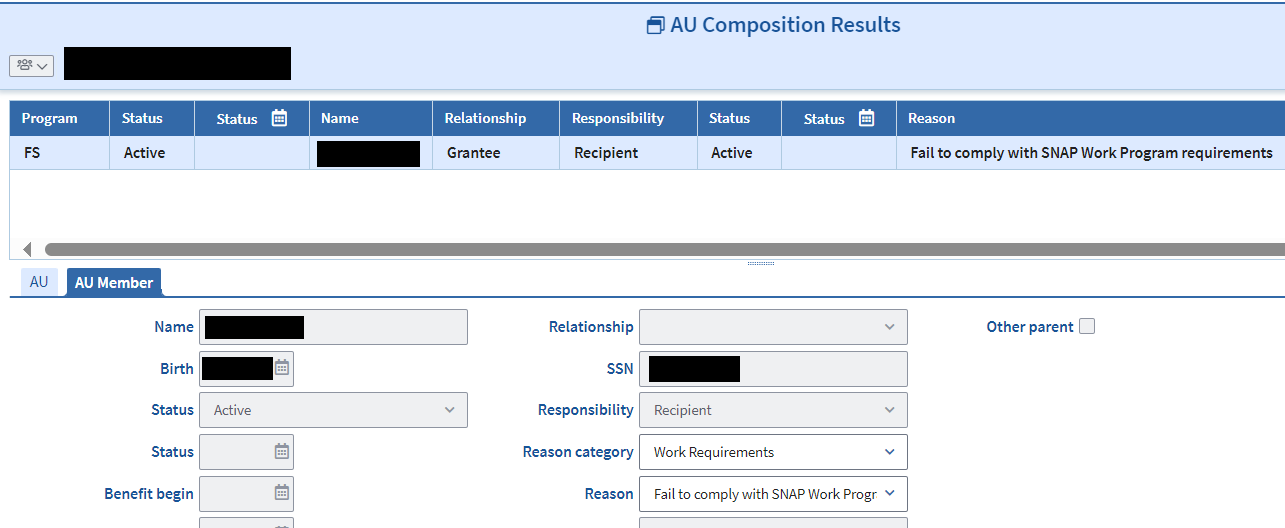
If the household has other members, you can approve them (for ongoing or expedited) if they are otherwise eligible. However, the client must be coded as a disqualified household member.
Reminder: Every person has the right to apply for SNAP. You must never discourage someone from applying even if they appear to be ineligible.
If a Client Regains, Do I Owe a Related Benefit?
You do not owe a related benefit unless you are late reinstating the client into the case. The reinstatement must be effective no later than the first SNAP allotment issued 10 days after:
- the date the client reported the change, or
- if the client did not report the change, the date you became aware of the change.
What Happens if a Client Does Not Meet After Regaining?
If a client regains eligibility by meeting but subsequently does not meet the ABAWD Work Rules, the client will not be disqualified right away. DTA will grant the client an additional three months in which they can be on SNAP without meeting the rules. These additional months are called “Exception Months.”
After the Exception Months, not meeting the rules will result in the client getting disqualified for the rest of the ABAWD Clock. The client will remain ineligible until they once again regain.
When Do Exception Months Begin?
The first Exception Month will be the first month in which the client does not meet after regaining eligibility. The client cannot choose when to start the Exception Months.
Can the Client Use Exception Months at Different Times?
Exception Months must always be consecutive. The client cannot use them at different times during the ABAWD Clock.
Can Exception Months Be Used More than Once?
Clients can only get Exception Months once during the ABAWD Clock.
However, DTA can remove the Exception Months and use them later if the client:
- meets the rules for all three months, or
- becomes exempt during all three months.
The steps for removing Exceptions Months are detailed in the ABAWD Clock Page.
The following example shows how this works:
|
Date |
Scenario |
|---|---|
|
12/31/2024 |
Arnel’s (he/him) SNAP case closes because he got three strikes. |
|
02/04/2025 |
Arnel files a new SNAP application. His SSN ends in 1. Arnel verifies that he is now working 20 hours per week. SNAP approved. The certification period is from 02/02/2025 through 02/01/2026. |
|
12/20/2025 |
Arnel submits his recertification. He reports that he is no longer working. Arnel has no other exemption. He must meet the ABAWD Work Rules. |
|
03/01/2026 |
Arnel does not verify participation during the recertification process. ABAWD Work Rules start date set to 03/01/2026. |
|
04/15/2026 |
Arnel does not meet the rules. His Exception Months are March, April, and May 2026. |
|
05/15/2026 |
Arnel sends proof of wages. Verification shows that he has been working over 20 hours per week since March 5. Staff are to use this verification to remove his Exception Months. However, Arnel’s wages put him over the income limit |
|
06/01/2026 |
Arnel’s case closes due to over-income. |
|
07/01/2026 |
Arnel reapplies for SNAP. He indicates that he lost his job. He has no other exemption. Arnel must meet the ABAWD Work Rules to get back on SNAP. |
|
07/31/2026 |
Arnel gives all mandatory verifications. DTA approves his application because Arnel still has Exception Months available since he did not end up using his Exception Months (for March, April, and May due to working). His new certification is from 06/02/2026 through 06/01/2027. However, Arnel did not verify that he met the ABAWD Work Rules. His Exception Months are now July, August, and September 2026. |
Last Update: August 10, 2026
|
|
|
||
| Digital Accessibility Statement | Privacy Policy | Site Policies | Public Records Requests |
|
© 2026 Commonwealth of Massachusetts. Mass.gov is a registered service mark of the Commonwealth of Massachusetts. |
|||