An official website of the Commonwealth of Massachusetts Here's how you knowHere's how you know

Simplified Reporting – Overview
Simplified Reporting
Simplified Reporting is a type of certification that allows for reduced reporting requirements for clients and reduced actions for DTA and results in more stable benefits. Simplified Reporting clients are required to report changes outside of application, Interim Report (IR) and Recertification periods if their monthly gross income exceeds the limit for the household size. In addition, if the household contains an Able-Bodied Adult Without Dependents (ABAWD), the household must also report if that person's weekly work hours fall below 20 hours per week or 80 hours averaged monthly.
Important: Information that is verified upon receipt must be acted upon immediately, even if the client was not obligated to report a change. When verified-upon-receipt information is received from the client or a match, benefits must be recalculated, regardless of how the benefit changes.
The Work Number must only be checked and used at application, Interim Report, and Recertification. You can only check it at case maintenance in certain scenarios involving Unemployment Compensation: See Processing Unemployment Compensation Matches or Client Reports Unemployment Compensation has ended.
For more information on using the Work Number during reporting periods, see The Work Number, Simplified Reporting – Interim Report, and Simplified Reporting – Recertification.
If the household experiences a change in income that puts them over their gross income limit, they must report this change no later than the 10th day following the end of the calendar month in which the change occurred (see Simplified Reporting Case Maintenance). Due to these unique reporting requirements, you must verbally explain Simplified Reporting rules to clients during the application interview and at recertification (if an interview is required).
This certification type can provide protection against errors for the Department. Simplified Reporting cases are required to check in with the Department halfway through their certification period by completing an Interim Report (IR).
Reporting vs. Verifying
Reporting is when a client informs the Department of changes (verbally or in writing) in their household circumstances, income, and/or expenses.
Ben calls to report that his rent decreased by $100.
Verifying is when the client submits documentation to substantiate a reported change with proofs such as pays stub, court orders, written self-declarations, etc.
Ben submits a lease to prove that his rent went from $300 to $400 per month.
Timeframes for Simplified Reporting
Households with a certification of Simplified Reporting are certified for specific timeframes based on the household’s composition and income sources.
Simplified Reporting – 12 Months
Simplified Reporting – 12 Months (SIMP-12) households are certified for a 12-month period with an IR required at month 6. These households typically have earned income, mixed income types and/or mixed household composition and may include an ABAWD
EDSAP Reporting
Elderly-Disabled Simplified Application Project Reporting (EDSAP Reporting): households are SNAP-only households where all adult household members are:
- Elderly (for EDSAP, to qualify for this reporting type, elderly is 65 years or more); or
- disabled
Note: EDSAP Reporting households may include children under 18 regardless of disability status.
EDSAP Reporting household members may have:
- unearned income
- no unearned income.
Households that include an active Earned Income record with a prospective average of $0 will also be eligible for EDSAP Reporting. EDSAP Reporting households must have no earned income.
Households that include earned income considered to be noncountable for SNAP are also considered eligible for EDSAP Reporting, if otherwise eligible.
Important: The presence of countable earned income in a case will preclude a household from being converted to EDSAP Reporting.
The addition of countable earned income to a household previously certified as EDSAP Reporting will result in the household being converted to Simplified Reporting (Former EDSAP).
For more, please see Types of Earned Income.
EDSAP Reporting households are certified for 36-months with no interview required at recertification (for more on waived interviews, please see Simplified Reporting Recertification), no gross income limit, and no IR requirement while the household remains eligible for EDSAP Reporting.
For more information about EDSAP Reporting and its IR requirements, please review Simplified Reporting Interim Report.
An EDSAP Reporting indicator icon will be applied in BEACON for all eligible households. This will be displayed on the ECF Home page in BEACON.
Simplified Reporting
When a household previously certified as Bay State CAP Reporting chooses to opt-out of Bay State CAP reporting and does not meet the criteria of EDSAP reporting, the household will be converted to Simplified Reporting.
Simplified Reporting households maintained their original certification period. Households converted to from EDSAP to Simplified Reporting (Former EDSAP) will have an IR requirement. Unlike SIMP-12, these households may be required to complete more than one IR during their certification period.
Simplified Reporting (Former EDSAP)
Simplified Reporting (Former EDSAP) households consist of members previously certified as EDSAP Reporting who reported the addition of earned income, the addition of a household member that is 18 or older and not disabled, or an existing household member turns 18 and is not disabled.
Simplified Reporting (Former EDSAP) households maintain their 36-month certification. Like EDSAP Reporting households, Simplified Reporting (Former EDSAP) households are not subject to a gross income limit.
Households converted to Simplified Reporting (Former EDSAP) have an IR requirement. Unlike SIMP-12, these households may be required to complete more than one IR during their certification period.
For more information about Simplified reporting (Former EDSAP) and its IR requirements, please review Simplified Reporting Interim Report.
A Simplified Reporting (Former EDSAP) indicator icon 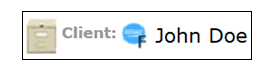 will be applied in BEACON for any converted household. This will be displayed on the ECF Home page in BEACON.
Note: If an ineligibility factor, such as countable earnings or changes to household composition, is removed from a Simplified Reporting (Former EDSAP) case, the case will be reclassified as EDSAP Reporting even if this change occurs during the certification period.
Last Update: August 10, 2026
|
|
|
||
| Digital Accessibility Statement | Privacy Policy | Site Policies | Public Records Requests |
|
© 2026 Commonwealth of Massachusetts. Mass.gov is a registered service mark of the Commonwealth of Massachusetts. |
|||