An official website of the Commonwealth of Massachusetts Here's how you knowHere's how you know

Simplified Reporting – Reporting Requirements During Case Maintenance
Overview
Simplified Reporting households have minimal reporting requirements outside of application, Interim Report (IR) and recertification periods. These households are required to report to DTA if the household’s income exceeds its maximum monthly income limit. The income limit is dependent on the household size and composition. In addition, if the household contains an Able-Bodied Adult Without Dependents (ABAWD), the household must also report if that person's weekly work hours fall below 20 hours per week or 80 hours averaged monthly.
To find the monthly income limits for a household go to: www.mass.gov/dta/program eligibility charts
Important: Information that is verified upon receipt must be acted upon immediately, even if the client was not obligated to report a change. When verified upon receipt information is received from the client or a match, benefits must be recalculated, regardless of how the benefit changes. The Work Number, although a trusted database, must not be used between SNAP certification periods.
Exception: In instances when there is a UC Match for ended UC or a client reports that their Unemployment Compensation (UC) has ended, please refer to the Unemployment Compensation OLG page for specific details.
Reporting Requirements for Simplified Reporting
These households are only required to report to DTA during case maintenance if:
- their gross income exceeds its maximum monthly gross income limit, and/or
- they are subject to the ABAWD Work Rules, and their work hours fall below 20 per week.
Gross Income Potentially Exceeds Monthly Gross Limit
If a household calls to report a change in income, you must review the reporting requirement. If the reported change does not put the household over the gross income limit, they are not required to report or verify this change during the certification period. If the household experiences a change in income that puts them over their gross income limit, they must report this change no later than the 10th day following the end of the calendar month in which the change occurred. For example, if the household receives a change in pay and the first payment is received on November 25th, the household would have to report the change by December 10th.
When a client reports a change in income, a Verification Checklist (VC-1) for proof of income must only be sent if the client indicates that they may exceed the monthly gross income limit. A VC-1 for optional verifications can be sent any time the client reports a change. A detailed narrative is critical so that a subsequent case manager knows that Simplified Reporting rules were appropriately considered when a VC-1 was or was not sent.
Subject to ABAWD Work Rules and Work Hours Fall Below 20 Per Week
During case maintenance, non-exempt clients who are meeting the ABAWD Work Rules by working must report if their hours drop below 20 per week. For more information, see ABAWD Work Rules Overview.
Clients who are exempt from the General Work Rules do not have to report if their hours drop below 20 per week. This rule only applies to clients who are not exempt from the ABAWD Work Rules.
Addressing Verified-Upon-Receipt Information
Verification that is submitted by the client which is from the primary source or a data source that is verified upon receipt must be acted on immediately, even if it was not required to be reported. If they submit paystubs to the Department without our requesting it, we are required to act on the information and recalculate the case even if it did not put them over the limit as it is verified upon receipt.
However, in some situations, verified upon receipt information may require the collection of additional verifications to properly institute the change. The Department may only request additional information from the household, if the point that needs clarification meets the criteria for unclear information as outlined below.
Reporting Address Change at Case Maintenance
Households on Simplified Reporting are not required to report an address change during the certification period. However, if the client does report it, then they are required to give us the associated shelter and utility changes unless homeless.
If they report the change of residential address either on the phone or in writing, you must send an optional VC-1 for proof of the new shelter and utility costs.
For SUA: Once the residential address is changed in BEACON and saved to the case, BEACON will end the current SUA expense and update the SUA page to blank. You must review and update the SUA window based on what the client stated over the phone or in writing and send the VC-1 accordingly.
If the client did not specify their utility costs, you must set all SUA questions to “No.” Additionally, you must send a VC-1 by using the User-Entered Verification section. You must select:
- Utility Costs in the Element section and
- the applicable SUA value (the VC-1 language is the same for all utility costs – Heat, Nonheat, Phone)
Important: If the client was already credited with H-EAT or LIHEAP, they will retain those credits and continue getting the Heating/Cooling SUA.
For shelter expenses:
- End the existing shelter expense record.
- Enter a new expense record with the correct shelter amount stated by the client. If the client did not specify their new shelter expenses over the phone or in writing, you must enter $0 for the amount as a placeholder until more information is received.
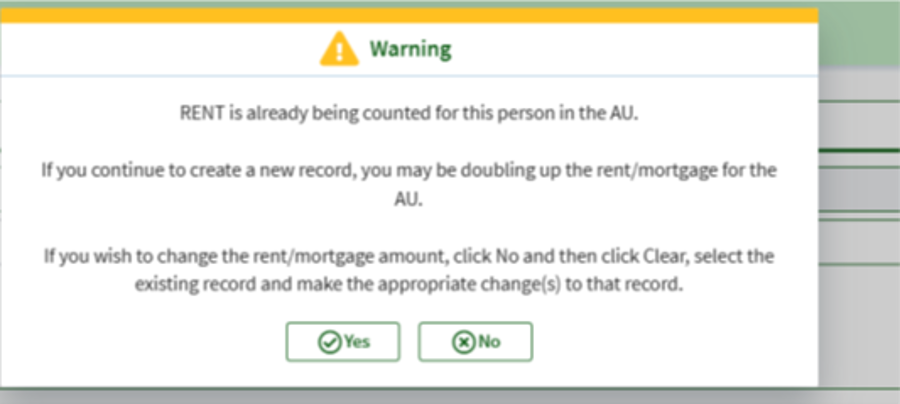
Important: When adding a new expense record after ending the old record, a pop-up message will appear to warn that a duplicate expense item is being entered. You must select “Yes” to continue entering the new expense record. View/HideView/Hide
- Send the VC-1 that generates with the new shelter expense record. Do not verify the shelter expense.
Important: For procedures regarding an Address Change reported via DTA Connect, please see DTA Connect: Updating Address
- Wrap and authorize the case without crediting the shelter and/or SUA expense. Review the EBC calculation to make sure the SNAP benefits are accurate.
Note: If the client was already credited with H-EAT or HEAP and their respective H-EAT and/or HEAP period has not expired, they will retain those credits and continue getting the Heating/Cooling SUA. In addition, BEACON will auto-verify the Heating/Cooling SUA on the verification tab with the relevant H-EAT or HEAP document of evidence indicating verified by EOHLC.
- If the verification is subsequently received, enter it into BEACON, verify on the Verification tab, and wrap/authorize the SNAP case to credit the household with the expense.
Assess whether a related benefit is owed for SNAP based on when the verification was received and when the change will take effect.
If not counting the expense results in a $0 benefit level or the case being closed for over-income, the case must not be wrapped at this time. Rather, you must follow these steps:
- Remove the authorization to process the case.
- Create an Action to process the change the day after the VC-1 Due Date (for more information on creating an Action, see Creating Follow-up Actions).
- If the optional verification is received, enter the expense and recalculate the benefits.
- If verification is not received process the case without entering the expense(s).
- If the client subsequently follows up with verification, the FAW who receives the Action to review the documents must add them to the BEACON record and recalculate the benefits. If necessary, FAW must issue a related benefit (see Department Responsibility to Take Timely Action for more information).
Reporting Changes to Expenses During Case Maintenance
Clients do not have to report changes to their expense amounts during case maintenance due to Simplified Reporting Rules (with the exception of shelter and utility expenses due to an address change as stated above). However, if a client does contact the Department and indicates that one or more of their expenses have changed but does not provide documentary evidence at the time of the reported change, you must:
- Enter a new record on the applicable BEACON window if it is a new change or enter the updated expense amount over the existing expense amount.
- Send the optional VC-1
Do not wrap the case if this is the only change being made to the case. The VC-1 will be sent advising the client to provide documentary evidence of the updated expense amount but will remain crediting the household with the previously verified expense amount.
Important: If a household was previously receiving an SUA and the client reports a change to their utility costs during their case maintenance period that triggers the same SUA, BEACON will automatically verify the new SUA verification item. Since the SUA will be auto-verified in this case, you must not send a VC-1. The household will continue to receive the same SUA without further verification needed.
Example: Grantee has not moved, but calls DTA during their case maintenance period in the summer to report that they no longer pay for heat and instead have started to pay electricity costs for an AC. When you select “No” to “Pay/share heating costs” and select Yes to “Have air conditioner, pay/share electricity costs” in the Case Maintenance workflow, BEACON will create a new HCSUA verification item but will auto-verify it since the household’s SUA has not changed. You must not send a VC-1. The household will continue to receive the HCSUA without needing to send in verification of their AC electricity costs during the case maintenance period.
Reporting Requirements for Elderly Disabled Simplified Application Project (EDSAP Reporting)
These households do not have a gross monthly income limit. They are only required to report changes in household composition or if any member of the household receives earned income at any point during the certification period. Information that is submitted by the client which is from a primary source or a data source that is verified upon receipt must be acted on immediately, even if it was not required to be reported.
Note: Because EDSAP households must include at least one elderly (65 years or more) and/or disabled member, these households are not subject to a gross income limit nor subject to the shelter cap.
These households are not required to report when a minor child graduates high school or when the minor turns 18.
EDSAP Reporting and Noncountable Earned Income
Households that report and verify earned income considered to be noncountable for SNAP are also considered eligible for EDSAP Reporting, if otherwise eligible. The presence of countable earned income in a case will preclude a household from being converted to EDSAP Reporting. The addition of countable earned income to a household previously certified as EDSAP Reporting will result in the household being converted to Simplified Reporting (Former EDSAP). For more, please see Types of Earned Income.
Reporting Requirements for Simplified Reporting (Former EDSAP)
When households become ineligible for EDSAP Reporting, they will be converted to Simplified Reporting (Former EDSAP). Converted households will maintain the same certification end date, but will begin to receive Interim Reports. Simplified Reporting (Former EDSAP) households may receive consecutive IRs during their certification period.
The household will receive its first Interim Report 45 days before the end of the household's next applicable Interim Report period. For more on EDSAP Reporting’s Interim Report requirements please see Simplified Reporting Interim Report.
Households converted to Simplified Reporting (Former EDSAP) will appear in BEACON as: 
When a household converts from EDSAP Reporting to Former-EDSAP, their reporting requirements will mimic those for Simplified Reporting households with no gross income limit. For more on EDSAP Reporting eligibility, please see Simplified Reporting - Overview.
Required to be Reported at Case Maintenance
| Change Factor | EDSAP Reporting | Simplified Reporting (Former EDSAP) | Simplified Reporting - 12 months |
|---|---|---|---|
| HH Composition (a member enters or leaves the HH) | Yes | No |
No |
| HH Receives Earned Income in any amount | Yes | No |
No |
| HH Receives Unearned Income in any amount | No | No |
No |
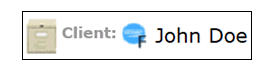
To assist in identifying these households, an indicator icon will be applied for all Former EDSAP households. This will be displayed on the ECF Home page in BEACON.
Changes that May Be Acted Upon at Anytime
The following changes may be acted upon at any point during the certification period, even if it decreases the household’s benefits, if the:
- household has voluntarily requested case closure;
- Department has information that is considered verified upon receipt; or
- Department has identified a household member as a fleeing felon, probation or parole violator.
Unclear Information
The Department must pursue clarification and verification of unclear information received during case maintenance if the information:
- is less than 60 days old at the time of the current month of review; and
- would have been required to be reported under Simplified Reporting rules.
Additionally, the Department must pursue clarification and verification (if applicable) of household circumstances that appear to present significantly conflicting information from that used by the Department at the time of certification. If the unclear or questionable information contributed to an overpayment, the Department must submit a fraud referral.
Example: A client sends in their Interim Report and claims no income or expenses, and are not homeless. The Interim Report is approved for ongoing benefits. Two months later, the client voluntarily sends in four weekly wage stubs. The wage stubs are entered into BEACON. The amount exceeds the household’s gross income limit, thus closing out the case. However, based upon the client’s current rate of pay and their year-to-date amount, you determine that the client began working four months ago and would have closed if the change was reported timely. You must complete a referral for recoupment.
Reporting Requirements for Simplified Reporting
When Bay State CAP clients choose to opt-out of Bay State CAP reporting, they will be converted to either EDSAP or Simplified Reporting. If clients are ineligible for EDSAP reporting, they will be converted to Simplified Reporting. Converted households will maintain the same certification end date but will begin to receive Interim Reports unless waived. Simplified Reporting subject to the IR requirement households may receive consecutive IRs during their certification period.
Households subject to the IR will receive their first Interim Report 45 days before the end of their next applicable period. For more on EDSAP Reporting’s Interim Report requirements, please see Simplified Reporting Interim Report.
When information is received from SDX, BEACON will automatically convert a case from Bay State CAP to EDSAP or Simplified Reporting because the case is no longer eligible for Bay State CAP. For more details, please see Bay State Combined Application Project (CAP) Overview.
Last Update: August 10, 2026
|
|
|
||
| Digital Accessibility Statement | Privacy Policy | Site Policies | Public Records Requests |
|
© 2026 Commonwealth of Massachusetts. Mass.gov is a registered service mark of the Commonwealth of Massachusetts. |
|||