An official website of the Commonwealth of Massachusetts Here's how you knowHere's how you know

Department Responsibility to Take Timely Action
Change in Income and/or Expenses that Reduces Net Income to Zero
When a SNAP household verifies a change in income and/or expenses in which:
- the household’s gross monthly income decreases, or
- countable monthly expenses increase, and
- the net income reduces to $0.
you must make the change effective for the cyclical month in which it was reported. To do this, you must issue a related benefit.
Important: A related benefit for a change resulting in the household’s net income reducing to zero will be acted upon by the Department if the client reports and verifies the change within 60 days of when the change occurred.
Before issuing this related benefit, you must:
- review the Financial Tab in the Interview Wrap Up page to confirm if the household’s net income has reduced to $0, and;
- cold call the client and inquire if they have any other unreported income if not already speaking with them. If the cold calls are successful, you must take their verbal self-declaration, or if unsuccessful;
Remember: Due to Simplified Reporting Rules, households do not have to report income outside of their reporting periods (application, IR, recertification) if the gross income does not put them over the income limit for their household size.
Likewise, it cannot be assumed when a client provides verification that an income source has ended during the case maintenance or Interim Reporting period, that their net income has definitively gone to $0.
- send an optional User-Entered Additional Verification VC-1 for Related Benefit with the following language if you are unable to reach the client:
“You have reported and verified that you are no longer receiving income from [EMPLOYER NAME/UNEARNED INCOME TYPE]. You may be able to receive additional SNAP benefits for the month you reported this change; however, you must confirm if you have any additional income first. Please contact the DTA Assistance Line to go over this or provide a written self-declaration indicating any new income, and the gross monthly amount.”
For [EMPLOYER NAME/UNEARNED INCOME TYPE] you enter either the name of the employer or the source of the income.
If the net income being reduced to $0 is due to an increase in expenses, and you are unable to reach the client to determine if there is any additional income, send an optional User-Entered Additional Verification VC-1 for Related Benefit with the following language: “You have reported and verified that your expenses are more than your income. You may be able to receive additional SNAP benefits for the month you reported this change; however, you must confirm if you have any additional income first. Please contact the DTA Assistance Line to go over this or provide a written self-declaration indicating any new income, and the gross monthly amount.”
Important: You must follow SLAM procedures accordingly when a household’s expenses are greater than their income.
- issue the related benefit if the client confirms they have no additional income, or they are at a reporting period, an interview is required and was conducted and they confirm that there is no additional income.
Important: If a client responds to the VC-1 and self-declares new income, and the client is not at Interim Report or Recertification, you must not enter the new income in BEACON or send a mandatory VC-1 for this income unless it exceeds the maximum gross for the client’s household size.
This self-declaration is for the purpose of determining if the household is eligible for a related benefit in the month that the change occurred due to their household’s net income reducing to $0.
If the client does not respond to the VC-1 or to the cold calls, you must not issue the related benefit, as it cannot be determined if the household’s income has reduced to $0. A detailed narrative must be completed.
Important: Clients that are subject to the General Work Rules and subsequently quit their job or reduce their work hours without verification of the reason their job ended also cannot be issued a related benefit if their net income reduces to $0 until they have verified their reason job ended. For more information, see Voluntary Quit and Reduction of Work Hours.
For more information on issuing related benefits, see Related Benefit.
Important: There are special procedures that apply to issuance of related benefits when Unemployment Compensation ends, and DTA further determines that net income has reduced to zero. Please refer to the Unemployment Compensation OLG page for details about processing such cases.
Examples
Alexandra (she/her), a household of 1 whose SSN ends in 0, reports and verifies on August 16 that she was laid off from her job and has no other income. When the earned income record is updated in BEACON, Alexandra’s net income is reduced to $0. When the case is wrapped, Alexandra’s benefits increase from $124 to $298 per month. Therefore, Alexandra is owed $174 ($298 - $124) for August.
Charlotte (she/her), a household of 2, whose SSN ends in 0, reports and verifies on August 26 that her rent has increased to $1,500/month. She confirms she has no other income. When the amount is updated in BEACON, Charlotte’s net income is reduced to $0. When the case is wrapped, Charlotte’s benefits increase from $450 to $546. Because the change was reported late in the cyclical month, BEACON sets the effective date of the change to October 1. Therefore, Charlotte is owed $96 ($546 - $450) for August and an additional $96 for September.
Josephine (they/them), a household of 1 who is subject to the General Work Rules and whose SSN ends in 4, reports and verifies on October 15 that they have ended their job on October 1 by submitting a termination letter through DTA Connect. Removing the income reduces Josephine’s net income to $0. Before issuing a related benefit, you must cold call Josephine to inquire if they have any additional unreported income, and to obtain a telephonic self-declaration of the reason Josephine’s job ended, as they are subject to the General Work Rules.
Delany (she/her), a household of 1, reported on August 15 that she lost her job due to a layoff back on July 5. Her SSN ends in a 3. She explains she has been overwhelmed with tasks and was unable to notify the Department sooner. Delany indicates she is not receiving any additional income at this time and is using her savings to cover her expenses as her unemployment is pending. Five days later (August 20), Delany provides a termination letter from her job indicating that she was laid off on July 5.
You must issue a related benefit for Delany’s July and August cyclical months since her net income reduced to zero for those two months and she reported and verified the loss of income within 60 days.
Determining Net Income in the SNAP Calculation
You can determine whether a change reduces a household’s net income to $0 by:
- opening the BEACON Result tab,
- highlighting the most recent Release information,
- opening the Financial tab, and
- scrolling down to where it says “Net Income.” View/HideView/Hide
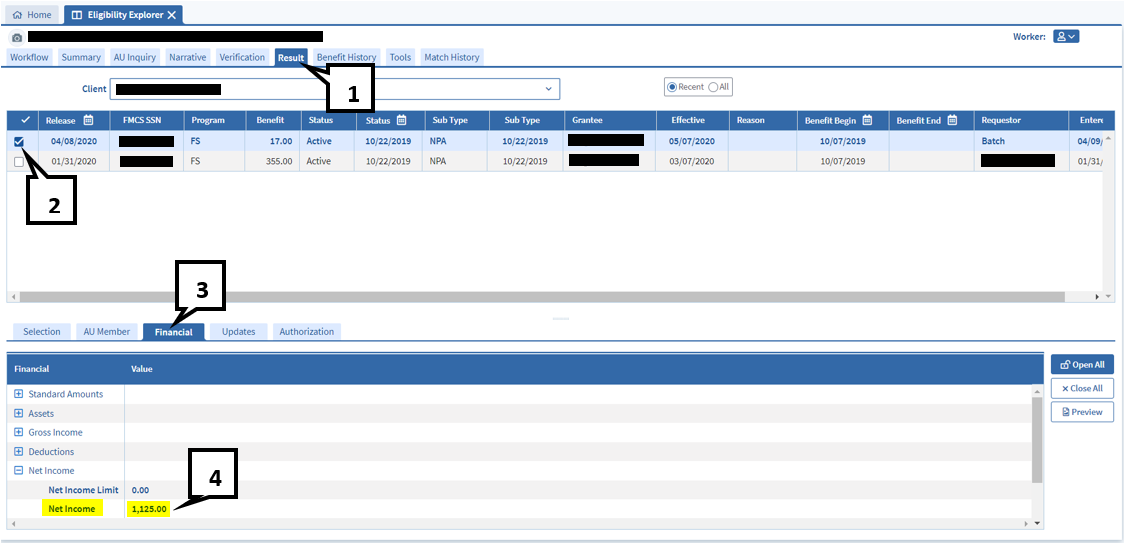
For more information on net income in the SNAP benefit calculation, see SNAP Calculation Page Example.
|
|
|
||
| Digital Accessibility Statement | Privacy Policy | Site Policies | Public Records Requests |
|
© 2026 Commonwealth of Massachusetts. Mass.gov is a registered service mark of the Commonwealth of Massachusetts. |
|||