An official website of the Commonwealth of Massachusetts Here's how you knowHere's how you know

Cuban/Haitian Entrant - SNAP
Eligibility Requirements
Cubans or Haitians classified as Cuban or Haitian Entrants under Section 501(e) of the Refugee Education Assistance Act of 1980 are considered qualified noncitizens. This law defines a Cuban or Haitian Entrant as a person who:
- was granted parole at any time;
- is the subject of removal proceedings but does not have a final, enforceable order of removal/deportation;
- This includes those with an order of supervision, which indicates they have an order of deportation, but the order is not enforceable.
- has a pending application for asylum; or
- has a pending application for adjustment to Legal Permanent Resident (LPR) under the Cuban Adjustment Act (CAA), Nicaraguan Adjustment and Central American Relief Act (NACARA), or Haitian Refugee Immigration Fairness Act (HRIFA), or has an LPR status under 5 years that shows adjustment to LPR from one of these statuses.
Individuals who meet Cuban/Haitian requirements outlined above must be coded as Cuban/Haitian Entrants in the Noncitizen Designation page of BEACON. The Section Reference must be updated with client’s current Class of Admission (COA) code, as this indicates the category under which the client was admitted into the United States. See section on Verification Documents a Client May Provide below.
Important: Cuban/Haitian Entrant applications are not to be denied for a noncitizen eligibility reason prior to consulting with the Procedural Mailbox.
Application Processing for Cuban/Haitian Entrants
Engaging with a Noncitizen Applicant who is a National of Cuba or Haiti
For many Cuban and Haitian applicants, this is likely their first time in the United States and their first time applying for government assistance, such as SNAP benefits. Many of these applicants also have limited English proficiency; this must be a consideration during the application process.
When establishing contact with Cuban/Haitian applicant, communication is important as it allows the worker to explain application procedures and to advise the applicant about critical next steps pertinent to their application. When engaging with the applicant, you must:
- Utilize interpreter services (when necessary) to ensure clear communication.
- Attempt 2 cold calls to perform an application interview. If cold call attempts are not successful, an appointment letter must be sent.
- During the call it is important to explain the application process, discuss each program they are applying for and how to utilize their benefits.
- If the client does not have an SSN, a Systems Generated 99# must be issued and provided to the client. Inform the client that they will need their 99# to activate and pin their EBT Card.
- Once verification of identity has been satisfied for the Grantee, an EBT card must be issued to the client.
- Advise clients to submit ALL paperwork received from Immigration to ensure a correct eligibility determination is made.
Social Security Number for Cuban/Haitian Entrants
New applicants from Cuba or Haiti will likely apply for DTA benefits before they have been issued a Social Security Numbers (SSN). If a client does not provide an SSN at application or reports that they do not have an SSN at application, they must be assigned a Systems Generated 99#.
When you enter a new client in BEACON, an auto populated verification for the SSN or Proof of Application will populate. You must disposition the auto populated verification request as verified, and issue a User Entered, optional VC-1 for Additional Verification entering in the Details field: Social Security Number or Proof of SSN Application. In the Document(s) of evidence field enter:
“Tell us this person’s Social Security Number; you can call and tell us. If this person doesn’t have a Social Security Number, you must provide proof that this person has applied for one.”
Because the SSN verification request is marked Optional, the case will not be denied for failure to provide this verification which many Cuban/Haitian Entrants cannot provide before interacting with an agency such as DTA. More information below in Good Cause for Not Providing a Social Security Number.
Providing Expedited Benefits
If the client reports that their INS status is one of the eligible qualified noncitizen statuses, and there are pending outstanding mandatory verifications, but the client otherwise meets eligibility for expedited benefits, expedited benefits must be issued.
Lack of verification of immigration status must not delay expedited service during the 7-day expedited time frame. If the applicant meets the criteria for expedited benefits, appears eligible for SNAP benefits and provides proof of identity for the grantee by Day 7, you must issue expedited benefits by the 7th calendar day following the date of application.
Note: If verification of identity of the grantee has been provided, the case manager must issue an EBT card.
Example 1: Daniel (he/him) is 67 years old and arrived in the US last week. He reports that he has been paroled and provides a Haitian passport but has provided no other documentation. He also report that he has no income. The worker must issue expedited benefits as, based on Daniel's report, he meets one of the qualified noncitizen statuses for SNAP and have provided verification of identity.
Example 2: Estephany (they/them) applies for SNAP benefits and reports that they have no income. They provide a form I-220A but have not provided any other documentation. The worker must issue expedited benefits, as the I-220A verifies the client is a Cuban/Haitian Entrant on an Order of Release on Recognizance.
Example 3: Emmanuele (she/her) is a 37-year-old from Haiti. She reports that she has no income and that she was sponsored by her sister and moved to the US three years ago. The worker has explored eligibility under the 40 work quarters and that did not help the client to qualify. The worker must not issue expedited benefits, as based on the information provided by the client, she does not appear to be eligible for SNAP benefits.
Important: Cuban/Haitian Entrant applications are not to be denied for reasons relating to noncitizen eligibility prior to consulting with the Procedural Mailbox.
Good Cause for Not Providing a Social Security Number
In accordance with 106 CMR 701.230(C)., good cause for failure to comply with the Social Security Number requirements exists when there is documentary evidence or collateral information that the household member has made every effort to apply for an SSN or to apply to have an already-existing SSN validated. Good cause must be verified monthly until the SSN is provided and verified by computer match with SSA in accordance with 106 CMR 362.500(B)(1).
Certain Cuban/Haitians, as specified in this document, cannot obtain an SSN. Good cause will be granted to those Cuban/Haitian Entrants at application. These are typically noncitizens described in Groups 1, 2, and 3 as listed in the chart below. After good cause has been granted, the Noncitizen Liaison of the assigned TAO will monitor receipt of SSN based on a report.
The report will consist of noncitizens who meet the following requirements:
- Any active noncitizen with a Systems Generated SSN; and
- The Country of citizenship is listed as Cuba or Haiti on the Noncitizen page in BEACON.
Non-Work SSN Letter
Some Cuban Haitian Entrants are not eligible to receive a Social Security Number (SSN) because they do not have a work permit. To get DTA benefits, these individuals must apply for a Non-Work SSN. To apply for a non-work SSN, they must provide a letter from DTA to SSA. SSA is required to provide Non-work SSNs to applicants who are otherwise eligible for government benefits as these programs all have a Social Security Number requirement.
Any Cuban/Haitian Entrant that does not have a work permit (employment authorization card) will require a Non-Work SSN Letter. To determine if a Cuban/Haitian case meets the requirement for a Non-Work SSN, follow the instruction outlined below:
- If the client did not provide a work permit (employment authorization card) as part of their verifications, but they are otherwise eligible as a Cuban/Haitian Entrant, you must forward the case details [e.g., Grantee’s APID, Grantee name, the name(s) of additional household member(s), the documentation used to determine eligibility and the date it was received in the client’s ECF] to your supervisor.
- If the client provides a work permit (employment authorization card), a Non-Work SSN Letter must not be prepared for the client, as this client is eligible for a real SSN. For these clients you must request verification of SSN or Proof of application for SSN, if not already provided.
- The supervisor must review the case submitted by the worker and determine if the case meets the requirements for a Non-Work SSN Letter.
- If the Cuban/Haitian Entrant did not provide work permit (employment authorization card), the supervisor must send the case details to the designated Noncitizen Liaison for a Non-Work SSN Letter.
-
Important: Most Cuban/Haitian applicants will require a Non-Work SSN Letter.
-
- If the Cuban/Haitian Entrant has a work permit (employment authorization card), the supervisors must return the case to the worker to issue a VC-1 for SSN or Proof of application for SSN, if not already provided.
- If the Cuban/Haitian Entrant did not provide work permit (employment authorization card), the supervisor must send the case details to the designated Noncitizen Liaison for a Non-Work SSN Letter.
The Noncitizen Liaison, of the assigned TAO, will ensure:
- The Non-Work SSN Letters are prepared and signed by the TAO Director.
- A copy of the letter is uploaded to the client’s ECF.
- Two cold calls to the client are performed to explain the process and answer any questions.
- A narrative is entered stating the letter was mailed and the outcome of the cold calls.
- The original signed letter is mailed to the client along with the cover letter explaining that the client must contact SSA with the Non-Work SSN Letter to obtain a Non-Work SSN. In some instances, the letter may be mailed to an Advocate or Helping Agency if we have the appropriate authorization to do so.
If a client subsequently contacts the Department and states that they have not received their Non-Work SSN Letter and one was previously issued, you must not mail them a copy of that letter on file. You must forward case details to your supervisor. The supervisor must forward the case information to the Noncitizen Liaison to complete a new Non-work SSN Letter. The Social Security Administration will not accept a copy of a Non-work SSN Letter.
Verification Documents a Client May Provide
The charts below display eligibility requirements for Cuban/Haitian Entrants. They have been classified into four groups and include a brief description of each group.
|
Group 1 - Paroled with Change/No Change to Status or Previously Granted Entrance with No Status and Subsequently Gained Status: A national of Cuba or Haiti who was paroled into the United States and has not acquired any other status under the INA and with respect to whom a final, non-appealable, and legally enforceable order of removal, deportation, or exclusion has not been entered; or Any individual granted entrance into the United States or subsequently granted any other special status established under the immigration laws for nationals of Cuba or Haiti, regardless of the status of the individual at the time assistance or services are provided: Please Note: SAVE responses may not align with the documentation provided by the client. Please see the SAVE Requests for Cuban/Haitian Entrants section below. |
| Documentation/Codes | Comments |
|---|---|
| A Cuban or Haitian passport with a §212(d)(5) stamp dated after October 10, 1980. | |
| An I-94 Arrival/departure card with a stamp showing paroled at any time as a "Cuban/Haitian Entrant (Status Pending)" | I-94 may refer to §212(d)(5), humanitarian or public interest parole |
| An I-94 Arrival/departure card with a stamp showing paroled into the U.S. on or after April 21, 1980 | I-94 may refer to §212(d)(5) |
| An I-94 Arrival/departure card with a DT Class of Admission | DT: Parole granted at port of entry or District Office |
| An I-94 Arrival/departure card or a passport with an HF stamp | The HF stamp indicates entry under the Haitian Family Reunification Parole (HFRP) Program |
| An I-94 Arrival/departure card or a passport with a CHP stamp | CHP: Individual paroled into the United States under the Cuban Humanitarian Parole process |
| An I-94 Arrival/departure card or a passport with an HHP stamp | HHP: Individual paroled into the United States under the Haitian Humanitarian Parole process |
| I-766 Employment Authorization Document with the code A04 | A04: Paroled as refugee (Paroled as a Refugee, does not qualify an individual as a “Refugee”, but it qualifies such noncitizens as Cuban/Haitian Entrants |
| I-766 Employment Authorization Document with the code C11 | C11: Individual paroled into the United States in the public interest or temporarily for emergency reasons |
| Adjustment code on the Permanent Resident Card (I-551) coded to CH-6, CU-0, CU-6, CU-7, CU-8, CU-9, CU-P, or CN-P [indicating adjustment to LPR status under Cuban Adjustment Act of 1966 (CAA)] | Even after a Cuban/Haitian Entrant becomes a Legal Permanent Resident (LPR), they retain the benefits of their prior status as a Cuban/Haitian Entrant |
|
Adjustment code on the Permanent Resident Card (I-551) HA-6, HB-6, HC-6, HD-6, HE-6, HA-7, HB-7, HC-7, HD-7, HE-7, HA-8, HB-8, HC-8, HD-8, HE-8, HA-9, HB-9, HC-9, HD-9, HE-9 [indicating adjustment to LPR status under Haitian Refugee Immigration Fairness Act (HRIFA)] |
Even after a Cuban/Haitian Entrant becomes a Legal Permanent Resident (LPR), they retain their prior status as a Cuban/Haitian Entrant |
| Adjustment code on the Permanent Resident Card (I-551) NC-6, NC-7, NC-8, or NC-9 [indicating adjustment to LPR status under the Nicaraguan Adjustment and Central American Relief Act (NACARA)] | Even after a Cuban/Haitian Entrant becomes a Legal Permanent Resident (LPR), they retain the benefits of their prior status as a Cuban/Haitian Entrant |
| Other documentation pertaining to an applicant adjustment to LPR status. Including, but not limited to Cubans or Haitians with an adjusted LPR status with the codes LB-2, LB-6, or LB-7. | These codes were used for individuals granted LPR status under any of the 1986 legislation provisions including Cuban/Haitian entrants. |
| Other documentation pertaining to an applicant who has Temporary Protected Status (TPS). |
Even after a Cuban/Haitian Entrant is granted TPS, they retain the benefits of their prior status as a Cuban/Haitian Entrant. Please Note: Clients with TPS are not generally eligible for SNAP. However, they may meet eligibility if they had a prior status as a Cuban/Haitian Entrant. See additional information below this table. |
| I-94, I-551, passport, form I-797 or other document indicating the individual was granted entry as a Special Immigrant Juvenile (SIJ). |
SIJs who are Cuban or Haitian nationals are considered to have met the definition of a Cuban-Haitian entrant prior to adjustment of status and retain their eligibility due to prior status. The COA code used on SIJ documents (I-94, passport, or I-551) has the prefix SL. |
| Other documents indicating an individual is paroled. Including, but not limited to Form I-385 Alien Booking Record or I-831 Continuation Page with a parole stamp or note indicating paroled status. | The form I-385 or I-831 alone does not confirm eligibility, but the presence of a parole stamp or indicates an individual has been paroled. |
|
Example 1: Esther (she/her) applies for SNAP for herself, her spouse and their two children. Esther provides a Haitian passports for all household members and Form I-385 (Alien Booking Record) for all household members. The Form I-385 for each individual indicates that they have been paroled. The worker is able to determine that each household member is eligible for SNAP, as their Form I-385 indicates that they have been paroled. Example 2: Jean Paul (he/him) provides a Form I-385 (Alien Booking Record) with a Parole stamp for verification of immigration status. The worker runs a SAVE request, which returns a status of Temporary Protective Status. Although Jean Paul is now classified as TPS, the worker can determine that they are eligible due the client previously being paroled into the United States. This document confirms that the client is previously eligible for SNAP as a Cuban/Haitian Entrant based on parole, and they remain eligible regardless of being granted TPS. |
|
Individuals granted Temporary Protected Status (TPS) are permitted to remain temporarily in the U.S. because their home nation is suffering under armed conflict, environmental disaster, or other extraordinary or temporary conditions. TPS is not a qualified noncitizen status, noncitizens granted TPS are not eligible to receive SNAP unless they are also in some other qualifying status. For example, Haitian nationals granted TPS are only eligible if they otherwise meet the definition of a Cuban or Haitian Entrant under Section 501(e) of the Refugee Education and Assistance Act of 1980.
|
Group 2 – Removal Proceedings: A national of Cuba or Haiti who is the subject of removal, deportation, or exclusion proceedings under the INA and with respect to whom a final, non-appealable, and legally enforceable order of removal, deportation, or exclusion has not been entered: |
| Documentation/Codes | Comments |
|---|---|
| DHS Form I-122 | Notice to Applicant Detained for a Hearing Before an Immigration Judge |
| DHS Form I-200 | Warrant for Arrest of Alien |
| DHS Form I-220A | Order of Release on Recognizance |
| DHS Form I-220B | Order of Supervision |
| DHS Form I-221 | Order to Show Cause and Notice of Hearing |
| DHS Form I-221S | Order to Show Cause, Notice of Hearing and Warrant for Arrest |
| Form I-286 Notice of Custody Determination | Checkbox will show either released under bond or released on own recognizance |
| Form I-352 Immigration Bond or document stamped “Bond Posted” | Released from immigration detention under bond |
| DHS Form I-485 date stamped by the Executive Office for Immigration Review (EOIR) | Application to Register Permanent Residence or to Adjust Status (Individual is subject of removal, exclusion, or deportation proceedings) |
| DHS Form I-589 date stamped by the Executive Office for Immigration Review (EOIR) | Application for Asylum and Withholding of Removal (Individual is subject of removal, deportation, or exclusion proceedings) |
| Executive Office for Immigration Review EOIR-26 | Notice of Appeal, date stamped by the Office of the Immigration Judge |
| Executive Office for Immigration Review EOIR-42B | Application for cancellation of removal |
| I-688B Employment Authorization Document with the provision of law 274a.12(c)(10) | Application for suspension of deportation/cancellation of removal submitted |
| I-766 Employment Authorization Document with the code A10, C10, C18 |
A10: Granted Withholding of Deportation or Removal C10: Application for suspension of deportation/cancellation of removal submitted C18: Order of Supervision |
| DHS Form I-862 | Notice to Appear |
| Other applications for relief that have been date stamped by EOIR | |
| Other documentation pertaining to an applicant’s removal, exclusion, or deportation proceedings | Example: a notice of a hearing date before an Immigration Judge |
| Other documents indicating an individual is subject of removal, deportation, or exclusion proceedings. Including, but not limited to Form I-385 or I-831. | The form I-385 or I-831 alone does not confirm eligibility, but indicates an individual has been paroled, is subject of removal, deportation, or exclusion proceedings. |
| Example: Marie (she/her) applies for SNAP benefits for herself. She provides a Haitian passport and a Form I-220A (Order of Release on Recognizance). The worker initiates a SAVE that returns a status of “Non-Immigrant” and a note stating, “Applicant is not a Cuban/Haitian Entrant.” However, due to the Form I-220A the worker is able to determine that the individual is eligible as a Cuban/Haitian Entrant for SNAP purposes. | |
|
Group 3 – Pending Asylum: A national of Cuba or Haiti who has an application for asylum pending with DHS/USCIS and with respect to whom a final, non-appealable, and legally enforceable order of removal, deportation, or exclusion has not been entered. |
| Documentation/Codes | Comments |
|---|---|
| DHS receipt for filing Form I-589 | Application for Asylum and Withholding of Removal |
| I-766 Employment Authorization document with the code C08 | Pending Application for Asylum filed on or after January 4, 1995 |
| I-688B Employment Authorization Document with the provision of law 274a.12(c)(8) | This is an older version of the employment authorization document, but it is still in use |
| Other documentation showing application for pending asylum. Including but not limited to Form I-797C. | |
| Example: Pierre (they/them) applies for SNAP for themself. They provide a Haitian passport and a Form I-589 (Application for Asylum or Withholding of Removal). The worker can determine that the client meets eligibility as a Cuban/Haitian Entrant, as they have a pending application for asylum. | |
|
Group 4 - Pending adjustment to Legal Permanent Resident (LPR) under the Cuban Adjustment Act (CAA), Nicaraguan Adjustment and Central American Relief Act (NACARA), the Haitian Family Reunification Parole (HFRP) Program, the Cuban Family Reunification Parole (CFRP) Program, or Haitian Refugee Immigration Fairness Act (HRIFA), or have an LPR status under 5 years that shows adjustment to LPR from one of these statuses. |
| Documentation/Codes | Comments |
|---|---|
| Any documentation showing pending application for an adjustment to LPR status under the Cuban Adjustment Act (CAA), Nicaraguan Adjustment and Central American Relief Act (NACARA), the Haitian Family Reunification Parole (HFRP) Program, the Cuban Family Reunification Parole (CFRP) Program or Haitian Refugee Immigration Fairness Act (HRIFA), including but not limited to Employment Authorization. | Application for adjustment of status under CAA, NACARA, HFRP, CFRP, or HRIFA may also qualify as a Cuban/Haitian entrant. |
| Example: Analise Castillo (she/her) applies for SNAP benefits. She is a national of Cuba her Employment Authorization card with a C09 COA code and a Form I-797C (Notice of Action) with a Case Type “I-485 Application to Register Permanent Residence or Adjust Status” and Preference Classification “Cuban Adjustment Act”. The worker requests a SAVE, and it returns a status of “Temporary Employment Authorized” with a C09 COA code. The worker can determine that the client is eligible as a Cuban/Haitian Entrant as the I-797C confirms that the client is applying for an adjustment to status under CAA. | |
Verification of Cuban or Haitian Nationality
If the immigration documentation provided by the client does not confirm the individual is a national of Cuba or Haiti, the client can provide:
- Current or Expired Passport from Cuba or Haiti;
- Birth Certificate;
- Certificate of Naturalization;
- Citizenship letter;
- National Identity Card;
- Birth Extract Issued by Haitian National Archives (accompanied by photo identification);
- Any document or returned data from DHS or federal hub that confirms nationality Haitian parent-child relationship will be considered proof of nationality; or
- Any authoritative document showing proof of applicant of member’s nationality.
Adjustment from Cuban/Haitian Entrant Status to Legal Permanent Resident (LPR)
When an individual meets eligibility as a Cuban/Haitian Entrant, but their status subsequently changes to LPR, the individual retains their eligibility for SNAP benefits as they have adjusted to LPR from a qualifying Cuban/Haitian Entrant status. Cuban/Haitian Entrants who subsequently obtain LPR status are not held to a five-year waiting period and continue to be eligible for SNAP even when adjusted to a Legal Permanent Resident status. A Cuban/Haitian Entrant whose status has been adjusted to LPR must be coded as Cuban/Haitian Entrant on the Noncitizen Designation page in BEACON. The Section Reference must be updated with client’s current COA code, as this indicates the category under which the client was admitted into the United States.
When processing an LPR (less than 5 years) case, you must check to see if the client previously held a qualifying status. This will ensure that we do not overlook potential eligibility for individuals who currently have an LPR status under 5 years. If the client is an LPR under 5 years but previously met eligibility as a Cuban/Haitian Entrant, you must be sure to correct the coding to Cuban/Haitian Entrant on the Noncitizen Designation page.
Note: Not all noncitizens from Cuba or Haiti are granted Cuban/Haitian Entrant status. If a noncitizen from Cuba or Haiti has LPR status but did not have a prior status of Cuban/Haitian Entrant, they must continue to be coded as a Legal Permanent Resident on the Noncitizen Designation page.
Adjustment from Cuban/Haitian Entrant Status to Temporary Protected Status (TPS)
When an individual meets eligibility as a Cuban/Haitian Entrant, but their status subsequently changes to TPS, the individual retains their eligibility for SNAP benefits as a Cuban/Haitian Entrant. A Cuban/Haitian Entrant whose status adjusts to TPS must be coded as Cuban/Haitian Entrant on the Noncitizen Designation page in BEACON, this is how they meet noncitizen eligibility. The Section Reference must be updated with client’s current COA code, as this indicates the category under which the client was admitted into the United States.
When processing a TPS case, you must check to see if the client previously held a qualifying status. This will ensure that we do not overlook potential eligibility for individuals who currently have a TPS status.
Note: Not all noncitizens from Cuba or Haiti are granted Cuban/Haitian Entrant status. If a noncitizens from Cuba or Haiti has TPS status but did not have prior status of Cuban/Haitian Entrant, they must continue to be coded as PRUCOL on the Noncitizen Designation page.
Eligibility for Children Born Outside of Haiti to Haitian Nationals
Children born abroad to two Haitian parents or to a foreign parent and one Haitian parent are also considered Haitian nationals. Regardless of the child’s country of birth, they are deemed Haitian nationals, provided that one of their parents is Haitian.
These children are eligible for SNAP benefits as Cuban/Haitian Entrants.
Important: This does not apply to children born outside of Cuba to Cuban nationals.
If needed, individuals can obtain Chilean Birth Certificates to verify relationship by visiting the Registro Civil website at Certificados en línea (registrocivil.cl).
SAVE Requests for Nationals of Cuba or Haitian Entrants
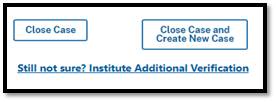
The initial SAVE response will not indicate whether the client is a Cuban/Haitian Entrant. SAVE offers an additional search criterion of Cuban/Haitian Entrant when completing a secondary review. If the SAVE response returns an immigration status that does not qualify the client for SNAP or returns no immigration status, the additional search criterion of Cuban/Haitian Entrant must be selected. The case manager must:
- select “Still not sure? Institute Additional Verification” on the SAVE response;
- select “Cuban/Haitian Entrant” under the Agency Requests. View/HideView/Hide
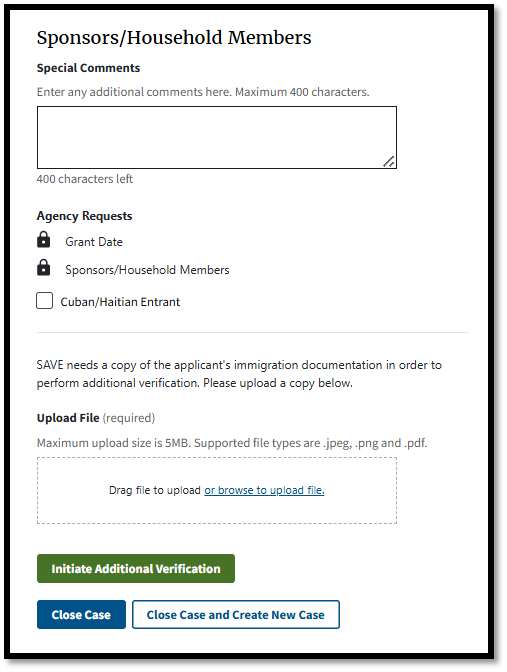
- detail the need for an additional review of the immigration status in the Special Comments section. You must:
- list the documents previously provided (all immigration documentation and the previous SAVE response).
- if applicable, detail how the client previously met eligibility for SNAP (e.g., Previous Noncitizen designation, COA code, Parole end date (if applicable), etc.).
- attach previously provided immigration documentation and previous SAVE response(s); and
- select “Initiate Additional Verification”.
Once returned, if the SAVE response does not always indicate the client is a Cuban/Haitian Entrant. If the SAVE response indicates that the “Applicant is not a Cuban/Haitian Entrant,” but the client has provided sufficient verification that they meet eligibility as a Cuban Haitian Entrant, the client must be considered a Cuban/Haitian Entrant for EAEDC eligibility purposes. At a later date, the SAVE response will indicate that the Applicant is a Cuban/Haitian Entrant.
You must scan the document into the client’s ECF when working in-office. When you are working remotely, you must attach the complete SAVE response to the case narrative.
If SAVE has not returned by day 30, but all the qualifying documentation submitted by the client is sufficient to establish eligibility as a Cuban-Haitian Entrant, the case must be authorized, provided that all other eligibility requirements have been met. Staff must also ensure that SAVE is followed up on once it becomes available. Staff must self-assign an Action to do further follow-up on SAVE and, if a response is returned, upload the response to the ECF.
Related Topics
Eligible Qualified Noncitizens Policy and Procedures
Verification of Immigration Status
For a quick review of common eligibility documentation see Attachment A: Cuban/Haitian Verification-Highlights.
Last Update: October 28, 2025
|
|
|
||
| Digital Accessibility Statement | Privacy Policy | Site Policies | Public Records Requests |
|
© 2026 Commonwealth of Massachusetts. Mass.gov is a registered service mark of the Commonwealth of Massachusetts. |
|||