An official website of the Commonwealth of Massachusetts Here's how you knowHere's how you know

Self-Sufficiency Specialist (SSS) Role
What is the Self-Sufficiency Specialist’s Role?
The Self-Sufficiency Specialist (SSS) provides intensive case management and support to TAFDC families with a grantee who is 23 years of age (up to their 24th birthday) or younger. An SSS works with each family to develop a solid foundation including establishing education, training, and employment goals, as well as strategies to overcome any challenges the family may have as they transition to economic mobility. All young parents age 23 and younger are assigned to an SSS for all case management services. This includes all young parents participating in a Young Parents Living Program (YPLP).
What is the Self-Sufficiency Specialist’s Caseload?
The target caseload for a Self-Sufficiency Specialist is approximately 120.
The Self-Sufficiency Specialist’s Target Population
Because the primary focus of the SSS is to provide intensive case management for grantees below age 24, every effort must be made to have all TAFDC applications of young parents taken by an SSS. If this is not possible, the Transitional Assistance Office (TAO) management team must assign the case to the SSS once the application is approved.
Any family with a grantee under age 24 that is not assigned to an SSS will appear in the AUs for Possible SSS Assignment view (Views > Daily Priority Actions > AUs for Possible SSS Assignment). The local office supervisory/management team must check the view regularly; families displayed on this view must be reassigned to an SSS. Every effort should be made to assign cases evenly between the TAO Self-Sufficiency Specialists (see AU Reassignment Recommendation Page).
Other Cases to be Assigned to the Self-Sufficiency Specialist if Additional Capacity Exists
Based upon the current caseloads within a TAO, if all families headed by a young parent have been assigned to an SSS and additional capacity exists, the TAO supervisory/management team will exercise discretion in determining and reassigning high need cases that would benefit from the intensive case management offered by the SSS. The TAO supervisory/management team will refer to the TAFDC Dashboard to filter for appropriate clients.
Populations with High Need that are to be Prioritized Include
- unhoused families, including but not limited to, those in homeless shelters or temporary housing,
- families facing housing insecurity, and
- families with urgent needs who have newly arrived in the U.S.
Important: Before reassigning a family to the SSS, it is important to process the case as fully as possible. This will help ensure a seamless and supportive transition for some of our most vulnerable families.
How to Reassign a Case to the AUs for Possible SSS Assignment View in BEACON
When DTA staff encounter a case where the grantee is a parent under age 24, they must process the recommendation on the AU Reassignment Recommendation page immediately (Case Maintenance > Program Administration > AU Reassignment Recommendation).
- Go to the AU Reassignment Recommendation page and
- select the client record for TAFDC – Basic.
- In the Recommend field select the YES radio button to enable the Job title field.
- In the Job title field select Self-Sufficiency Specialist and
- click Save.
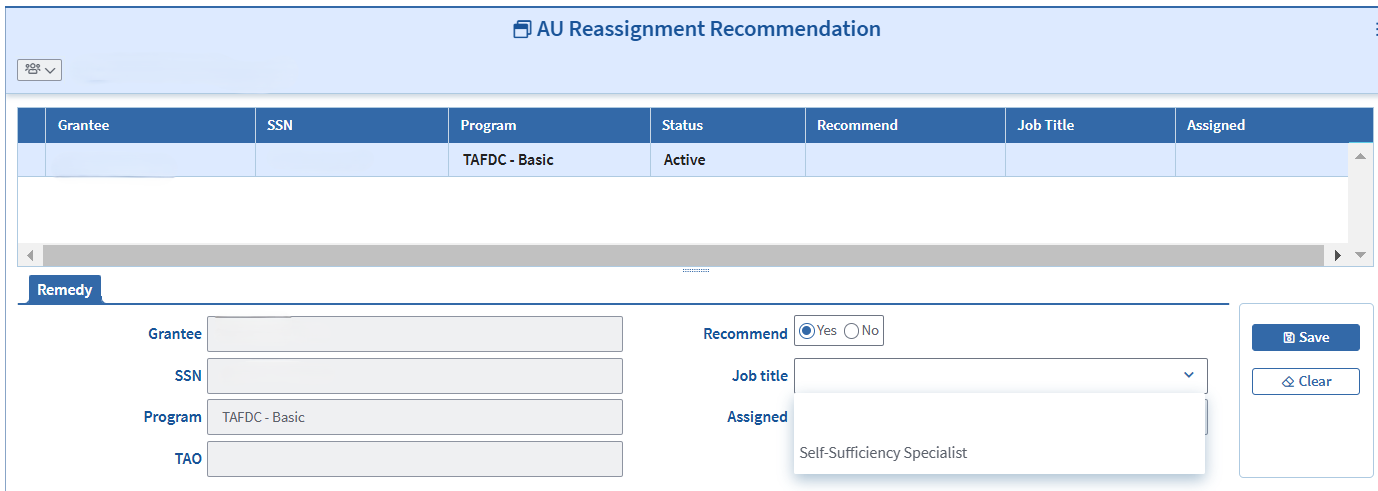
The client will be viewable in the AUs for Possible SSS Assignment view (Views > Daily Priority Actions > AUs for Possible SSS Assignment). The TAO supervisory/management team will reassign each case and clear the record on this view.
The Importance of Co-Case Management
The Self-Sufficiency Specialist collaborates with the client and any relevant provider(s) (e.g., YPLP, homeless shelter, Pathways to Work program, etc.) as appropriate, to support the client in setting goals and developing an economic mobility plan to meet those goals. This includes (a) short-term goals and plans for family stability and (b) long-term goals and plans for economic mobility.
Key Aspects of Co-Case Management
The SSS is the first point of contact between the TAO and any relevant provider(s) serving clients in their caseload. The SSS engages in co-case management for each case by:
- collaborating with the provider to support the client in setting long-term and short-term goals for family stability,
- collaborating with the provider to support the client in developing an economic mobility plan (e.g., education, training, and employment goals),
- connecting with each client and their provider regularly via emails, phone calls, and in-person meetings, and
- visiting providers that serve the clients in their caseload once a month to monitor progress, celebrate successes, and discuss any challenges. These visits are to be scheduled at a time that is mutually convenient for the program, the clients, and the local TAO. During these visits, the SSS should meet with program staff and each client to monitor progress, celebrate successes, and discuss any challenges. The SSS works as part of the team to address any concerns or barriers for the program or for the client, including maintenance of benefits. When the SSS has access to BEACON on site, they will perform any necessary case maintenance activities including TAFDC case reevaluations.
Related Topics
Parents Under 20 – Introduction
SSS's Responsibilities for Parents Under 20
Consequences for Not Meeting School Rules
FEW and SSS Reengagement Responsibilities
Last Update: May 13, 2025
|
|
|
||
| Digital Accessibility Statement | Privacy Policy | Site Policies | Public Records Requests |
|
© 2026 Commonwealth of Massachusetts. Mass.gov is a registered service mark of the Commonwealth of Massachusetts. |
|||