An official website of the Commonwealth of Massachusetts Here's how you knowHere's how you know

 |
This topic has been recently added to the Online Guide or has been substantially or completely revised |
Child Care Services
Overview
Purpose of DTA Child Care
The Department of Transitional Assistance (DTA) issues child care referrals for eligible TAFDC clients, and former clients, who need child care to participate in employment, education, training, or other approved activities. SNAP-only clients participating in the SNAP Path to Work program may also qualify for child care.
DTA determines whether a family qualifies for a child care referral and must offer a referral whenever the family is eligible. Staff must also inform clients of how they may become eligible for a referral if they do not currently qualify. See the Child Care Eligibility Chart.
The Child Care Resource and Referral (CCR&R) agency authorizes child care services, assists families in selecting a provider, and manages the family's ongoing child care authorization.
Roles and Responsibilities
DTA Responsibilities
DTA staff are responsible for:
- determining whether the family is eligible for a DTA child care referral;
- identifying the appropriate child care referral type;
- issuing the child care referral;
- explaining the child care referral process to the client; and
- referring the family to the appropriate Child Care Resource and Referral (CCR&R) agency.
Child Care Resource and Referral Agency (CCR&R) Responsibilities
After receiving a referral from DTA, the CCR&R agency is responsible for:
- determining the appropriate child care authorization;
- assisting the family in selecting a child care provider;
- explaining available child care options;
- determining whether a parent fee applies;
- authorizing child care services;
- reauthorizing child care; and
- managing ongoing changes to the child care authorization.
Client Responsibilities
Clients are responsible for:
- providing accurate household and contact information;
- cooperating with the CCR&R agency throughout the authorization process;
- selecting a child care provider;
- completing any required verification requested by the CCR&R agency; and
- reporting changes that may affect their child care authorization.
Important: A DTA child care referral does not authorize child care services. Child care is authorized by the CCR&R agency after the family completes the authorization process.
Determining Eligibility for a Child Care Referral
TAFDC Child Care
During application, reevaluation, and case maintenance, staff must discuss child care with clients who may need child care to participate in employment, education, training, or other approved activities.
When a client reports new employment or enrollment in an education or training activity during case maintenance, staff must refer the client to the assigned Full Engagement Worker (FEW) or Self-Sufficiency Specialist (SSS), as appropriate, to determine eligibility and establish or update the client's Pathways to Work Plan when required.
Clients Subject to TAFDC Work Rules
Clients who are subject to TAFDC work rules qualify for one of the following child care referral types:
1. Seeking Activity Child Care
Clients participating in the 60-day Pathways to Work Planning Period may receive a Seeking Activity child care referral. A Seeking Activity child care referral allows the authorization of child care for up to 12 weeks.
Seeking Activity Child Care is available to clients who are:
- in their Pathways to Work Planning Period;
- developing an employment or education plan; or
- transitioning from exempt status to work program required status.
The referral allows clients to secure child care while preparing to participate in an approved Pathways to Work activity.
2. Approved Pathways Activity
Clients subject to TAFDC work rules, including parents under 20, may receive an Approved Pathways Activity child care referral when they are participating in an approved Pathways to Work activity. An Approved Activity child care referral allows the authorization of child care for 12 months.
Before issuing the referral, staff must verify that:
- the client has an active, approved Pathways to Work Plan in BEACON;
- the Work Requirements – TAFDC page is coded correctly; and
- the approved Pathways activity supports qualifying employment, education, or training.
Important: An Approved Pathways Activity child care referral cannot be issued unless all required Pathways to Work coding has been completed.
Important: Parents under age 18 attending high school or a high school equivalency program who are ineligible for TAFDC due to the income deemed from their parents are eligible for child care.
Clients Exempt from TAFDC Work Rules
Some clients who are exempt from TAFDC work requirements may still qualify for DTA child care.
Voluntary Participation
Clients who are exempt from TAFDC work rules are eligible for child care when they voluntarily participate in Pathways to Work. This includes, but is not limited to, ineligible noncitizens with an approved Pathways to Work Plan (see Noncitizens Not Authorized to Work).
Important: DTA staff must not issue an Approved Pathways Activity child care referral for work when the client is not authorized to work in the U.S.
To establish voluntary participation, staff must:
- create an active Pathways to Work Plan and
- update the Pathways Section (mid-page). Select Volunteer from the dropdown list as the Participation Reason on the Work Requirements TAFDC page (see snip). View/HideView/Hide
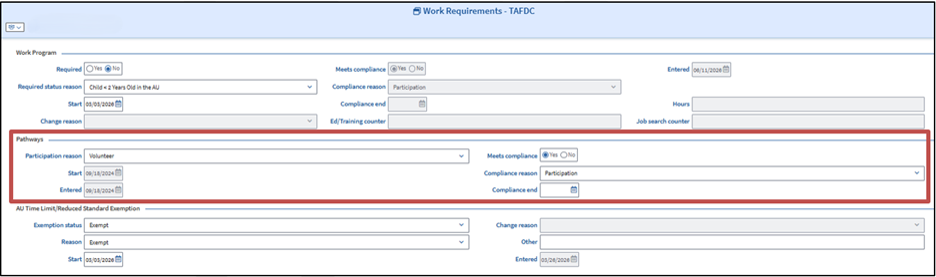
Do not change the following fields on the Work Requirements TAFDC page:
- Work Program Required;
- Required Status Reason;
- Exemption Status; or
- Reason.
Important: Staff must document the client's voluntary participation in the narrative.
Clients Living in Shelter
Clients residing in an approved shelter placement may qualify for an Approved Pathways Activity child care referral when they are unable to participate in employment or another qualifying activity because they are:
- experiencing homelessness; or
- unable to participate because DTA does not have an appropriate Pathways to Work activity available.
Approved shelter placements include, but are not limited to:
- Emergency Assistance shelters;
- Domestic Violence shelters;
- Young Parent Living Programs (YPLP); and
- other approved emergency shelter placements.
Noncitizens Authorized to Work
Noncitizens who are authorized to work in the United States, and voluntarily participate in Pathways to Work, may qualify for child care when they have an active, approved Pathways to Work Plan. The plan may support any approved Pathways to Work activity, including, but not limited to, employment.
Noncitizens Not Authorized to Work
Noncitizens who are not authorized to work in the United States and volunteer to participate in Pathways to Work may qualify for child care when they have an approved Pathways to Work Plan that supports an activity that does not require work authorization. See Voluntary Participation for instructions on coding voluntary participation. Pathways to Work plans for this population can include;
Important: Two-parent household requirements continue to apply.
- English for Speakers of Other Languages (ESOL);
- Adult Basic Education (ABE); and
- other approved education or training activities.
Relative Caregivers
Relative caregivers receiving TAFDC for a child-only case may qualify for a Relative Caregiver child care referral when they:
- are employed; and
- earn at least minimum wage.
To determine eligibility, staff must:
- Access the caregiver's Electronic Case Folder.
- Enter the caregiver's earned income on the Earned Income page.
- Mark the income as noncountable for TAFDC purposes.
Important: Do not create a Pathways to Work Plan for a relative caregiver.
Two-Parent Households
Both parents in a two-parent household must have an active, approved Pathways to Work Plan unless one parent is receiving SSI and a competent medical authority states they are unable to provide care for the child(ren) during the other parent’s work or activity.
Example: Avery (she/her) and Sam (he/him) have two children in elementary school. Avery works full-time and Sam receives SSI and does not work. Sam has submitted a letter from his primary care physician stating that Sam cannot work or take care of their children while Avery is at work due to his disability. The assigned FEW/SSS is to issue an Approved Pathways Activity child care referral after documenting the exception in BEACON.
Parents on SSI
A child care referral may be provided for a parent who is receiving SSI when needed for sustaining employment or participating in an approved employment-related activity. These are approved on a case by case basis. To get approval send a SECURE: email to DTA.EmploymentServices@state.ma.us.
Transitional Child Care (TCC)
Eligibility
Clients who previously received TAFDC are eligible for child care through a Transitional Child Care referral when they request child care within 24 months of the TAFDC case closure. The CCR&R will determine if the client has a service need.
Issuing the Transitional Child Care Referral
When an eligible former TAFDC client requests child care, the assigned Full Engagement Worker (FEW)/Self-Sufficiency Specialist (SSS) MUST issue a Transitional Child Care referral. The CCR&R is responsible for verification.
The assigned FEW/SSS will:
- confirm the TAFDC closing date;
- verify the request is within the 24-month eligibility period;
- select the Transitional Child Care Referral type in BEACON; and
- issue the child care referral.
After receiving the referral, the CCR&R agency will:
- verify that the family meets eligibility requirements of the Department of Early Education and Care (EEC) and the CCR&R,
- verify the client's activity, when required;
- determine the appropriate child care voucher;
- issue a provisional voucher, when applicable; and
- authorize child care services.
If the CCR&R agency determines that the family is not eligible for Transitional Child Care, the CCR&R agency will work with the family to evaluate eligibility for and/or obtain other available child care financial assistance programs.
SNAP-Only Child Care
DTA Child Care Options for SNAP-only Clients
1. Transitional Child Care Referral:
A SNAP-only client whose former TAFDC closed may request Transitional Child Care within 24 months of the case closure (issued by the FEW/SSS).
Important: This is the preferred option because option #2 is a one-time issuance.
2. SNAP Path to Work Referral:
A SNAP-only client (who is an eligible member of the SNAP household) participating in an approved SNAP Path to Work program activity may receive a SNAP Path to Work Child Care Referral. If the eligible SNAP-only client already has an active child care voucher that requires the parent to pay an out-of-pocket fee, the SNAP Employment & Training Specialist must issue a SNAP Path to Work Child Care Referral so the existing voucher can be converted to a 12-month SNAP Path to Work voucher with no parent fee. Once converted, the no-parent fee remains in effect for the full 12-month authorization period. SNAP-only clients who are not eligible for child care through DTA are not to be informed about Resources for SNAP or TAFDC Clients Who Are Not Eligible for Child Care Through DTA.
Role of SNAP Employment & Training Specialist
- Verify Activity Status: When a SNAP-only client or SNAP Path to Work provider reports the client is participating in a SNAP Path to Work activity, the activity status must be verified by a SNAP Employment & Training (E&T) Specialist.
- Issue the SNAP Path to Work Child Care Referral: Only SNAP Employment & Training Specialists are authorized to issue a SNAP Path to Work Child Care Referral.
- Explain the Child Care Referral Process.
Important: SNAP Path to Work enrollment MUST be verified by a SNAP Employment & Training Specialist (SNAP-only clients do NOT have a Pathways to Work plan in BEACON).
SNAP Employment & Training Specialists May Receive Child Care Referral Requests From:
- A SNAP Path to Work participant directly,
- A SNAP Path to Work provider on behalf of a participant,
- a Full Engagement Worker (FEW) on behalf of a participant, or
- a FAW or Economic Assistance Case Manager on behalf of a participant.
When and How to Refer a SNAP-only Client to the SNAP Employment & Training Specialist
A SNAP-only client must be an approved SNAP Path to Work participant to qualify for child care. See SNAP Path to Work for information about program eligibility.
Important: An ineligible member of the SNAP household is NOT eligible for SNAP Path to Work or SNAP child care. They are not to be referred to a SNAP Employment & Training Specialist.
When the Client Reports They Are Enrolled in a SNAP Path to Work Activity
If an eligible SNAP-only client reports they are already enrolled in a SNAP Path to Work activity, send a SECURE: email to the assigned SNAP Employment & Training Specialist and cc your own supervisor (see SNAP E&T Specialist TAO Assignments). The email must include the client’s name and agency ID (AP ID).
Staff must:
- Advise the client that they are being referred to the SNAP Employment & Training unit
- to confirm their enrollment in a SNAP Path to Work activity, and
- if eligible, to receive a child care referral.
- Explain that if they are eligible for a child care referral, a SNAP Employment & Training Specialist will follow-up to provide a referral.
When an Eligible Client is Considering Participating in SNAP Path to Work
If an eligible SNAP-only client is interested in exploring participation in SNAP Path to Work, staff must:
- Provide the client with the SNAP Path to Work website information to look at their options (www.snappathtowork.org).
- Advise them that they must be enrolled with an approved activity to be eligible for child care through DTA.
- Provide the SNAP Path to Work Line (888-483-0255) to speak to a DTA Employment & Training Specialist.
If the client has questions about SNAP Path to Work, needs help exploring their options, or is ready to enroll, send a SECURE: email to the assigned SNAP Employment & Training Specialist and cc your supervisor (see SNAP E&T Specialist TAO Assignments). The email must include the client’s name and agency ID (AP ID).
What About Families Who Are Paying a Portion of Their Child Care Expense?
DTA staff must discuss potential child care eligibility with all families who are receiving either TAFDC or SNAP. There may be times when a family has a child care voucher in place and the parent is responsible for paying a portion of the total child care expense. This is called Income Eligible Child Care (IECC). Families receiving DTA assistance who are eligible for child care through DTA do not have to pay any portion of the child care expense while DTA child care is in place.
If the family has child care in place where they are paying out-of-pocket, staff must determine whether they are eligible for a DTA child care referral type. If requirements are met, you must issue the applicable DTA child care referral type.
Eligible Children
All children in the filing unit must be included on the child care referral regardless of their status in the assistance unit. They must:
- live in the home and
- be under age 13 (a child with a medical/behavioral need, disability, or court-involved status may be eligible up to age 16).
Important: Do not manually remove a child from the child care referral. Any questions about a child’s eligibility for child care must be sent to DTA.EmploymentServices@state.ma.us with SECURE: in the subject line.
Processing a Child Care Referral
Before issuing a child care referral, staff must confirm the family's eligibility and ensure that all required information has been reviewed and updated in BEACON.
Once eligibility has been confirmed, review the sections in BEACON listed below and update any information that is incomplete or inaccurate before issuing the referral.
Contact Information
Review the client's information in BEACON and confirm that the following is current and accurate:
- mailing address;
- residential address, if different from the mailing address;
- telephone number; and
- email address.
Important: The Child Care Resource and Referral agency uses the contact information included on the referral to contact the family and complete the child care authorization process. Outdated or incorrect information may prevent the Child Care Resource and Referral agency from reaching the family and delay access to child care.
Household Information
Review the Household Composition workflow to verify:
- household members;
- children requiring child care;
- residential address;
- shelter status, when applicable; and
- that all required eligibility verifications have been completed.
When the client resides in an approved shelter placement, verify that the shelter information has been entered correctly before issuing the referral.
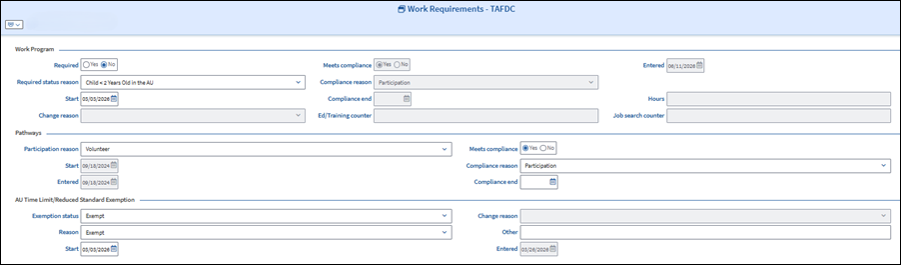
Work Requirements TAFDC
When applicable, review the Work Requirements TAFDC page to verify:
- whether the client is subject to TAFDC work rules or exempt;
- the client's participation status; voluntary participation, when applicable;
- whether a two-parent household requires two active Pathways to Work Plans; and
- whether parents under age 20 are correctly coded as meeting school attendance requirements. View/HideView/Hide
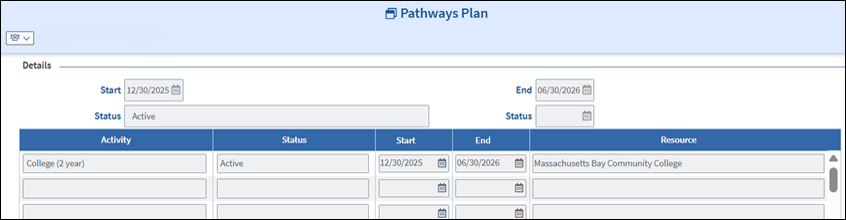
Pathways Plan page
When an Approved Pathways Activity child care referral is being issued, verify that:
- each required participant has an active, approved Pathways to Work Plan; and
- the approved activity supports qualifying employment, education, or training. View/HideView/Hide
Important: An Approved Pathways Activity child care referral cannot be issued until all required Pathways to Work Plans have been established and approved.
Result Tab
Review the Result tab to confirm:
- household members included in the assistance unit;
- whether an Employment Services referral is required; and
- whether a former TAFDC client is eligible for Transitional Child Care. View/HideView/Hide

For Transitional Child Care requests, use the Benefit End Date to determine whether the request falls within the 24-month eligibility period.
Previously Issued Child Care Referrals
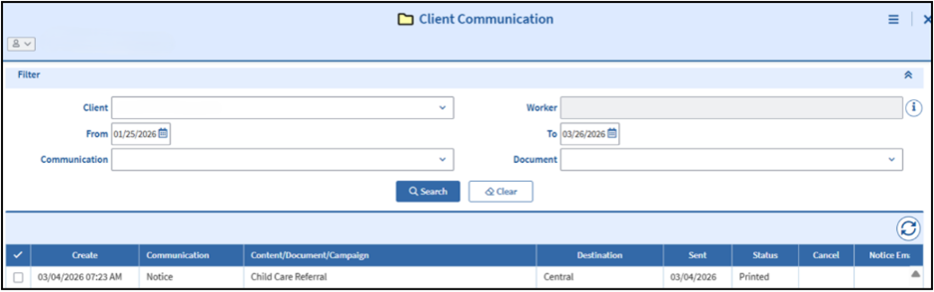
You can search the Client Communication folder for any previous Child Care Referral notice(s) sent to the client. There must be a corresponding narrative that provides case details. View/HideView/Hide
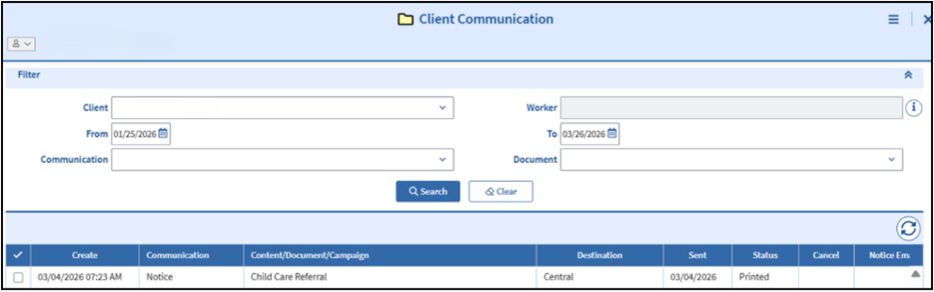
Note: The Last DTA field on the Support Services page (Pathways to Work > Support Services) might display a Child Care Referral issuance date. However, checking the Client Communication folder will provide the most accurate information.
Complete the Child Care Workflow
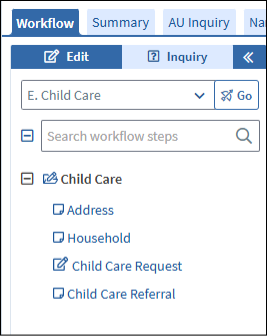
Child Care Request Page
Complete the Child Care Request page by completing all fields on this page. View/HideView/Hide
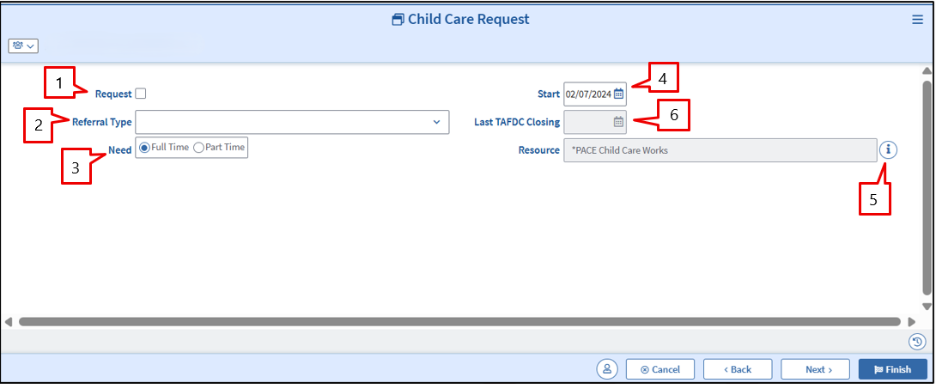
- Request checkbox: Click to initiate the request for a referral.
- Referral Type field: Use the dropdown list to make a selection based on the type of child care referral the family is eligible for (see Determining the Correct Child Care Referral).
- Need field: Select Full Time or Part Time Need based on the family’s request for child care coverage.
- Start field: Today’s date will autofill in this field and on the Child Care Referral notice.
Note: The date on the Child Care Referral notice will autogenerate with today’s date even if you try to manually change the field to a different date. However, the CCR&R will know the correct date for their system. View/HideView/Hide
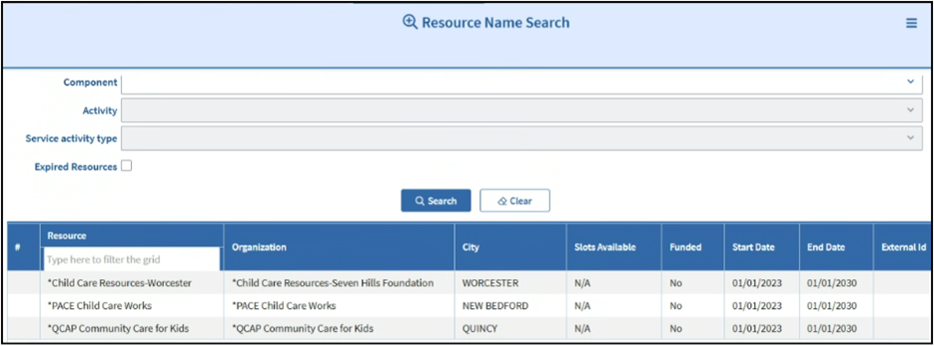
- Resource field: Click on the
 information button to access the Resource Name Search pop-up window. Under Resource select the CCR&R agency that provides child care services to the city/town where the family resides. This will close the window. Your selection will be displayed in the Resource field of the Child Care Request page.
 - Last TAFDC Closing field: If the grantee’s TAFDC case was or is closed, the most recent TAFDC closure date will be displayed.
Important: When a former TAFDC client is requesting Transitional Child Care, use the date displayed in this field to calculate how many months the case has been closed. If fewer than 24 months, you must issue a Transitional Child Care Referral.
- Click Next and the Child Care Referral page will open.
Child Care Referral Page
The Child Care Referral page displays each child who may be included on the referral. Review all information carefully before generating the referral.
- The Request section will display all children in the household up to age 16.
- You must select the Exception approval checkbox for any child 13 or older who needs child care due to a medical/behavioral need, disability or court-involved status. Inform the client that the CCR&R agency will work with the family to verify the exception, if necessary. View/HideView/Hide
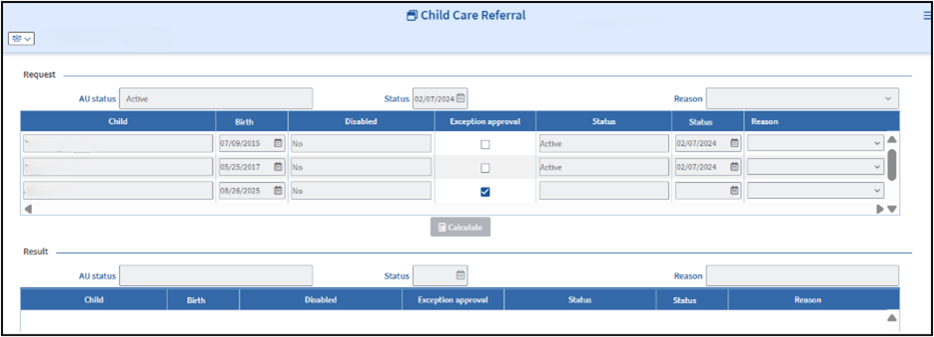
- Click Calculate.
The Result section will now display the children and their child care eligibility status.
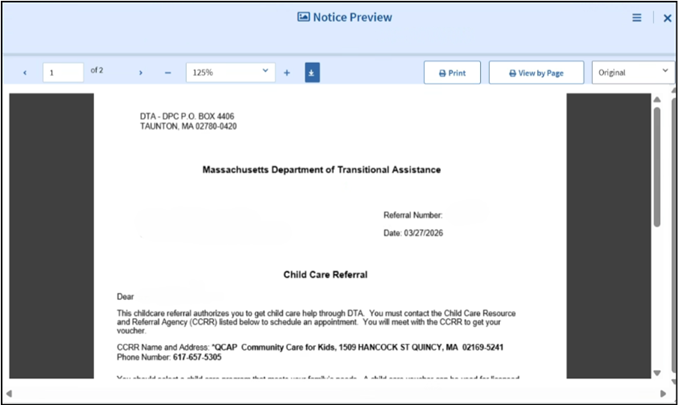
- Click Finish. The Child Care Referral notice will generate and automatically open in a separate Notice Preview window. View/HideView/Hide
Send the Referral
After generating the Child Care Referral notice, staff must send the referral to the appropriate Child Care Resource and Referral (CCR&R) agency.
- Save the Referral: Click the blue download button
 to save the Child Care Referral notice as a PDF file on your computer. When prompted, rename the file with the client’s first initial and full last name. (for example, JSmith.pdf).
 - Email the Referral: Send all Child Care Referral notices to the selected Child Care Resource and Referral (CCR&R) agency via a SECURE email. To encrypt the email, enter "SECURE:" at the beginning of the subject line. All emails containing confidential client information must be sent using this process, regardless of whether the recipient is a DTA employee or an external partner. View/HideView/Hide
Composing the Email
- Create a new email addressed to the selected CCR&R agency.
- Enter SECURE: Client Last Name, First Initial in the subject line.
- Attach the Child Care Referral PDF, saved using the client's first initial and full last name (for example, JSmith.pdf).
- If the client has requested email correspondence, include the client's email address in the body of the email, as it does not appear on the Child Care Referral notice.
- Send the email.
- Document the action in a BEACON narrative. The narrative must include:
- the action taken;
- the family's current child care eligibility;
- a summary of any discussion with the client; and
- confirmation that the Child Care Referral was sent to the appropriate CCR&R agency.
Notices
- After the referral is generated, the Child Care Referral notice is mailed to the client through Central Print; and a copy is stored in the Client Communication folder.
- When issuing a DTA child care referral for the first time to the family, provide the client with the Child Care Fact Sheet (CCFS).
The fact sheet explains:
- who may qualify for child care;
- how the authorization process works;
- how to contact the local CCR&R agency;
- available child care options; and
- how to locate a licensed child care provider.
After the Child Care Referral is Issued
Once DTA issues a Child Care Referral notice, responsibility for authorizing and managing child care services transfers to the Child Care Resource and Referral (CCR&R) agency.
Working with the Child Care Resource and Referral (CCR&R) Agency
The Department of Early Education and Care (EEC) contracts with Child Care Resource and Referral (CCR&R) agencies to administer child care authorizations for eligible families. After receiving a Child Care Referral from DTA, the CCR&R agency becomes the primary point of contact for the client throughout the authorization process.
The CCR&R agency:
- determines authorization eligibility;
- assists the family in selecting a provider;
- authorizes child care services; and
- manages ongoing child care services.
Authorization appointments may be completed:
- by telephone;
- virtually; or
- in person, at the client's request.
During the authorization process, the CCR&R agency:
- reviews the family's eligibility;
- collects any required documentation;
- assists the family in selecting a child care provider;
- authorizes child care services when appropriate; and
- explains the family's ongoing responsibilities.
Clients may electronically complete and submit required forms during the authorization process. The CCR&R agency also offers clients the opportunity to receive future communications by text message.
Duration of a Child Care Referral
A DTA Child Care Referral notice is valid for 90 days from the date it is issued. If the referral is not used within the 90-day period and the family remains eligible, DTA must issue a new Child Care Referral notice.
Important: Issuing a new child care referral does not automatically authorize child care services. The CCR&R agency must complete the authorization process before services can begin.
When Child Care is Unavailable
In some situations, the CCR&R agency may determine that appropriate child care is unavailable or that the client has declined all available providers. When this occurs, the Family Access Administrator (FAA) notifies the DTA staff member identified on the Child Care Referral notice.
For clients subject to TAFDC work rules, staff must determine whether the client qualifies for good cause when the CCR&R agency verifies that appropriate child care is unavailable. For additional information, see Good Cause for TAFDC Work Rules.
Managing a Child Care Referral
Once child care has been authorized, the CCR&R agency manages the family's ongoing authorization. Depending on the family's circumstances, DTA may need to issue a new child care referral to support continued child care eligibility.
Reauthorization
The CCR&R agency is responsible for reauthorizing child care services. Approximately 60 days before the current authorization expires, the CCR&R agency sends the family a reauthorization notice. Staff are to remind clients to keep their mailing address, email address, and telephone number current with both DTA and the CCR&R agency to avoid delays during reauthorization.
SNAP
SNAP Path to Work child care referrals are issued only once and are not reauthorized by DTA. At the end of the 12-month authorization period, participants must work directly with their Child Care Resource and Referral (CCR&R) agency to determine whether they meet the Department of Early Education and Care (EEC) eligibility requirements for ongoing child care assistance.
Important: DTA cannot issue a second SNAP Path to Work Child Care Referral notice based on continued SNAP Path to Work participation.
Active TAFDC
When the family's TAFDC case remains active and the family continues to meet child care eligibility requirements, DTA may issue a new child care referral, as appropriate.
Former TAFDC
Former TAFDC Families who continue to remain eligible for a Transitional Child Care referral will work directly with the CCR&R agency throughout the reauthorization process. A new Transitional Child Care referral is usually not required, but the CCR&R will reach out to DTA staff if a new referral is necessary.
Updating a Referral
Staff must issue a new child care referral whenever a change affects the family's child care authorization.
Examples include:
- the birth of a child;
- a change from part-time to full-time child care;
- approval of TAFDC while another child care authorization remains active;
- a change in household composition; or
- another change affecting the family's child care needs.
After issuing the updated referral, staff must send the revised Child Care Referral notice to the appropriate CCR&R agency.
Note: Updating a child care referral does not change the authorization period established by the CCR&R agency unless otherwise determined by the CCR&R agency.
Ending a Referral
A child care referral may be ended when:
- the client requests that the referral be ended;
- another agency becomes responsible for providing child care services; or
- a change in custody requires the child care authorization to transfer to another parent or caregiver. View/HideView/Hide
The Request Section
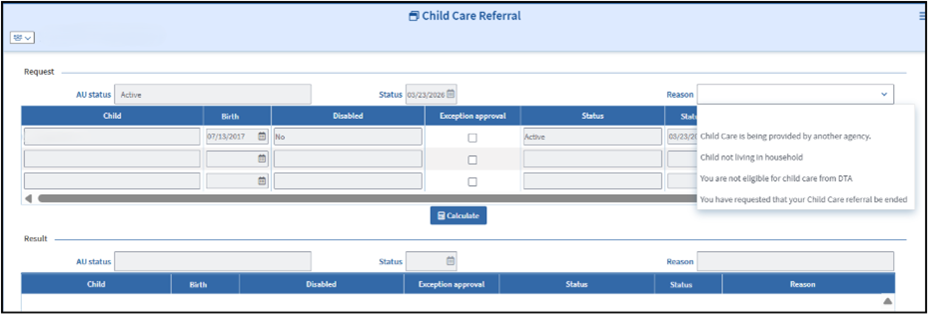
- The AU Status field displays whether the referral is currently Pending or Active. In the Reason field, select the appropriate dropdown option to end the child care referral (for the household or for a specific dependent):
- Child care is being provided by a different agency
- Child not living in household
- You are not eligible for child care from DTA
- You have requested that your Child Care referral be ended
- Click Calculate.
The Result Section
The Result section will display the name of each child, their Status of eligibility, and the Reason.
Click Finish and the Child Care End Notice will generate and
- will automatically open in a separate Notice Preview window.
- Send the Child Care End Notice to the appropriate CCR&R agency;
- a copy is mailed to the client through Central Print; and
- a copy is stored in the Client Communication folder.
If one or more children remain eligible for child care, BEACON automatically generates an updated Child Care Referral notice. Staff must send both the Child Care End Notice and the updated Child Care Referral notice to the appropriate CCR&R agency.
Documentation Requirements
Whenever a child care referral is updated or ended, staff must document the action in a BEACON narrative. The narrative must include:
- the action taken;
- the family's current child care eligibility;
- the reason for the update or closure;
- any discussion with the client; and
- confirmation that all required notices and referrals were sent to the appropriate CCR&R agency.
Clients Not Eligible for DTA Child Care
Some clients who are not eligible for a DTA child care referral may still qualify for child care financial assistance or early education services through another state agency or community-based program. In this situation, staff must discuss available resources and encourage the client to contact the appropriate organization to determine eligibility.
Alternative Resources for Child Care
Clients may be referred to one or more of the following resources, depending on their circumstances. Staff are to encourage clients who are not already on the statewide child care financial assistance waitlist to visit the Department of Early Education and Care’s Child Care Financial Assistance page or contact their local CCR&R agency to discuss available options.
Department of Early Education and Care
Families can check their eligibility and/or get on the child care waitlist via the Department of Early Education and Care’s (EEC) Child Care Financial Assistance webpage. Clients who are not eligible for a Child Care referral from DTA may apply directly online at childcare.mass.gov/families/login. DTA staff must direct families who do not qualify for a DTA child care referral to the Child Care Financial Assistance webpage.
Child Care Resources and Referral (CCR&R) Agency can help families
The local Child Care Resource and Referral (CCR&R) agency can help families:
- determine eligibility for child care financial assistance programs;
- apply for available child care vouchers;
- locate licensed child care providers; and
- obtain information about available child care resources within their community.
Mass 211
Mass211 provides information about a variety of community resources, including: child care; housing assistance; food resources; health services; and other community-based supports.
Department of Children and Families (DCF)
Clients involved with the Department of Children and Families (DCF) may qualify for child care services through DCF. When appropriate, advise the client to contact their DCF caseworker for additional information.
Executive Office of Housing and Livable Communities (EOHHLC)
Families participating in programs administered by the Executive Office of Housing and Livable Communities (EOHLC) may qualify for child care assistance through housing-related supportive service programs.
Early Head Start and Head Start
Eligible families may qualify for comprehensive early childhood education services through Early Head Start or Head Start programs (for children age 0-5). These programs may provide: early education; family support services; and child development resources.
Coordinated Family and Community Engagement Documentation Requirements
Families with young children may receive parenting support, early childhood education resources, developmental information, and community referrals through Coordinated Family and Community Engagement programs.
EEC Parent Fee Calculator
Families may use the Department of Early Education and Care (EEC) Parent Fee Calculator to estimate any parent fee that may apply to a child care authorization.
Child Care Eligibility Chart
The chart below summarizes when/how a family is eligible for DTA issued child care. It displays specific household circumstances, applicable child care referral types, and eligibility requirements.
|
Household Circumstances |
Child Care Referral Type |
Duration |
Eligibility Requirements |
|---|---|---|---|
|
SNAP-only Client |
SNAP Path to Work |
12 months |
Enrolled in an approved SNAP Path to Work program activity (MUST be issued by a SNAP Employment & Training Specialist) |
|
Pathways to Work planning period (exploring activities; includes becoming non-exempt) |
Seeking Activity |
3 months |
|
|
Approved Pathways Plan (work program required or voluntary participation) |
Approved Pathways Activity |
12 months |
A TAFDC client subject to work rules must have an active/approved Pathways Plan in BEACON (For a two-parent household, BOTH parents must have an active/approved plan in BEACON) |
|
Parent Under 20 |
Approved Pathways Activity |
12 months |
TAFDC client must meet school rules |
|
Residing in a shelter |
Approved Pathways Activity |
12 months |
TAFDC client verified as being in a shelter placement (see Participation in Housing Search on OLG page Using Meets Compliance) |
|
Noncitizen who is not authorized to work in the U.S. |
Approved Pathways Activity |
12 months |
TAFDC client with an active/approved Pathways Plan in BEACON (supports their economic mobility goals but does not include employment) |
|
Relative Caregiver |
Relative Caregiver |
12 months |
TAFDC client must be employed at minimum wage or more |
|
Former TAFDC client |
Transitional Child Care (See special instructions for issuing a Referral for Transitional Child Care) |
12 months |
Must be requested within 24 months of case closure. See Transitional Child Care |
Related Topics
TAFDC Pathways to Work Programs Overview
Last Update: September 30, 2026
|
| ||
| Digital Accessibility Statement | Privacy Policy | Site Policies | Public Records Requests |
© 2026 Commonwealth of Massachusetts. Mass.gov is a registered service mark of the Commonwealth of Massachusetts. | |||