An official website of the Commonwealth of Massachusetts Here's how you knowHere's how you know

Medical Expenses Claimed by Subsidized Housing Tenants
Overview
Clients who live in state or federal public or subsidized housing can claim out of pocket medical expenses as a deduction on their income. The tenant is required to verify this information with the local Housing Authority or housing agency administering the subsidy.
The medical expense deduction can lower the amount of their monthly rent. Public/subsidized housing tenants typically verify their medical expenses when they apply for housing and when their rent is recertified, usually on an annual basis.
DTA will accept and recognize the expenses already claimed by a tenant in public or subsidized housing as proof of medical expenses if the tenant is aged 60+ or disabled. This document serves as verification of costs already verified by the Housing Authority. Clients who elect to use housing authority documentation as verification of medical expenses must have that expense treated as a non-recurring expense.
You must determine the appropriate way to enter this one-time expense using the averaging options outlined in the non-recurring medical expense section of the Guide.
Example
John and Mary are in their 70s and live in elder housing in Springfield. They have combined Social Security income of $2,400 a month. The Springfield Housing Authority has calculated their rent after identifying $6,000 in medical expenses. DTA can credit the household for these medical costs because all household members are elderly and have verified their medical expenses using their Housing Authority documentation.
Verification
Medical verification from the Housing Authority is one of many verification options for clients. You must check whether the Housing Authority clearly identifies the tenant to whom the medical expenses are attributable. If the verification does not display the applicable tenant (or identifies a tenant who is not part of the SNAP household and/or qualified for the medical deduction), then the verification is insufficient.
If the verification is sufficient, you must enter in BEACON the medical expenses line item from the housing authority documentation as Type: Other Health Costs/Subtype: Other health costs, and use “documents from housing authority" as the document of evidence on the Verification tab details. The documents presented to DTA will differ by Housing Authority.
You must review the documentation carefully and enter the amount that reflects the total expense verified, and not the value that the housing authority used in their calculation. Federal and state Housing Authorities typically allow tenants to claim unreimbursed medical expenses that exceed 3% of the tenant’s gross income. SNAP allows medical expenses above $35.00 per month to be claimed as a deduction. For that reason, be sure to take the full medical expenses claimed and then divide this annual amount over the appropriate number of months. If the household is already receiving credit for medical expenses from the Housing Authority, the only additional expenses that may be considered are over the counter medications or healthcare products.
You must not subtract self-paid Medicare premiums unless the Housing Authority documentation specifically itemizes that expense. For example, if the total amount on the form was $1,000.00 and the form provided a total value without a breakdown, $1,000.00 must be entered in BEACON. If the form itemized the expenses and Medicare was listed, you must subtract the cost of Medicare.
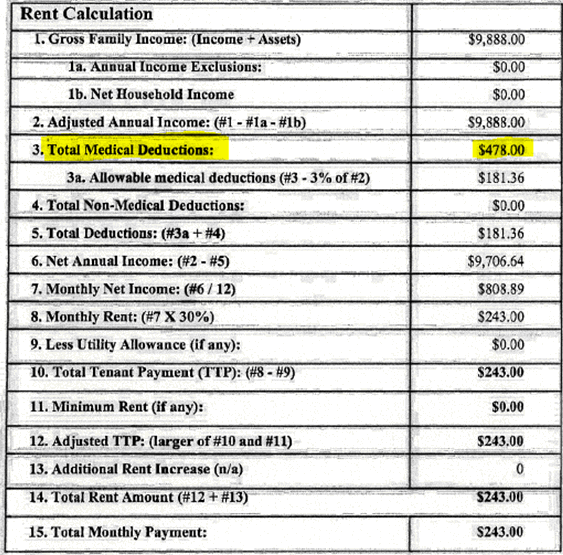
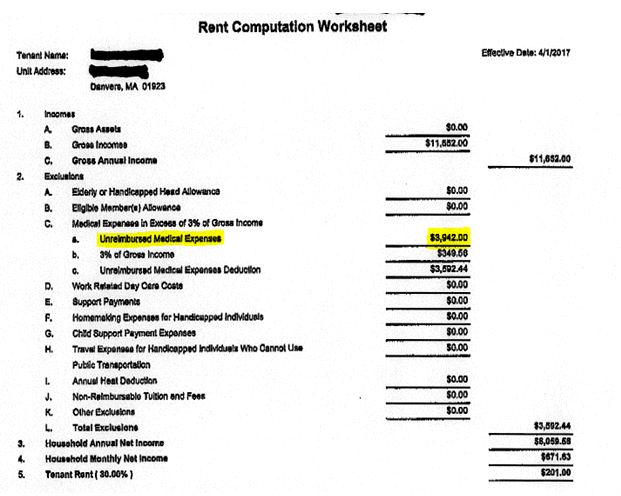
You must review each form carefully as they differ between Housing Authorities. Please see the two sample forms below. In the first sample, the $478.00 value on line 3 would be entered in BEACON on the Medical Expenses page as Type: Other Health Costs/Subtype: Other health costs. In the second sample, the $3,942.00 value on line 2.C(a) would be entered as Type: Other Health Costs/Subtype: Other health costs. View/HideView/Hide
Over the Counter Medical Expenses for Ongoing Cases
Most Housing Authorities do not include over-the-counter medical expenses, unlike the SNAP program. For that reason, tenants who claim their unreimbursed medical expenses used for public or subsidized housing can also claim their over-the-counter medical expenses for SNAP.
If the client submits a Housing Authority document, you must check BEACON for previous medical expense records. You must determine whether these records include credit for over-the-counter expenses. If a previous record for over-the-counter expenses exists, you must leave that record in the Medical Expense page. You must input a record for the medical expense amount listed on the Housing Authority document and end all records except for the over-the-counter expenses.
If the medical expenses on file do not account for over-the-counter expenses, you must compare the value on file with the value verified by the Housing Authority document. If the medical expense amount from the Housing Authority document is more or less than what is on file in BEACON, you must end all other records and add the Housing Authority amount as this figure is verified upon receipt.
If a client submits a Housing Authority document plus additional verifications, such as a prescription printout or bill from a hospital, you must explain to the client that we may only accept actual verifications of expenses (other than over the counter) or the Housing Authority document. You must review the actual verifications of expenses and the Housing Authority document to advise the client on their best course of action. To avoid possible over issuance of benefits, we cannot accept both.
Last Update: May 21, 2026
|
|
|
||
| Digital Accessibility Statement | Privacy Policy | Site Policies | Public Records Requests |
|
© 2026 Commonwealth of Massachusetts. Mass.gov is a registered service mark of the Commonwealth of Massachusetts. |
|||