Dependent Care Expenses Deduction
This is an optional verification.
Overview
The dependent care deduction is allowable for SNAP households that report dependent care as being necessary because they are:
- continue employment
- search for a job
- Attending a training or education program(s) to prepare for employment
- disabled
Dependent care expenses are allowed for care provided to a child under 18 or for a person with disabilities of any age in need of care. The person with a disability does not have to be federally certified as disabled.
For information on the dependent care deduction for TAFDC, see Dependent Care Deduction and Entering Dependent Care Expenses Data – TAFDC.
Note:
When a household:
- includes a person who incurs dependent care costs or
- includes a disabled child or adult that incur costs
- that qualify under both the Medical Expense Deduction and the Dependent Care Expense Deduction, the cost may be deducted as either expense, but not both.
In these situations, you must review which deduction will be most beneficial for the household. See examples below.
Examples
Example: Susan (she/her) is the grantee in a SNAP household of 2 that includes her 6-year-old son, Matt (he/his). Matt has a disability that occasionally requires care by a medical professional. Due to this, Susan pays a visiting nurse service $50 per month for an attendant to care for Matt after school for two hours each day, Monday through Friday, to accommodate her work schedule.
If entered as a Dependent Care Expense, Susan’s household would receive a $50 per month dependent care expense deduction.
If entered as a Medical Expense, Susan’s household would receive a $155 per month medical expense deduction since the $50 paid to the visiting nurse service exceeds the $35.01 threshold required to receive the Standard Medical Deduction.
In this example, the Medical Expense Deduction is more beneficial to the client.
Example: Susan (she/her) is the grantee in a SNAP household of 2 that includes her 6-year-old son, Matt (he/his). Matt has a disability that occasionally requires care by a medical professional. Due to this, Susan pays a visiting nurse service $200 per month for an attendant to care for Matt after school for two hours each day, Monday through Friday, to accommodate her work schedule.
If entered as a Medical Expense, Susan’s household would receive a $165 per month medical expense deduction (Actual Medical Expense $200 - $35 = $165).
In this example, the Dependent Care Expense deduction is more beneficial to the client.
The amount of the dependent care expense must be entered separately for each dependent for whom the expense is incurred. Reimbursed dependent care is not an allowable deduction. Only the non-reimbursed portion of the expense is allowable.
The costs of care provided by a relative may be deducted so long as the relative providing the care is not part of the same SNAP household as the child or dependent adult receiving the care.
Example: Cynthia (she/her) is the grantee of a SNAP household of three that includes her daughters Laura, 20, and Victoria, 12. Cynthia states she pays Laura $20 per week to babysit Victoria after school.
This would not be an allowable Dependent Care Deduction as Laura is a member of the SNAP household.
Example: Cynthia (she/her) is the grantee of a SNAP household of four that includes her husband Stephen (he/his), her daughter Victoria (she/her), age 12, and her son Stephen Jr. (he/his), age 5.
Cynthia’s other daughter, Laura age 20, lives in the next town over. Cynthia pays Laura to babysit Stephen Jr. and Victoria four days per week.
While Laura is a relative, since she is not part of the SNAP household, this is an allowable Dependent Care Deduction.
Allowable Dependent Care Expenses Include
- private dependent care arrangements with providers not in the household. This includes expenses paid to a relative who is not a part of the same SNAP household as the child or adult receiving the care.
- payments for child and adult care, including co-pays for subsidized care
- extended day programs
- activity or other fees associated with the care provided to the dependent that are necessary for the household to participate in the care
- before and after school programs, such as Boys and Girls Clubs, YMCA and YWCA
- summer camp fees
- transportation costs to and from program sites using Federal Mileage Rates
- the cost of public transportation such as bus or cab fare, and Uber service
Note: The cost of transportation is not an allowable expense when free bus service, such as school busing, is otherwise available. Transportation costs to or from before and after school programs that allow for a household member to search for, accept, or continue employment, comply with a SNAP Employment & Training Program, or attend training or education to prepare for employment are allowable.
Important: A client can provide a written self-declaration indicating the percentage used for transportation costs, if the transportation cost is used for other types of transportation than just strictly for dependent care-related travel. (i.e. a monthly MBTA pass may be used to travel to work or for recreational purposes, while only a portion is used for travelling to the dependent care provider).
There is no cap or limit on the amount of allowable Dependent Care Expense that can be claimed by a household / household member.
Dependent Care as a Medical Expense
When a household includes an individual who incurs dependent care costs, or includes a disabled child or adult who incur costs, that qualify under both the Medical Expense Deduction and the Dependent Care Expense Deduction, the cost may be deducted as either expense, but not both.
In these situations, you must review which deduction will be most beneficial for the household.
When entering new dependent care expenses as medical expenses for households already receiving the Standard Medical Expense (SMD) deduction:
- if the new expense amount does not put the total medical expense amount over the $190 threshold for the Actual Medical Expense deduction, you must enter the expense as dependent care. If not, the additional expense will not be reflected in the final benefit calculation and will not impact the client’s SNAP benefit amount. A detailed narrative must be created explaining what action was taken.
- If the new expense amount is sufficient to qualify the household for the Actual Medical Expense deduction, it must be verified as a medical expense (see Verification of Dependent Care as a Medical Expense below).
Example
Carrie (she/her), 35, is the grantee in a SNAP household of 3 that includes her spouse Gary (he/his), 30, and her disabled daughter Shelah (she/her), 6. Carrie receives the SMD deduction of $155 due to verified medication expenses of $40 per month. Due to conflicting work schedules and the necessity of care due to her daughter’s disability, the household elects to put Shelah in medically supervised daycare two afternoons per week. Carrie supplies receipts from her new childcare provider showing she now pays $100 dollars per month for this care.
When added to the household’s existing medical expenses, the household’s expense deduction would remain at $155 as the addition of the daycare expense is insufficient to meet the threshold for the Actual Medical Expense deduction.
When added as a dependent care expense, the household would receive a $100 per month dependent care deduction in addition to the $155 Standard Medical Deduction, for a total deduction of $255.
Verification of Dependent Care Expenses and Dependent Care as a Medical Expense
Dependent care expenses (whether used as a dependent care expense or as a medical expense) must be verified via documentary evidence, or collateral contact must be explored if the client cannot obtain documentary evidence. A written self-declaration of dependent care expenses may only be accepted as a last resort if the client has provided a reasonable explanation as to why they cannot obtain documentary verification or a collateral contact. Acceptable documentary verifications of dependent care expenses include, but are not limited to:
- a letter from the provider
- canceled checks written to the provider
- a day care voucher
- any third-party documentation stating the name of the dependent, the amount paid and hours of care
- any transportation related costs such as parking or tolls receipts or statement or receipts from a transportation company (e.g., Lyft, Uber) or for public transportation (e.g., bus, subway, taxi, The RIDE
If the client drives the dependent to and from the dependent care provider, clients may verify the addresses and frequencies of the mileage by providing a telephonic or a written self-declaration. In such cases, you must mark the expenses as verified in the Verification tab by selecting Self-Declaration.
You must enter the home address of the client and the destination of the trip into a map service such as Google Maps or MapQuest. These sites will provide mileage based on a default route. The default route should be used to calculate the allowable expense unless the client indicates that they take a different route.
You must not assume that all transportation expenses are round-trip. When discussing mileage-related expenses with clients, it is important that you establish whether the mileage declared is one-way or round-trip.
You must save the route results and calculation and attach it to the narrative. Clients must not be asked to provide these printouts. You must include a clear explanation of the expense in the case narrative.
Example
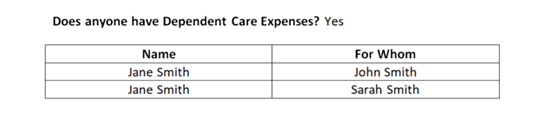
Jane Smith (she/her) states during her SNAP application interview that she pays a daycare expense of $25 per week, per child. The case manager tells the client that she must submit verification of the daycare expense (e.g., statement from provider proving the daycare amount she is responsible for) in order to receive credit for the expense. The case manager adds the dependent care expense into BEACON; however, leaves the record unverified and sends the corresponding optional VC-1 to the grantee.
Entering Dependent Care as a Medical Expense in BEACON
To ensure that households with dependent care expenses that also qualify as medical expenses have the expense credited properly, when the expense:
- is eligible as a Dependent Care and Medical Expense
- is in the client’s best interest to be entered as a medical expense; and
- is not related to transportation
a VC-1 for optional Dependent Care Medical Expenses must then be sent to the client. When verification of the dependent care as a medical expense is received and it works in the client’s best interest for the dependent care to be entered as a medical expense due to the dependent care amount, a medical expense entry created.
When processing these expenses, you must:
- send an Optional VC-1
- From the Verification tab. Click New under User Entered View/HideView/Hide
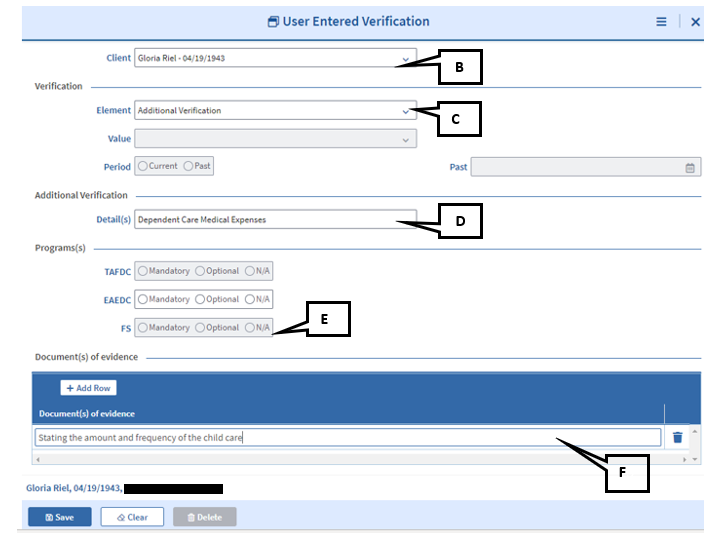
- From the Verification tab. Click New under User Entered View/HideView/Hide
| B | select the grantee from the Client dropdown |
| C | select Additional Verification from the Element dropdown |
| D | enter “Dependent Care Medical Expenses” in the Details box |
| E | select Optional in the Programs section enter, “Please provide signed and dated documentation from the care provider stating the amount and frequency of the care.” In the Document(s) of Evidence field |
| F | click Save to save your edits and add the optional verification to the VC-1, or click Clear to clear all fields. |
- write a detailed Narrative explaining the action taken
Related Topics
Entering Dependent Care Expenses Data
Dependent Care Expenses Policy and Procedures
Last Update: May 21, 2026