Simplified Reporting – Interim Report
SNAP clients classified as Simplified Reporting must complete an Interim Report (IR) at a check-in point during their certification period. This involves the completion of the IR form and verification of certain eligibility factors.
Who Is Required to Complete an Interim Report?
All Simplified Reporting households must complete an IR. Except for certain Former EDSAP cases, Simplified Reporting households will be required to complete an IR at their certification midpoint. The frequency for Former EDSAP cases to complete an IR may vary based on when in their certification period they were converted. IR requirements also include Simplified Reporting households that are receiving SNAP in combination with TAFDC or EAEDC.
EDSAP Households
EDSAP Reporting households do not have an IR requirement while the household is certified as EDSAP Reporting. To assist in identifying these households, this indicator icon is applied to all EDSAP Reporting cases. This is displayed on the ECF Home page in BEACON:
Reminder: In some circumstances, an IR may be mailed to a Simplified Reporting (Former EDSAP) household that has converted to EDSAP Reporting prior to the IR being received by DTA. In these situations, the EDSAP Reporting household is no longer required to submit the IR.
However, if an IR is received for these households, it must be dispositioned as Reviewed & Entered. You must review the IR and any verification attached for changes and act upon those changes. Proofs supplied by the client are considered verified upon receipt, unless questionable.
IRs for Simplified Reporting (Former EDSAP) Households
Households that become ineligible for EDSAP Reporting will be converted to Simplified Reporting (Former EDSAP). When the household converts to Simplified Reporting (Former EDSAP), the household y will be sent its first Interim Report 45 days before the IR closing date for the current period. When households convert and there are not 45 days before the IR closing date for the period, the household will receive an IR for the next scheduled IR period. The IRs will be issued in 6-month increments.
Simplified Reporting (Former EDSAP) will receive consecutive IRs for the duration of their certification period.
To assist in identifying Former EDSAP households, an indicator icon will be applied to all Former EDSAP households. This will be displayed on the ECF Home page in BEACON:
Important: The 36-month certification period will not be shortened when a household converts to Simplified Reporting (Former EDSAP). The client will be responsible to complete an initial IR and subsequent IRs every six months until the time of recertification.
When a household converts to EDSAP Reporting, the conversion will occur at the time the change is approved.
Kevin (they/them) is an EDSAP Reporting certified, household of 1. Kevin’s certification period begins on December 1, 2025. On March 10, 2026, Kevin adds their son Mark (he/him), 26, to their case. Since Mark is 26 years of age and is not disabled, Kevin’s case is converted to Simplified Reporting (Former EDSAP). In addition, the fact that Mark has earned income also disqualifies the household from EDSAP Reporting. Based on the IR schedule prepared by BEACON, Kevin’s current IR period will end May 31, 2026. Since there are at least 45-days before the IR closing date for this period, Kevin will be sent an IR that they must complete and return. After this initial IR, Kevin will be required to complete IRs every six months for the remaining 30 months of the certification period, if the household continues to be ineligible for EDSAP Reporting.
Lara (she/her), aged 61, and her spouse Lewis (he/him), aged 64, are an EDSAP Reporting certified household with RSDI-only income. Their certification began on December 13, 2025. On April 15, 2026, Lara reports that she now has a small part time job and submits paystubs. Lara’s case is converted to Simplified Reporting (Former EDSAP). Based on the IR schedule prepared by BEACON, Lara’s current IR period will end on June 12, 2026. Since there are not at least 45-days before the IR closing date for this period, Lara will be sent an IR 45 days before the next IR closing date (December 12, 2026). After this initial IR, Lara will be required to complete IRs every six months for the remaining 24 months of her certification period.
Natacha (they/them), aged 54, is a disabled grantee of a HH of 3. The household includes their spouse, Carlos (he/him), aged 61, and their 16-year-old daughter (she/her), Morena. Natacha’s SNAP case is certified on February 12, 2025, and is eligible for EDSAP Reporting. On May 12, 2026, Morena turns 18. Natacha’s case is converted to Simplified Reporting (Former EDSAP) at that time. Based on the IR schedule prepared by BEACON, Natacha’s current IR period will end on July 3, 2026. Since there are at least 45-days before the IR closing date for this period, Natacha will be sent an IR that they must complete and return. After this initial IR, Natacha will be required to complete IRs every six months for the remainder of the certification period.
Tina (they/them), aged 68, opted-out of Bay State CAP reporting on March 18, 2025. Simultaneously with opting-out of Bay State CAP, they also reported that they are now working ten hours per week at Trucchi’s. They submit their last four paystubs in addition to the Bay State CAP Client Options form. Their certification end date is June 1, 2027. Tina’s case is converted to Simplified Reporting. They will be sent an IR that they must complete and return. After this initial IR, Tina will be required to complete IRs every six months for the remaining months of their certification period.
Steps in the Interim Report Process
The IR form is mailed to clients 45 days before the end of the first half of the certification period (SIMP-12). Former EDSAP clients receive IRs every 6 months (see below for more details).
Client completes an IR telephonically, electronically via DTAConnect, or submits the paper IR form.
The IR form must be reviewed to ensure that what the client reported on the IR is recorded in BEACON.
Important: Not all information entered by clients during the DTA Connect IR workflow will prepopulate into BEACON. Staff must review the datasheet in its entirety to determine what must be entered into BEACON and if there is any clarification needed from the client to process the IR.
- A cold call must only be attempted when there is information on the IR that needs clarification. An interview must not be scheduled or conducted at IR.
- If there is unclear information and the cold call is unsuccessful, a verification checklist (VC-1) must be sent using the language prescribed in the Establishing Contact at IR When Information is Incomplete, Questionable, or Contradictory section of this page.
- If the cold call is successful, a Verification Checklist (VC-1) is sent for any outstanding item.
- If all mandatory verifications are received and procedures for optional verifications (see below for more details) are followed, the case is recalculated and, if still eligible, approved for the remainder of the certification period.
- If the IR is not returned 20 days after it is sent, the client will receive an IR Warning Notice.
- If the IR form is not returned 30 days after it was sent or it is returned but mandatory verifications that were requested within that period have not been provided, the client will receive an IR Closing Notice.
What Changes Must be Reported During the Interim Report Process?
Certain changes must be reported during the Interim Report process. The item may then need to be verified by documentary evidence, collateral contact, or written/verbal self-declaration. (Whether self-declaration is acceptable depends on the item being verified, or if only allowed as a last resort.) The changes that must be reported at IR are as follows:
- Earned income
- Unearned income at the household level of more than $125.
- Earned or unearned income from a new source.
- Household composition
- If changes are reported regarding the eligibility status of existing household members, the information must be verified.
- If the change pertains to the addition of a new household member, verification may be required based on the circumstances of the new household member. For example, adding a new household member who is a noncitizen.
- Address
- If the household moved, new housing expenses must be verified as an optional expense. If the expense is not verified (including a self-declaration), then the household cannot be credited with housing expenses. For households that have not moved, housing expense changes are optional and do not need to be reported. They will continue to receive their existing housing expenses.
- Child support expenses.
Verifying Earned Income at Interim Report
At IR, clients must report whether they have a new source of earned income or any change in earned income for an existing job. If either of these conditions are met, the income must be verified.
Clients at IR must verify earned income that changes due to pay per hour, salary amount, source of income, starting, stopping or changing full-time or part-time status. The $125 reporting threshold only applies to unearned income.
Work Number
BEACON will automatically run the Work Number match at IR.
When a client completes the IR over the phone and signs the IR telephonically, and if there is a Work Number match, you must review the Work Number information with them. If the client confirms that the Work Number information is correct, you must accept the Work Number as verification of earnings. Record the earned income in BEACON and mark it as Verified. If the client disputes the Work Number information, you must send a mandatory VC-1 for earned income (or termination of employment, if applicable).
For clients that do not initiate the IR telephonically, the procedures for using the Work Number are included in the sections below.
Procedures for Addressing Cases with No Earnings on File
If a client has no earned income on file, the following question will appear on the IR form or as part of the DTA Connect IR workflow: Is anyone in the household working or earning income?
See the sample below:
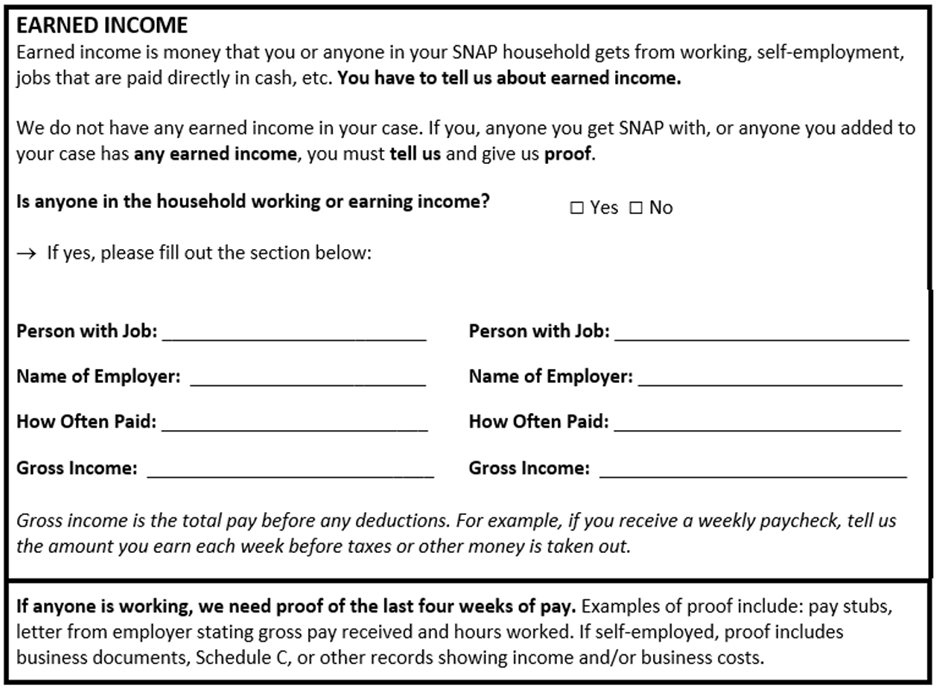
Clients who check Yes must fill out the information in the section below. If they do not, you must apply the procedures for Establishing Contact at IR When Information is Incomplete, Questionable, or Contradictory.
Note: For clients completing their IR on DTA Connect, any gross income amounts reported for a new earned income source will be found on the datasheet but will not prepopulate into BEACON.
If the client checks No, then:
- If there is no Work Number match (or the Work Number shows inactive employment or no wages in the last 30 days), no further action for earned income is required.
- If there is a Work Number match showing active employment and wages within the last 30 days, attempt to cold call the client two times.
- If both cold calls are unsuccessful, send a VC-1 for earned income.
- If one of the calls is successful, ask the client if the match information is accurate.
- If the client confirms the match information, disposition the match and mark earned income as Verified. Use the most recent wages in Work Number when processing the IR.
- If the client disputes the match information, send a VC-1 for earned income.
If the client checks Yes and provides the employment information, then:
- If the client submits verification of the earnings with the IR, mark earned income as Verified. Enter the gross wages on the verification into BEACON.
-
Note: If there is a Work Number match for the job that the client reported and already submitted verification for, you must disposition the match and use the wage verification that the client submitted with the IR.
-
- If the client does not submit verification of earnings with the IR and there is no Work Number Match (or the Work Number shows inactive employment or no wages in the last 30 days), send a VC-1 for earned income.
- If there is a Work Number match showing active employment and wages in the last 30 days for the job that the client reported on the IR, mark earned income as Verified. Use the most recent wages in Work Number when processing the IR. You do not have to send a VC-1 or cold call the client to confirm the information.
Important: Sometimes, the Work Number may show active employment and wages within last 30 days for an employer different from the one that the client reported at IR. Whenever this happens, you must cold call the client two times to confirm whether the information is accurate. If you are unable to reach the client, send a VC-1 for the employer on record and the matched employer. If the client confirms the information (e.g., they have a second job), you must use the most recent wages from this other employer when processing the IR. If the client disputes the information, you must send a VC-1 that includes a request for proof of earned income from the matched employer.
If the Work Number shows that the other job is inactive or displays no wages from the other job within the last 30 days, you must disregard the information and disposition the match.
Procedures for Addressing Cases with Earnings on File
If a client has earned income on file, the following question will appear on the IR form or as part of the DTA Connect IR workflow: Has this income changed, or do you expect this income to change?
To answer this question, the client must choose one of the following answers:
- This job has ended.
- If yes, when did this job end?
- This job will end.
- If yes, when will this job end?
- Still have this job, but pay has gone up or down.
- This income is expected to change before {30 days after certification midpoint}.
- This income is not expected to change. The amount shown is about what I earn now.
See the sample below:
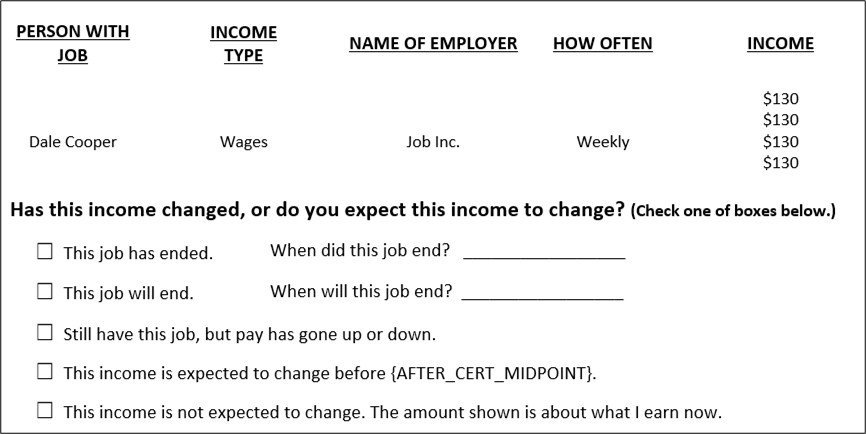
If the client does not answer any of these questions, you must follow the procedures for addressing incomplete information detailed in Establishing Contact at IR When Information is Incomplete, Questionable, or Contradictory.
Important: For IRs submitted via DTA Connect, it is crucial that you check the IR datasheet. This will tell you how the client responded to this question. This is how you will know which procedures to follow (detailed in the sections below).
Staff must be aware that all income information provided by the client appears on the datasheet; however, not all reported income information prepopulates into BEACON, such as the ending of a job, the date a job ended or the gross amounts of any new earned income reported.
Client Selects “This job has ended”
If the client indicates that their job ended, you must send a VC-1 for termination of employment if:
- the client does not provide verification of termination of employment with the IR; and
- there is no Work Number match for the employer, or the Work Number shows that the job is active with wages received in the last 30 days.
If there is a Work Number match showing that the employer on record is inactive or that no wages from that employer were received within the last 30 days, disposition the match and remove the employer from the BEACON record. Mark the termination of the employment as Verified. Do not send a VC-1.
If the client submits verification of job termination with the IR (e.g., a letter from the employer), mark termination of employment as Verified. Do not send a VC-1. Even if there is a Work Number match with conflicting information, i.e., active employment and wages within the last 30 days for the same employer, you must remove the job record because the verification that the client submitted with the IR supersedes the Work Number.
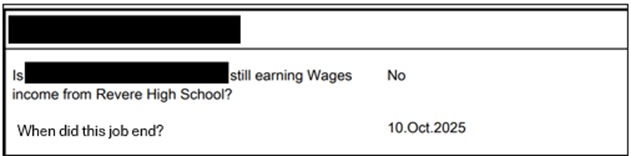
Below is a sample datasheet for when the client submits the IR via DTA Connect and reports that their job has ended:
Client Selects “This job will end”
If the client indicates that the job will end, they must provide an end date on the IR.
Job Will End Before or Within 30 Days After the Certification Midpoint
If the end date provided by the client is before or within 30 days after the certification midpoint, you need verification of termination of employment. You must send a VC-1 unless the client provided verification with the IR or Work Number displays “Inactive” for the job in question.
Reminder: The certification midpoint is first day of the sixth month of the certification period. It is the start date for which the IR is approved for. For example, if a client (whose SSN ends in 0) is certified from 12/01/2025 through 11/30/2026, their certification midpoint is 06/01/2025.
Job Will End More Than 30 Days After the Certification Midpoint
If the end date provided by the client is more than 30 days after the certification midpoint, then you do not have to update the employer on record at this time. However, if you happen to speak with the client, you must advise them that they may get higher benefits later on if they verify their termination of employment during case maintenance.
Note: In this scenario (i.e., client reports that their job will end more than 30 days after the certification midpoint), the employer on record may still appear in the Work Number. If the Work Number displays active employment and wages in the last 30 days for the employer on record, you must use the most recent wages in Work Number when processing the IR. Do not send a VC-1 or cold call the client.
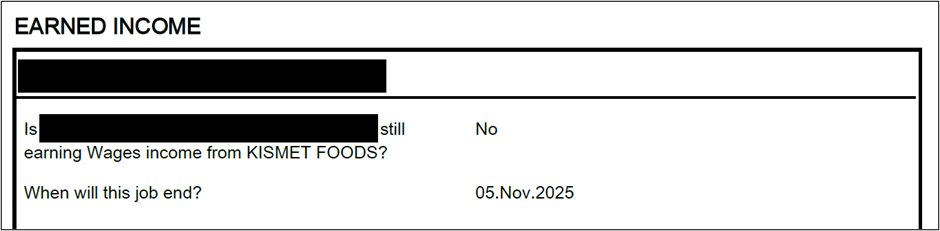
Below is a sample datasheet for when the client submits the IR via DTA Connect and reports that their job will end:
Client Selects “Still has this job, but pay has gone up or down”
If the client indicates that they still have this job but their pay has gone up or down, you must send a mandatory VC-1 for earned income if:
- the client does not provide verification of earned income with the IR; and
- there is no Work Number match.
If there is a Work Number match, you must:
- Check whether the Work Number information matches the employer on record and shows wages received within the last 30 days.
- If no, send a VC-1 for earned income.
- If yes, you must use the most recent wages in Work Number when processing the IR. Disposition the match and mark earned income as Verified. Record the earned income in BEACON. Do not send a VC-1.
If the client submits verification of the earned income with the IR, you must update the earnings using the verification that the client submitted. You must do this even if the Work Number displays different earned income amounts because the verification supersedes the Work Number.
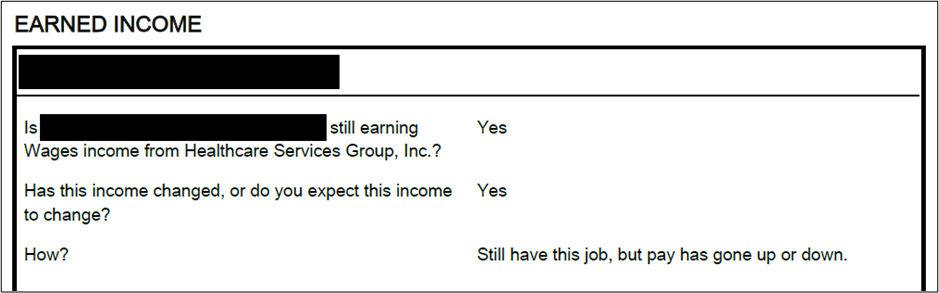
Below is a sample datasheet for when a client submits the IR via DTA Connect and reports that their pay has gone up or down:
Client Indicates that Income Will Change Before or Within 30 Days of Certification Midpoint
If the client indicates that their earnings are expected to change before or within 30 days after the certification midpoint (i.e., the first month of the last half of the certification period), you must count the client’s anticipated earnings from the new hours and/or rate. For SNAP purposes, the effective date of the change is the date the client receives a payment reflecting the change (see examples below).
For verification, the client can submit a letter from their employer confirming the expected change (e.g., new hourly rate and weekly hours, expected average gross wages).
To request this item, issue a User Entered VC-1 with a Verification Element of Additional Verification, enter “Anticipated Wages” under the Additional Verification Details, select Mandatory for the applicable Program(s), and add the following text in Document(s) of evidence “You told us that your pay from {JOB} will be changing. Please send us proof such as a letter from your boss telling us your new hourly rate and/or hours per week.”
Important: If you happen to be speaking with the client and they tell you that their earnings have not changed but are expected to change more than 30 days after the certification midpoint, they do not have to submit proof of earnings based on the anticipated changes.
However, you must advise them that they are required to report the change when it occurs if it results in their total monthly income exceeding their gross income limit. Additionally, they may report a decrease in income when it occurs, as it could cause their SNAP benefits to increase.
The earnings entered into BEACON in this instance must only include the anticipated earnings and not the client’s prior earnings, as this calculation is meant to project what the client will be receiving monthly for the next 6 months. Below are some examples:
Albert (he/him) submits his IR for November 2025. His SSN ends in “0.” The first cyclical month after the certification midpoint is 11/01/2025 through 11/30/2025. Albert is employed and earns $15 per hour. However, Albert indicates on the IR that he expects his wages to change beginning 11/10/2025. He submits a letter from his boss confirming that his weekly work hours will decrease from 40 hours per week to 30 hours per week beginning with his 11/10/2025 pay date. Staff must record the wages and only use pay associated with the 30 hours per week to calculate the Monthly prospective in BEACON:
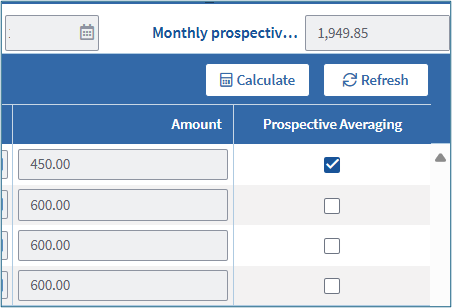
Note: When entering anticipated wages in the Earnings tab in the Earned Income page, BEACON will not have yet populated the row with the future pay period(s). In this case, you must enter the anticipated earnings (from the new hours and/or rate) in the latest pay period(s) available in the Earnings tab. You must also include in the narrative what pay was used to calculate the Monthly prospective and why.
Genevieve (she/her) submits her IR for September 2025. Her SSN ends in “9.” The first cyclical month after the certification midpoint is 09/14/2025 through 10/13/2025. Genevieve is employed but checks that she expects her wages to change within 30 days of the certification midpoint. Genevieve is paid weekly and submits a letter from her boss confirming that her hourly rate and weekly hours will change beginning with her shift on 10/08. However, Genevieve will not receive the first pay stub reflecting this change until 10/17. In this case, you must process the IR with the earnings that are already on record. For SNAP purposes, the effective date of the change is based on the date Genevieve receives a payment that includes the new hours and rate, which in this case is more than 30 days of the certification midpoint.
Below is a sample datasheet for when the client submits the IR via DTA Connect and reports that their income will change within 30 days of the certification midpoint:
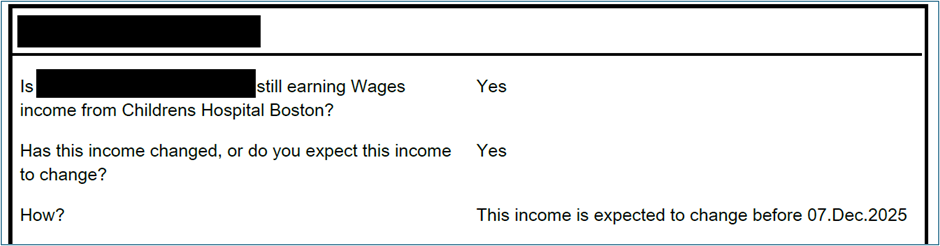
Client Selects “This income is not expected to change”
If the client indicates that their earnings are not expected to change and that the amount shown is about what they earn now, you must check whether the Work Number returned a match automatically.
If there is no Work Number match for that employer, process the case using the income that is in the case record and that the client indicated is not expected to change.
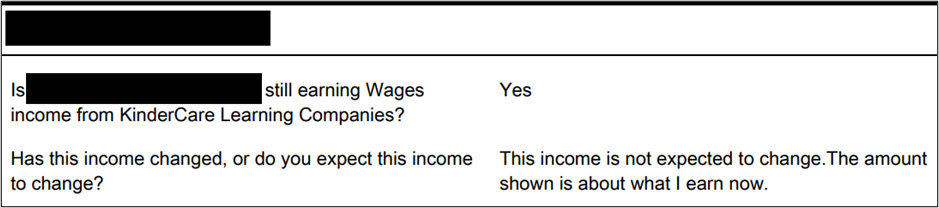
If there is a Work Number match for that employer, you must use the most recent wages in Work Number when processing the IR. You must disposition the match and mark earned income as Verified. Record the earned income in BEACON. Do not send a VC-1.
Below is a sample datasheet for when the client submits the IR via DTA Connect and reports that their pay is not expected to change:
Earned Income Summary Table
The table below summarizes the IR processing steps for households with earned income on record and verification is not submitted with the IR.
| Client Selection | Did the job appear on the Work Number? | What does the Work Number show? | When will the change occur? | Next Steps |
| This job has ended. | Yes | Work Number shows job as active with wages received in the last 30 days. | Before the certification midpoint | Send a VC-1 for termination of employment. |
| Yes | Work Number shows job inactive or no wages have been received in the last 30 days. | Before the certification midpoint | Mark termination of employment as Verified. Do not send a VC-1. | |
| No | N/A | Before the certification midpoint | Send VC-1 for termination of employment. | |
| This job will end. | Yes | Work Number displays active employment with wages within 30 days. | Before the certification midpoint or within 30 days after the certification midpoint. | Send a VC-1 for termination of employment. |
| Yes | Work Number displays inactive or no wages past 30 days. | Before the certification midpoint. | Mark termination of employment as Verified. Do not send a VC-1 | |
| No | N/A | Before or within 30 days 30 days after the certification midpoint. | Send a VC-1 for termination of employment. | |
| No | N/A | More than 30 days after the certification midpoint. | Continue counting the existing earnings on file or new earnings, if client provided with IR. | |
| Yes | Job will be ending but client is still working. Match displays active wages. | More than 30 days after the certification midpoint. | Enter the Work Number wages and mark earned income as Verified. | |
| Still have this job, but pay has gone up or down. | Yes | Work Number displays wages received within past 30 days. | Before certification midpoint. | Enter the Work Number wages and mark earned income as Verified. |
| Yes | Work Number displays wages received within past 30 days. | Before certification midpoint. | Send VC-1 for wages. | |
| No | N/A | Before certification midpoint. | Send VC-1 for wages. | |
| This income is not expected to change. | No | N/A | N/A | Process the case using the income that is in the case record and that the client indicated is not expected to change. |
| Yes | Work Number displays current wages over the past 30 days. | N/A |
Process the case using the most recent wages in Work Number. |
What Changes Do Not Need to be Reported During the Interim Report Process
- Housing expense changes (unless the household moved)
- Dependent care expense changes
- Medical expense changes (for guidance on handling these changes, see Medical Deduction During Review Periods)
Important: Unless the client indicates that one of the above-listed elements changed or the Department has information that is verified upon receipt, the information that was used in the previous calculation must continue to be used.
Processing Interim Reports with Changes
When you work on an IR with reported changes, you must only update the applicable pages. Since the case is active and at IR, certain program integrity checks have automatically been applied to the case (i.e., Work Number, UC, and SDX/Bendex). The two external data sources that are not automatically run are MobiusView and SAVE. At IR, you must only review data sources that are applicable to the case. For more information on which databases to review at application, see External Databases.
If a client reported a change to earned income, for example, only the earned income section must be updated; other pages must be left alone.
Best Practices for Staff to Address IRs Submitted Via DTA Connect
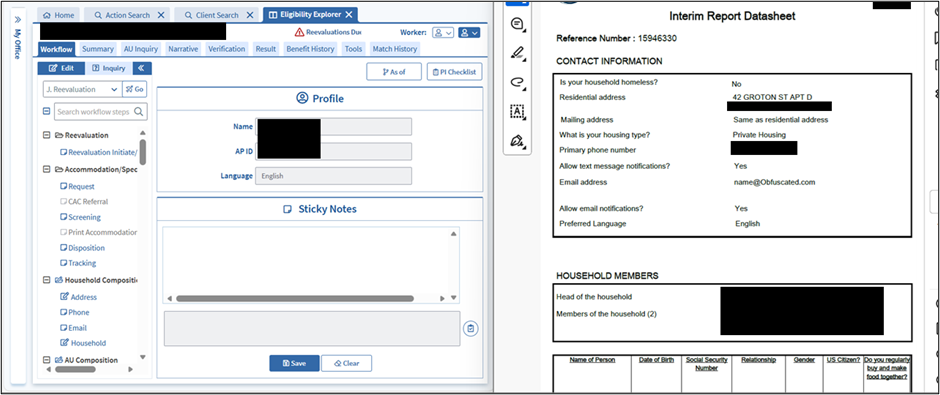
For IRs submitted via DTA Connect, a useful practice is to download the scanned IR form/datasheet from the Client Communications tab, and then tile it (or snap it to the side of your screen) so you have it side by side with BEACON. See the example below:
As you navigate the workflow, you may also get a pop-up message if the client ended a record (e.g., an earned income source) via their DTA Connect Interim Report:
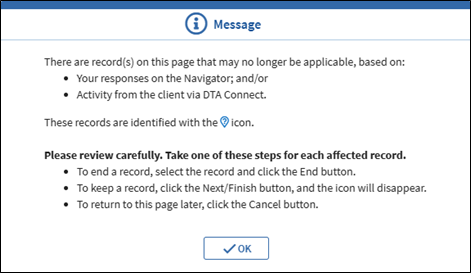
Reviewing the form/datasheet concurrently with BEACON (including pop-ups) helps ensure that you will not overlook items that are required to be addressed at IR.
Processing Interim Reports with No Reported Changes
You must authorize an IR when the client submits a complete Interim Report with no reported changes and no outstanding Program Integrity concerns. A “complete IR” means that the client:
- provided a signature,
- completed all sections where a response is required by providing the same information that is already on record, and
- left blank any sections that instruct the client to leave them blank unless reporting a change.
Regarding the paper IR form: If the sections that require a response are blank, the Interim Report is considered incomplete. Optional expense sections do not need to be completed or verified unless the client reports a change.
Reminder: The paper Interim Report form does not have checkboxes for the client to indicate “Change” or “No Change.” To determine whether anything has changed, you must carefully review each section of the form.
The IR Timeline for Warning and Closing Notices
If the Department does not receive the IR 20 days after it is sent, a Warning Notice will be issued explaining that the case is in danger of closing. The Warning Notice advises that the IR is due to DTA 10 days after the Warning Notice is mailed. If the Department does not receive the IR 10 days after the Warning Notice is sent, a separate notice will be issued explaining that the case will be closed on a future date because the IR was not returned. If the client does not follow up, the case will be closed automatically at the halfway point of the certification period.
Example of IR Not Received
Peter’s SSN ends in 0 and the halfway point of their certification period is June 30.
| Date | Timeline |
|---|---|
| May 15 | The IR is automatically mailed and is due back on June 5. |
| June 5 | The IR is not received by DTA. Peter is automatically sent the Warning Notice stating that they must submit the IR by June 15. |
| June 15 | The IR is not received by DTA. Peter is automatically sent the closing letter stating that their benefits will stop on June 30 because they did not submit the IR. |
| June 30 | The IR is not received. Peter’s case is automatically closed for Failure to Complete an Interim Report. |
If the Department does not receive mandatory verifications after receiving the IR, initiating it in BEACON and sending a VC-1, the client will be mailed a notice 30 days after the IR is sent explaining that the case will be closed because we did not get the verification(s) needed. If the client does not follow up, the case will be closed automatically at the halfway point of the certification period. It’s important to remember that the closing notice for missing verifications will not be generated unless:
- mandatory verifications are not verified on the BEACON Verifications tab 30 days after the IR was mailed, and.
- a VC-1 was issued within the first 30 days of the IR period.
The closing notice for missing verifications will not be generated if only optional verifications are missing.
Example of IR Received but With Verifications Missing
Kurt’s SSN ends in 0 and the halfway point of their certification period is June 30.
| Date | Timeline |
|---|---|
| May 15 | The IR is automatically mailed and is due back on June 5. |
| May 23 | The IR is received, but Kurt reports a change in earned and does not submit recent pay stubs. A VC-1 is sent for earned income. |
| June 15 | The pay stubs are not received. Kurt is automatically sent the closing letter stating that their benefits will stop on June 30 because they did not submit the required verifications. |
| June 30 | The pay stubs are not received. Kurt’s case is automatically closed in BEACON for Failure to compete Interim Report process. |
Interim Report Closing Reasons That Will Display in BEACON
If the case is not wrapped up by the BEACON release date and the IR form is not returned, the case will be closed for “Failure to Complete an Interim Report”.
If the case is not wrapped up by the BEACON release date and the client failed to provide missing mandatory verifications, the case will be closed for “Failure to complete Interim Report process”.
Establishing Contact at IR When Information is Incomplete, Questionable, or Contradictory
Once a signed IR form is received, it meets the minimum requirements for initiation and must not be dispositioned as Inadequate. Two cold calls must be attempted to discuss incomplete, questionable, or contradictory financial and nonfinancial household circumstances that impact eligibility.
Reminder: A “complete IR” means that the client provided a signature, completed all sections where a response is required by providing the same information that is already on record, and left blank any sections that instruct the client to leave them blank unless reporting a change.
If a paper IR form is unsigned or the sections that require a response are blank, the Interim Report is considered incomplete.
The cold call is used to clarify information, but does not necessarily mean an interview has been held or is needed. You must identify the reason for the cold call in the Phone page. If the client is reached, you must discuss the areas requiring clarification and send a VC-1 (if necessary) based on the conversation. Do not update the Interview page just because contact with the client is made.
- If the client verbally indicates that they do not have any changes to report, you must document this in the Narrative. You do not need to send a VC-1 or return the form to the client in this instance.
- If the client verbally indicates that they have changes involving verification items that can be verified with a telephonic self-declaration (such as rent or dependent care), you must ask the client to verify them via telephonic self-declaration. See Telephonic Signature for more information. If the client verbally indicates changes involving mandatory or optional items that cannot be verbally/telephonically self-declared, you must send a VC-1 for the changes reported.
Important: You must not conduct a complete case review simply because you have the client on the phone or in front of you at a TAO.
If the client cannot be reached, you must send a VC-1 for clarification of the section that is incomplete, questionable or contradictory. The following sections if left blank are not considered incomplete: Contract Information (which includes address, phone, shelter costs and utilities) and Household Members.
The VC-1 must request items that would otherwise be discussed. You must send the VC-1 locally with a printout of the Interim Report which clearly identifies the missing information that the client did not complete.
Use Additional Verification and copy the following language:
“We received your Interim Report, but it is missing information that we need to process your case. You may call us to let us know what your current circumstances are, you may complete the highlighted sections of this form, or you may submit verification of any changes.”
If any of the missing/contradictory sections involve mandatory elements, such as earned income, the Additional Verification must be coded as Mandatory.
If the only missing/contradictory sections are for optional verifications, such as a rent expense, the Additional Verification must be coded as Optional.
You must not attempt phone contact at IR if:
- no change is reported;
- the information reported is consistent with what is known to the Department; and
- the change reported is clear, but proof has not been provided. In this situation, a Verification Checklist (VC-1) must be sent if the change is not available to the Department though a trusted source, documentary evidence already in the case record, or self-declaration.
Verifications
If the client indicates that there have been no changes to income or expenses, additional verification is not required at IR. Income from a new source or a change in earned income or a change in unearned income of more than $125 per month must be verified. Expenses that have changed must be verified to be included in the calculation. Before you issue a VC-1, you must check whether the item requiring verification:
- is a permanent verification that was already provided;
- is available through a verified-upon-receipt source;
- can be verified by another scanned document in the Electronic Case Folder;
- if self-declaration is allowable, can be telephonically verified or was already self-declared on the IR or another piece of paper.
If you cannot verify an item(s) based on the information available, you must issue the client a VC-1. If you send a VC-1, you must ensure that the outstanding item(s) is listed on the Verification tab. Verified items must be marked by selecting the appropriate Documents of Evidence on the Verification tab. An item must not be marked as verified before the corresponding verification is received.
Action: DTA Connect – Reported Change
If a client uses the DTA Connect to report a change during their 45-day IR period, BEACON will create the Action: DTA Connect – Reported Change. When this occurs, BEACON will add a pencil to re-visit the page(s) pertinent to what the client reported on DTA Connect.
If you receive this Action, you must review the change(s). If the information from the client is not questionable, incomplete or contradictory; mark the item as verified and write a detailed narrative.
Note: If the pertinent item is not displayed on the Verification tab, it is likely because the client went back into DTA Connect and removed the item that they originally reported. If this occurs, just write a detailed narrative and disposition the Action. To find out what the client originally reported, open the Client Communication tab in BEACON and review the DTA Connect datasheet.
Otherwise, you must apply the following procedures if the:
Item has Questionable/Incomplete/Contradictory Information
If the item is questionable, incomplete or contradictory information (e.g., client reported new dependent care expenses but did not specify whether they are necessary for work, school, training, etc.), you must attempt to cold call the client two times. If one of the calls is successful, you must address this information with the client and determine at that time whether they qualify for the dependent care deduction.
If the call is unsuccessful, you must send a VC-1. Use Additional Verification to request information about the missing verification (e.g., dependent care, medical, etc.) and code it as Optional, and copy the following language:
“You submitted a change on DTA Connect, but we need more information to process this change. You may update the information on DTA Connect, call us at 877-382-2363 to discuss how you may verify this item, or you may submit verification of [MISSING VERIFICATION].”
After taking the appropriate steps, you must disposition the DTA Connect – Reported Change action using the normal Business Process procedures.
If a Client Reports Veteran’s Income on DTA Connect Interim Report
If a client uses DTA Connect to report VA income as new unearned income, the income will appear on the Other Income Status page as “Veterans’ Benefits” and cannot be edited.
To ensure the income is properly recorded, you must attempt to determine whether the VA income is VA State or VA Federal Service-Related. If no verification is available (or you cannot determine the VA income type from the verification that is available), you must cold call the client for clarification. For more information on recording VA income, see State Veterans’ Benefits and Federal Veterans’ Benefits.
If you do not have verification of the VA income, you must send a mandatory VC-1. However, you must not send a VC-1 solely to request proof of the VA income type. If you are unable to determine the type (after making the effort to do so) and you can otherwise process the case, you must process the IR with the income entered as “Veterans’ Benefits.” You must also write a narrative saying that staff must attempt to find out this income type at the client’s next review period.
When to Process an IR with Optional Verifications Outstanding
IRs must be processed without delay if:
- the only outstanding verification(s) is optional; and
- the case will not be denied or reduced to a $0 benefit level if the optional verification(s) is not credited.
If a VC-1 issued at IR is only for an optional verification(s), you must review what the household’s benefit level will be if the verification(s) is not credited. Complete the workflow without entering the unverified item(s) and wrap up the case. If not counting the item(s) results in a benefit level that is greater than zero, you must immediately process the IR. If the verification(s) is subsequently provided, a supplement may be owed.
If not counting the item(s) results in a $0 benefit level or the case being denied for over-income, the IR must not be processed at this time. Rather, you must follow these steps:
- remove the authorization to process the case
- create an Action to process the case on the BEACON Release Date that occurs right before the halfway point of the certification period
- for more information on creating an Action, see Creating Follow-up Actions
- for help on determining the correct BEACON Release Date, follow the steps in Release Date Rules
- if the optional verification(s) is received on or before the BEACON Release Date, enter the item(s) and approve the IR
- if verification is not received by the BEACON Release Date, process the case without entering the expense(s)
Optional Expense Reporting
Both the paper IR form and the DTA Connect IR workflow provide clients with the opportunity to report changes to shelter expenses, utility expenses, dependent care expenses, and/or medical expenses. If a client reports a change in any of these expenses, you must send a VC-1.
If a client does not report a change in expenses, the expenses that were used in the previous benefit calculation must continue to be used when processing the IR. Exception: If the client reports a change in residential address, they must verify shelter and utilities (whether or not either of these items have changed):
- If a client reports a change in residential address, you must attempt to cold call the client twice.
- If one of the calls is successful, review verification options with the client. If the client is not reasonably able to obtain documentary evidence of rent and utilities, you must accept their telephonic self-declaration.
- If both calls are unsuccessful or the client can get documentary evidence, send a VC-1 for rent and SUA.
- Zero out the current record for shelter and/or utility expenses.
Note: The online IR datasheet will display optional expense section(s) situational to a client’s reporting or non-reporting of any changes to optional expenses. For example, if a client did not move and did not report any changes to their existing shelter and utility costs, their IR datasheet will simply not display a shelter or utility cost section. The existing shelter and utility costs will remain in their case when processing the IR.
If a client reports a change in their optional expenses you must send the client a verification checklist for the reported change, unless the client indicates that they cannot verify the item via documentary evidence.
Important: If an online IR Datasheet shows that a client directly updated any pre-existing medical-related mileage or transportation record, you must review those changes and obtain any other necessary verification (e.g., new self-declaration of starting/destination addresses, number of trips) to correctly process their medical-related mileage or transportation costs at IR.
If both calls are unsuccessful, or the client had reported a change in an item for which verification is required, that cannot be verified by telephonic self-declaration, you must zero out the specific expense and send a VC-1 for the optional expense. If the client returns the verification, they may be entitled to a related benefit.
The BEACON Interim Report Process
Staff will receive Interim Reports through the Process Online Interim Report Action, the Process Scanned Interim Report Action, or the Reevaluations Due View.
The Reevaluation workflow is used to initiate, complete and submit an Interim Report.
You must start the Interim Report process in the following situations:
- The client is in-person within the 45-day period and able to complete the Interim Report workflow with a case manager.
- A signed form is returned to the Department. This will be assigned to FAW staff as a Process Scanned Interim Report Action. Economic Assistance case managers will see the form availability on the Reevaluations Due View.
- The Interim Report process is completed online (BEACON will initiate this automatically). This will be assigned to FAW staff as a Process Online Interim Report Action. Economic Assistance case managers will see the form availability on the Reevaluations Due View.
Starting the Interim Report Process
- enter the Reevaluation workflow
- go to the Reevaluation Initiate/Reinitiate page
- click the SNAP program on the page and select the case needing to be recertified
- if the case is not already initiated, click the Initiate check box
- click Save
- Go through the applicable steps related to cold calls (if applicable) and verification requests as outlined above. After all client-involved steps are completed, you will be able to submit the Interim Report.
- Make sure all required windows within the Reevaluation workflow have been reviewed and updated
- click Application/Reevaluation Print
- select Reevaluation from the drop-down box
- click Generate
- click Print. If an Interim Report form has already been received, the BEACON-generated form does not need to be signed.
- go to the Reevaluation Submit page
- click Submit (The reevaluation type and date will be prefilled by BEACON. The type or date may be changed, if necessary.)
- go to the Interview Wrapup page
- click Selection
- click the applicable checkboxes pertaining to the reevaluation
- click Finish
- click EBC Results
- click Calculate
- select the record in the page for the case being reevaluated on the Updates Tab. The Benefit Effective Date is automatically populated but can be changed if Proration is needed.
- click Save
- click Finish
- review the calculation
- write a detailed Narrative.
The client will be sent a notice showing the recalculated SNAP benefit or a closing notice if the household is no longer eligible for SNAP benefits.
Reinstating Untimely or Incomplete Interim Reports
BEACON will close a case if the IR process is not complete by the BEACON release date a few days prior to the end of the certification period. If a client submits an IR form after the BEACON release date, you must:
- reinstate case and enter Form Received date to initiate the IR. If the client comes to the TAO to complete the IR, you must print the BEACON-generated IR for the client to sign and enter the date of the in-office interview as the Form Received date
- click Save
- complete all required pages and follow procedures for Processing an Interim Report in BEACON
If verifications are received prior to closing, the Benefit Effective Date field will be blank on the Interview Wrap up page. Fault will not be determined because although late, the IR requirements were met by the closing date. Enter the client’s next cyclical issuance date (day after closing date) as the Benefit Effective Date and wrap up the case.
If verifications are received after the closing, the Benefit Effective Date field on the Interview Wrap up page will be set based on the BEACON fault reason. The Fault Reason and Classification will be displayed in Interview Wrap up. The Verification Received field will be enabled only for reinstatements of IRs closed for “Failure to complete Interim Report process”.
Extended Reinstatement Period
In limited and extenuating circumstances, a case can be reinstated up to 3 months after the recertification closing date if a scanned:
- IR form with a DTA Received date between the SNAP Notice sent date and the closing date is available to be processed; or
- verification with a DTA Received date between the SNAP Notice sent date and the closing date plus 30 days is available to be processed.
Denying a Reinstated IR
If a reinstated IR is not dispositioned by the 30th day following the closing date, BEACON will deny the reinstatement for “Failure to Complete Interim Report Process after Reinstatement” if the client fails to provide verifications.
The case will not be eligible to be reinstated again. The client must reapply through the normal application process.
Last Update: April 6, 2026