An official website of the Commonwealth of Massachusetts Here's how you knowHere's how you know

Unearned Income Overview
Types of Unearned Income
Any income that is not earned is unearned and is recorded on the Other income page on BEACON. This includes, but is not limited to, the following income types:
- Assistance Payments such as TAFDC, EAEDC, or other assistance programs based on need
- Pensions or retirement benefits (sometimes verifiable via SDX. An overnight request must be submitted through a SVES Request in BEACON.)
- Annuities
- Veterans’ benefits (federal veteran benefits are verifiable via SDX for clients who receive SSI. An overnight request must be submitted through a SVES Request in BEACON.)
- Disability benefits
- Workers' compensation (verifiable via SDX for clients who receive SSI. An overnight request must be submitted through a SVES Request in BEACON.)
- Unemployment Compensation (most UC types for Massachusetts is verifiable via Department of Unemployment Assistance data source)
- Social Security (RSDI) (verifiable via BENDEX. An overnight request must be submitted through a SVES Request in BEACON.)
- SSI (verifiable via SDX. An overnight request must be submitted through a SVES Request in BEACON.)
- Strikers’ benefits
- Foster care payments (must be verified only when the foster care child or adult is included in the SNAP household. If the head of household opts to exclude the foster care child or adult from the SNAP household, the foster care payments are non-countable)
- Child support payments made to the household through the Department of Revenue (verifiable via RAPID)
- Support and alimony payments made directly to the household from non-household members
- Support and alimony (i.e., DEFRA) payments of up to $50 per month received as a TAFDC-Related Benefit by a household with a TAFDC member
- Dividends, interest, royalties and other direct money payments that can be construed to be a gain or benefit
- Dividends from excluded trust funds, which the household has the option of either receiving as income or reinvesting in the trust, are to be considered income in the month they become available to the household, whether collected by the household
- or reinvested in the trust, unless otherwise exempt.
- Payments from government-sponsored programs such as the Agricultural Stabilization and Conservation Service Programs
- Rental income (Unless a household member actively engages in the management of the property an average of at least 20 hours per week). If so, the income is considered earned income. See Rental, Roomer, and Boarder Income SNAP.
- Trust funds: Money withdrawn from trust funds that are excluded from assets must be considered income in the month received unless otherwise exempt
- Deemed sponsor income for sponsored noncitizens for whom deeming is applicable. For households containing sponsored noncitizens, the income of the sponsor and the sponsor’s spouse, if living with the sponsor, must be deemed as unearned income to the household
Important: Staff must always use the electronic databases available as the primary source of verification for unearned income. These databases include DUA, External SSA Data Screen, SAVE, and RAPID. Clients must only be asked to provide verification of these income sources if there is discrepant information.
Managed Income (Protective Payments)
All or part of a Public Assistance (TAFDC or EAEDC) grant, which would normally be provided as money payment to the household, that is diverted to a third party(s) or to a protective payee for the purpose of managing a household’s expenses is counted as unearned income. However, payments by the Department that would not normally be provided in a money payment to the household and that are over and above normal public assistance grants are excluded as a vendor payment if they are made directly to a third party for a household expense. This rule applies even if the household has the option of receiving a direct cash payment.
Vendor Payments
Monies that are legally obligated and otherwise payable to the household, but which are diverted by the provider of the payment to a third party for household expenses, are counted as unearned income and not excluded as a vendor payment. The distinction is based on whether or not the person or organization making the payment on behalf of a household is using funds that otherwise are payable to the household. Funds include:
- wages earned by a household member and owed to the household
- a PA grant to which a household is legally entitled; and
- support or alimony payments in amounts that are legally obligated to a household member
Even if an employer, agency, or former spouse who owes these funds to a household diverts them to a third party to pay for a household expense, these payments are still counted as income to the household. However, if an employer, agency, former spouse or other person makes payments for household expenses to a third party from funds that are not legally obligated to the household the payments are considered vendor payments and excluded from income.
Examples of Countable and Non-countable Vendor Payments
- A friend or relative uses their own money to pay the household's rent directly to the landlord. This vendor payment shall be excluded.
- A household member earns wages. However, the wages are garnished or diverted by the employer and paid to a third party for a household expense, such as rent. This vendor payment is counted as income.
- An employer pays a household's rent directly to the landlord in addition to paying the household its regular wages the rent payment must be excluded from income. Similarly, if the employer provides housing to an employee in addition to wages, the value of the housing shall not be counted as income.
- A household receives court-ordered monthly support payments in the amount of $400. Later, $200 is diverted by the provider and paid directly to a creditor for a household expense. The payment is counted as income because the payment is taken from money that is owed to the household.
- A court awards support payments in the amount of $400 a month and in addition orders $200 to be paid directly to a bank for repayment of a loan. The $400 payment is counted as income and the $200 payment is excluded from income because it is not otherwise payable to the household. Support payments not required by a court order or other legally binding agreement (including payments in excess of the amount specified in a court order or written agreement) which are paid to a third party on the household's behalf shall be excluded from income.
Certain Recouped Monies
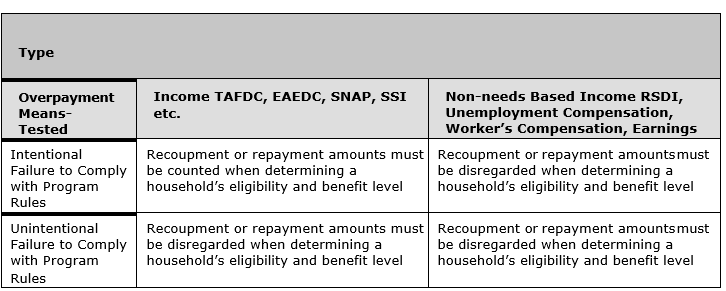
Monies withheld from a PA grant or repaid by the client to the PA program are considered countable unearned income if the following conditions apply:
- The monies are voluntarily or involuntarily withheld or returned to repay a prior overpayment that was caused by the household’s intentional failure to comply with the requirements of another federal or state means-tested program, and
- The overpayment is not considered excluded income.
Federal or state means tested programs include but are not limited to TAFDC, EAEDC, SNAP or SSI. Otherwise, recouped monies are not counted in determining income for SNAP purposes.
Examples of Countable and Noncountable Recoupments
- Mrs. Smith (she/her), a TAFDC/SNAP client, was found guilty of committing an Intentional Program Violation in the TAFDC program. Her grant after the disqualification penalty is $579.00 per month. However, $57.90 per month is being deducted from her grant for recovery of the overpayment, leaving her with a net grant of $521.10. Her countable income for SNAP purposes is $579.00.
- Mrs. Smith’s (she/her) normal social security retirement check of $900.00 per month is reduced to $750.00 to repay a over-issuance caused by the Social Security office. Her countable income for SNAP is $750.00.
The following Chart identifies the correct treatment of the repayment amount based on the type of: (1) overpayment and (2) income source.
Related Topics
Other Income Policy and Procedures – SNAP
Last Update: September 15, 2026
|
|
|
||
| Digital Accessibility Statement | Privacy Policy | Site Policies | Public Records Requests |
|
© 2026 Commonwealth of Massachusetts. Mass.gov is a registered service mark of the Commonwealth of Massachusetts. |
|||