An official website of the Commonwealth of Massachusetts Here's how you knowHere's how you know

Rights and Responsibilities
The language below constitutes the Rights and Responsibilities which will be used for all DTA programs.
Department of Transitional Assistance (DTA) Notice of Rights, Responsibilities and Penalties
- This notice lists rights and responsibilities for all DTA programs. You must follow the rules for programs you apply for.
- Please read these pages and keep them for your records.
- Let DTA know if you have any questions.
I swear under penalty of perjury that:
- I have read the information in this form, or someone read it to me.
- My answers in this form are true and complete to the best of my knowledge.
- I will give DTA information that is true and complete to the best of my knowledge during my interview and in the future.
I understand that:
- giving false or misleading information is fraud,
- misrepresenting or withholding facts to get DTA benefits is fraud,
- fraud is considered an Intentional Program Violation (IPV), and
- if DTA thinks I committed fraud, DTA can pursue civil and criminal penalties against me.
I also understand that:
- DTA will verify the information I give with my application. If any information is false, DTA may deny my benefits.
- I may also be subject to criminal prosecution for providing false information.
- If DTA gets information from a reliable source about a change in my household, my benefit amount may change.
- By signing this form, I give DTA permission to verify my eligibility for benefits, including:
- Get information from other state or federal agencies, local housing authorities, out-of-state welfare departments, financial institutions, and Equifax Workforce Solutions (the Work Number). I also give these agencies permission to share information about my household’s eligibility for benefits with DTA.
- If DTA uses information from Equifax about my household earned income, I have the right to a free copy of my Equifax report if I request it within 60 days of DTA’s decision. I have the right to question the information in the report. I may contact Equifax at: Equifax Workforce Solutions, 11432 Lackland Road, St. Louis, MO 63146, 1-800-996-7566 (toll free).
- I have a right to a copy of my application, including the information that DTA uses to decide about my household’s eligibility and benefit amount. I can ask DTA for an electronic copy of the completed application.
How Will DTA Use My Information?
By signing below, I give DTA permission to get information from and share information about me and members of my household with:
- Banks, schools, government, employers, landlords, utility companies and other agencies to check if I am eligible for benefits.
- Electric, gas and telephone companies so I can get utility discounts. The companies cannot share my information or use it for any other purpose.
- The Department of Housing and Community Development to enroll me in the Heat & Eat Program. This program helps people get the most SNAP benefits possible.
- The Department of Early and Secondary Education so my children can get free school meals.
- The Woman, Infants and Children (WIC) Program so that any children under age 5 or a pregnant woman in my household can get WIC.
- The United States Citizenship and Immigration Services (USCIS), to verify my immigration status. Information from USCIS may affect my household’s eligibility and amount of DTA benefits.
Note: Even if you are not eligible for benefits due to immigration status, DTA will not report you to immigration authorities unless you show DTA a final order of deportation.
- The Department of Revenue (DOR) to verify my eligibility for income-based tax credits, such as Earned Income and Limited Income, and to see if I am eligible for “No Tax Status” or hardship status.
- The Department of Children and Families (DCF) to coordinate services offered jointly by DTA and DCF.
How Does DTA Use Social Security Numbers (SSNs)?
DTA is allowed to ask for SSNs under The Food and Nutrition Act of 2008 (7 U.S.C. 2011-2036) for SNAP and under M.G.L. c. 18 Section 33 for TAFDC and EAEDC. DTA uses SSNs to:
- Check the identity and eligibility of each household member I apply for through data matching programs.
- Monitor compliance with program rules.
- Collect money if DTA claims I got benefits that I was not eligible for.
- Help law enforcement agencies catch people hiding from the law.
I understand that I do not have to give DTA the SSN of any non-citizen in my household, including myself, who does not want benefits. The income of a non-citizen may count even if the non-citizen does not get benefits.
Right to an Interpreter
I understand that:
- I have a right to a free professional interpreter provided by DTA if I prefer to communicate in a language other than English.
- If I have a DTA hearing, I can ask DTA to give me a free professional interpreter, or if I prefer, I can bring someone to interpret for me. If I need DTA to give me an interpreter for a hearing, I must call the Division of Hearings at least one week before the hearing date.
Right to Register to Vote
I understand that:
- I have the right to register to vote through DTA.
- DTA will help me fill out the voter registration application form if I want help.
- I can fill out the voter registration application form in private.
- Applying to register or declining to register to vote will not affect my DTA benefits.
Employment Opportunities
I agree that DTA may share my name and contact information with employment and training providers, including:
- SNAP Path Work providers or DTA specialists for SNAP clients; and
- Contracted Employment and Training providers or Full Engagement Workers for TAFDC clients.
SNAP clients may voluntarily participate in education and employment training services through the SNAP Path to Work program.
Citizenship Status
I swear that all members of my household applying for DTA benefits are either U.S. citizens, or lawfully residing noncitizens.
Supplemental Nutrition Assistance Program
I understand that:
- DTA manages the SNAP program in Massachusetts.
- When I file an application with DTA (by phone, online, in person, or by mail or fax), DTA has 30 days from the date it got my application to decide if I am eligible.
- If I am eligible for expedited (emergency) SNAP, DTA has to give me SNAP and make sure I have an Electronic Benefit Transfer (EBT) card within 7 days from the date they got my application.
- I have a right to speak to a DTA supervisor if:
- DTA says I am not eligible for emergency SNAP benefits, and I disagree.
- I am eligible for emergency SNAP benefits, but do not get my benefits by the 7th day after I applied for SNAP.
- I am eligible for emergency SNAP benefits but do not get my EBT card by the 7th day after I applied for SNAP.
- When I get SNAP, I have to meet certain rules. When I am approved for SNAP, DTA will give me a copy of the “Your Right to Know” brochure and the SNAP Program brochure. I will read the brochures or have someone read them to me. If I have any questions or need help reading or understanding this information, I can call DTA at 1-877-382-2363.
Telling DTA about changes in my household:
- If I am a SNAP Simplified Reporting household, I do not have to report most changes to DTA until the Interim Report or Recertification is due. The only things I have to report sooner are:
- If my household’s income goes over the gross income threshold (listed on my approval notice).
- I have to report this by the 10th day of the month after the month my income went over the threshold.
- If I have to meet the Able-Bodied Adults Without Dependents (ABAWD) Work Rules and my work hours drop below 20 hours per week.
- If my household’s income goes over the gross income threshold (listed on my approval notice).
- If everyone in my household is 60 or older, disabled, or under 18 years old, and no one has earnings from work, the only things I have to report are:
- If someone starts working, or
- Someone joins or leaves my household.
- I have to report these changes by the 10th day of the month after the month of the change.
- If I get SNAP through Transitional Benefits Alternative (TBA) because my TAFDC stopped, I do not have to report any changes to DTA for the 5 months that I get TBA.
- If I get SNAP through Bay State CAP, I do not have to report any changes to DTA.
If I and everyone in my household gets cash assistance (TAFDC or EAEDC), I must report certain changes to DTA within 10 days of the change. See When do I need to tell DTA about changes in my household? under Transitional Aid to Families with Dependent Children (TAFDC) and Emergency Aid to the Elderly, Disabled, and Children (EAEDC) below.
- I may get more SNAP benefits if I report and give DTA proofs for the following, at any time:
- Child or other dependent care costs, shelter costs, and/or utility costs;
- Child support that I (or someone in my household) is legally required to pay to a non-household member; and
- Medical costs for members of my household, including myself, who are 60 or older or disabled.
Work rules for SNAP clients: If you get SNAP benefits and are between the ages of 16 and 59 you may need to meet general SNAP work rules or the ABAWD work rules unless you are exempt. DTA will tell me and members of my household if we need to meet any Work Rules, what the exemptions are, and what will happen if we do not meet the rules.
If you are under the SNAP Work Rules:
- You must register for work at application and when you recertify for SNAP. You register when you sign the SNAP application or recertification form.
- You must give DTA information about your employment status when DTA asks.
- You must report to an employer if referred by DTA.
- You must accept a job offer (unless you have a good reason not to).
- You must not quit a job of more than 30 hours a week without a good reason.
- You must not cut your work hours to less than 30 hours a week without a good reason.
SNAP Rules
- Do not give false information or hide information to get SNAP benefits.
- Do not trade or sell SNAP benefits.
- Do not alter EBT cards to get SNAP benefits you are not eligible for.
- Do not use SNAP benefits to buy ineligible items, such as alcoholic drinks and tobacco.
- Do not use someone else’s SNAP benefits or EBT card unless you are an authorized representative, or the recipient has given you permission to use their card on their behalf.
SNAP Penalty Warnings
I understand that if I or any member of my SNAP household intentionally breaks any of the rules listed above, that person will not be eligible for SNAP for one year after the first violation, two years after the second violation and forever after the third violation. That person may also be fined up to $250,000, imprisoned up to 20 years, or both. They may also be subject to prosecution under Federal and State laws.
I also understand the following penalties. If I or a member of my SNAP household:
- Commit a cash program Intentional Program Violation (IPV) they will be ineligible for SNAP for the same period they are ineligible for cash assistance.
- Make a fraudulent statement about their identity or residency to get multiple SNAP benefits at the same time they will be ineligible for SNAP for ten years.
- Trade (buy or sell) SNAP benefits for a controlled substance/illegal drug(s), they will be ineligible for SNAP for two years for the first finding, and forever for the second finding.
- Trade (buy or sell) SNAP benefits for firearms, ammunition or explosives, they will be ineligible for SNAP forever.
- Make an offer to sell SNAP benefits or an EBT card online or in person the State may pursue an IPV against them.
- Pay for food purchased on credit they will be ineligible for SNAP.
- Buy products with SNAP benefits with the intent to discard the contents and return containers for cash they will be ineligible for SNAP.
- Flee to avoid prosecution, custody or confinement after conviction for a felony they will be ineligible for SNAP.
- Violate probation or parole, where law enforcement is actively seeking to arrest them they will be ineligible for SNAP.
Anyone who became a convicted felon after February 7, 2014 is ineligible for SNAP benefits if they are a fleeing felon or are violating probation or parole - in accordance with 7 CFR 273.11(n) - and were convicted as an adult of:
- Aggravated sexual abuse under section 2241 of title 18, U.S.C.;
- Murder under section 1111 of title 18, U.S.C.;
- Any offense under chapter 110 of title 18, U.S.C.;
- A Federal or State offense involving sexual assault, as defined in section 40002(a) of the 1994 VAWA (42 U.S.C. 13925a); or
- An offense under State law determined by the Attorney General to be substantially similar to an offense described in this list.
Nondiscrimination Statement
In accordance with federal civil rights law and U.S. Department of Agriculture (USDA) civil rights regulations and policies, this institution is prohibited from discriminating on the basis of race, color, national origin, sex (including gender identity and sexual orientation), religious creed, disability, age, political beliefs, or reprisal or retaliation for prior civil rights activity.
Program information may be made available in languages other than English. Persons with disabilities who require alternative means of communication to obtain program information (e.g., Braille, large print, audiotape, American Sign Language), should contact the agency (state or local) where they applied for benefits. Individuals who are deaf, hard of hearing or have speech disabilities may contact USDA through the Federal Relay Service at (800) 877-8339.
To file a program discrimination complaint, a Complainant should complete a Form AD-3027, USDA Program Discrimination Complaint Form which can be obtained online at: https://www.usda.gov/sites/default/files/documents/ad-3027.pdf, from any USDA office, by calling (833) 620-1071, or by writing a letter addressed to USDA. The letter must contain the complainant’s name, address, telephone number, and a written description of the alleged discriminatory action in sufficient detail to inform the Assistant Secretary for Civil Rights (ASCR) about the nature and date of an alleged civil rights violation. The completed AD-3027 form or letter must be submitted to:
- mail:
Food and Nutrition Service, USDA
1320 Braddock Place, Room 334
Alexandria, VA 22314; or
- fax:
(833) 256-1665 or (202) 690-7442; or
- email:
FNSCIVILRIGHTSCOMPLAINTS@usda.gov
This institution is an equal opportunity provider.
Transitional Aid to Families with Dependent Children (TAFDC) and Emergency Aid to the Elderly, Disabled, and Children (EAEDC)
TAFDC and EAEDC are cash assistance programs. To learn more and to apply, visit DTAConnect.com or call your local DTA office. This information only applies to households who are applying for or get TAFDC or EAEDC.
When do I need to tell DTA about changes in my household?
I must tell DTA about changes that could affect my TAFDC or EAEDC (cash benefits) within 10 days, except that I do not have to tell DTA about a change in my earnings of less than $100 per month. This includes changes in my income, address, who I live with, family size, work, and health insurance.
How do I get health insurance?
- If I get TAFDC or EAEDC, I will get MassHealth too.
- If I am denied TAFDC or EAEDC, MassHealth will use my information to see if I am eligible for health insurance.
- If my EAEDC stops, I need to apply for MassHealth separately. To ask for an application call 1-800-841-2900.
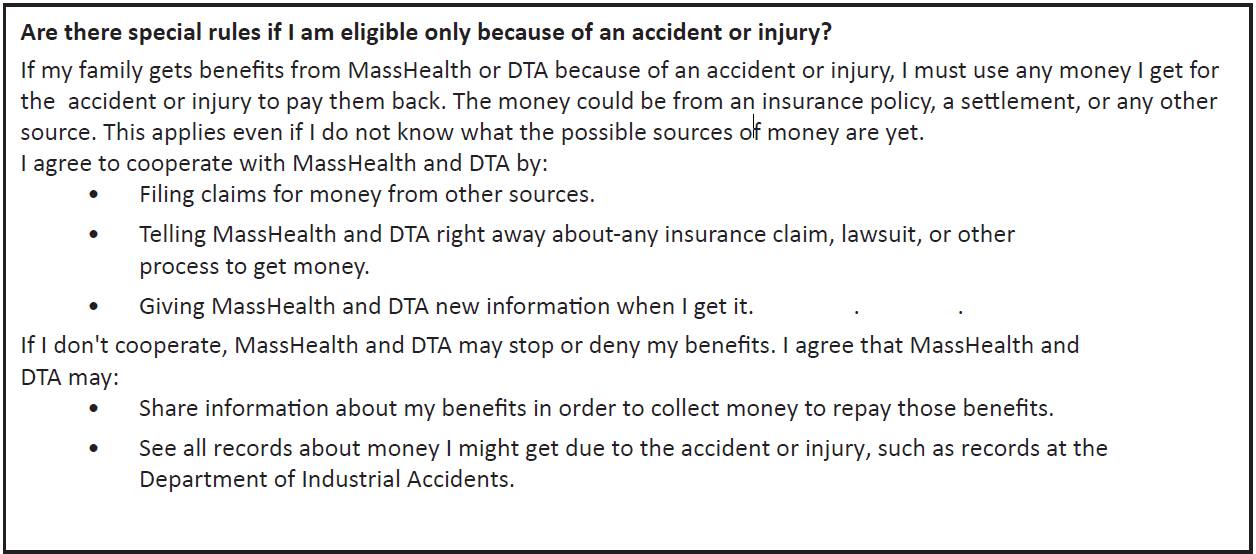
If I get MassHealth, I agree that MassHealth may collect:
- money owed to me from another source for my medical care, and
- medical support from the absent parent of any child under age 19 who gets MassHealth benefits.
If I am getting EAEDC because I have a disability or I am over 65 years old, I have to apply for federal Supplemental Security Income (SSI) benefits.
If I am approved for SSI benefits that cover the same time that I got EAEDC, the Social Security Administration will send some of my retroactive SSI to DTA to repay the EAEDC.
Important Notice About the Law and Your Benefits
An Intentional Program Violation (IPV) is intentionally giving a false or misleading statement or misrepresenting, hiding, or withholding facts, either orally or in writing, in order to establish or maintain eligibility for TAFDC or EAEDC benefits, or to gain benefits to which I am not entitled. If I am found guilty of an IPV by a court of law, an administrative disqualification hearing, or by signing a waiver, I will be disqualified from receiving TAFDC or EAEDC benefits for a period of:
- 6 months for the first violation
- 12 months for the second violation
- forever for the third violation
In addition, other laws may apply.
Prohibitions on EBT Card Purchases
I understand it is illegal to use TAFDC or EAEDC funds held on an electronic benefit transfer (EBT) card to pay for the following: alcoholic beverages; tobacco products; lottery tickets; adult oriented material or performances; gambling; firearms and ammunition; vacation services; tattoos; body piercings; jewelry; televisions; stereos; video games or consoles at rent-to-own stores; recreational marijuana; court-ordered fees; fines; bail or bail bonds.
Prohibitions on Where I May Use My EBT Card
I understand it is illegal to use my electronic benefit transfer (EBT) card at the following locations: adult bookstores; adult paraphernalia stores or adult oriented performance establishments; ammunitions dealers; casinos; gambling casinos or gaming establishments; cruise ships; firearms dealers; jewelry stores; liquor stores; manicure shops or aesthetic shops; cash transmittal agencies to foreign countries; recreational marijuana stores or tattoo parlors.
Penalties for Prohibited EBT Card Cash Purchases
- First Offense: I must pay back DTA the amount spent.
- Second Offense: I must pay back DTA the amount spent and will lose cash benefits for two months.
- Third Offense: must pay back DTA the amount spent and will lose cash benefits permanently.
Last Update: July 22, 2021
|
|
|
||
| Digital Accessibility Statement | Privacy Policy | Site Policies | Public Records Requests |
|
© 2026 Commonwealth of Massachusetts. Mass.gov is a registered service mark of the Commonwealth of Massachusetts. |
|||