An official website of the Commonwealth of Massachusetts Here's how you knowHere's how you know

The Out of State EBT Card Usage Match
Overview
The Out Of State EBT Card Usage Match is used to inform DTA about clients who have continuously and exclusively used their EBT cards in another state. DTA utilizes this match because continuous EBT usage in another state may indicate that the client is no longer residing in Massachusetts. Massachusetts residency is an eligibility requirement for all DTA programs.
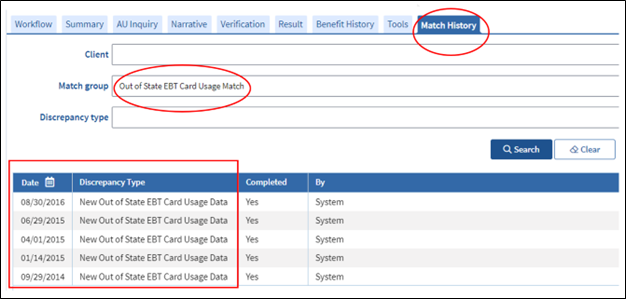
You can access this match in BEACON by clicking “Match History” and selecting “Out of State EBT Card Usage Match” in the Match group dropdown. You can review the details of each match by clicking “New Out of State EBT Card Usage Data” under the Discrepancy Type category. See below: view/hideview/hide
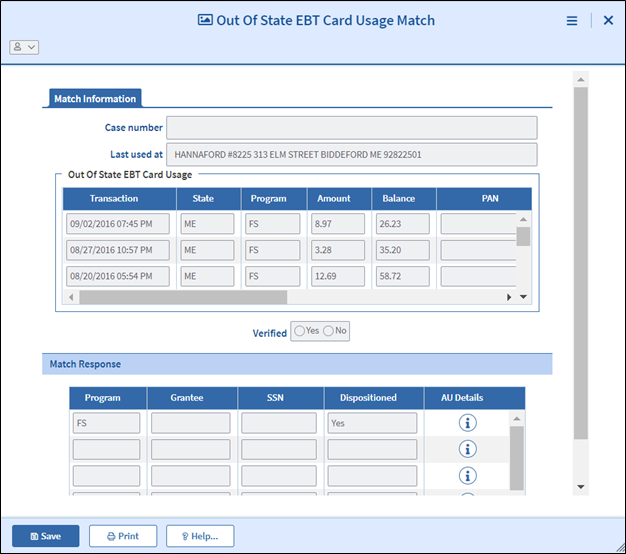
The screenshot below displays the page that opens if you make a New Out of State EBT Card Usage Data selection. This page displays the match details, including each transaction date, state, retailer, and amount: view/hideview/hide
For monitoring purposes, BEACON classifies EBT usage locations into three regions as follows:
- In-State – Massachusetts
- In-Region – Vermont, Rhode Island, New Hampshire, Connecticut, Maine, and New York
- Out-of-Region – All the remaining states
Match Procedures for TAFDC, EAEDC, and Combo Cases
EAEDC, TAFDC, or combo (EAEDC/TAFDC and SNAP) households will appear on the Out Of State EBT Card Usage Match if they use their EBT cards outside of Massachusetts exclusively for a period of 45 days or longer.
If the out-of-state transactions are In Region, a data match specialist from the Program Integrity (PI) Unit will review the details of the card usage on the match view. If the data match specialist determines that the client’s EBT usage patterns are consistent with those of clients who reside near the Massachusetts border, the data match specialist will disposition the match. If the data match specialist determines that the client’s residency is questionable, they will send the client a Residency Verification Notice: view/hideview/hide
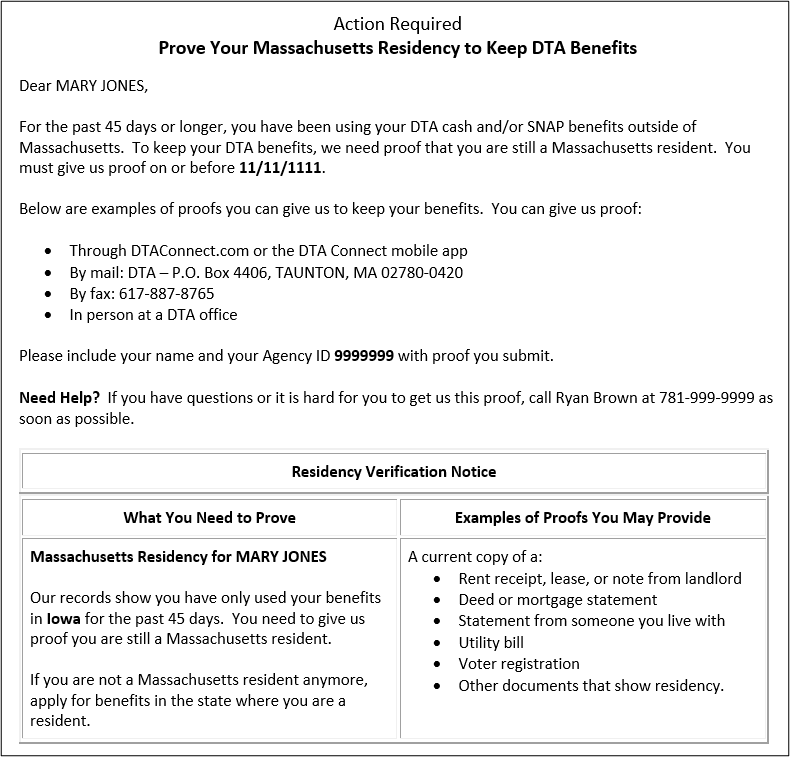
Note: If a household is coded in BEACON as homeless, the Residency Verification Notice will include additional language to accommodate homeless clients who have more difficulty obtaining verification of residency: “If you are a Massachusetts resident and do not have other proofs, you can send us a written statement about your residency.”
For example, if an individual who is homeless lives in Massachusetts but has no fixed address, income, or expenses, they may have trouble providing documentary evidence or collateral contact of residency. They can provide a written and signed self-declaration of residency.
If the out-of-state transactions are Out of Region, BEACON will send the Residency Verification Notice automatically.
When a Residency Verification Notice is sent (automatically by BEACON or manually by staff), BEACON will add the following element to the Verification tab: Questionable Massachusetts Residency. BEACON will display the proper due date for the residency verification on this tab.
TAFDC, EAEDC, or combo clients who are sent a Residency Verification Notice will be asked to provide verification within 10 days from the date the notice is sent.
If the client verifies residency, the match must be dispositioned, the Verification tab updated and a narrative must be written indicating that residency was verified.
If the client does not verify Massachusetts residency during the verification timeframe, BEACON will automatically close the case (25 days after the match appeared) for “Fail to submit required verifications.” The match will not be dispositioned so that future case managers will know to address this information if the client attempts to reopen their case.
For NPA SNAP cases with an associated TAFDC or EAEDC case, if the Out Of State EBT Card Usage match appears during the NPA SNAP client’s 45-day Interim Report (IR) period and the client fails to resolve the match, both the SNAP and TAFDC/EAEDC case will be closed for missing verification. This will occur even though the IR only pertains to SNAP.
Important: If a TAFDC or EAEDC client reports to a TAFDC or EAEDC case manager that they are or planning to be temporarily absent from Massachusetts, the Temporary Absence page must be updated. If a valid, current reason has been entered in the Temporary Absence page, the TAFDC or EAEDC client will not appear on the Out of State EBT Card Usage Match.
For more information, see Temporary Absence from MA – TAFDC, and/or Temporary Absence from MA – EAEDC.
Match Procedures for SNAP-only Cases
SNAP-only households whose certification type is Simplified Reporting, Simplified Reporting – 12 Months, EDSAP Reporting, or Simplified Reporting (Former EDSAP), will appear on the Out of State EBT Card Usage Match if they have exclusively used their SNAP benefits in an:
- In-region state for at least 75 days; or
- Out-of-region state for at least 75 days, and are within their 45-day recertification or IR periods.
Requesting Verification for In-Region Cases
If a SNAP-only household appears on the Out Of State EBT Card Usage Match for In-Region transactions, a data match specialist from the PI unit will review the details of the card usage on their match view. If the data match specialist determines that the client’s EBT usage patterns are consistent with the shopping patterns of clients who reside near the Massachusetts border, the data match specialist will disposition the match. If the data match specialist determines that the client’s residency is questionable, they will send the client a Residency Verification Notice. For Simplified Reporting cases, PI unit staff will only be able to send the Residency Verification Notice during the household’s 45-day IR or recertification period.
Requesting Verification for Out-of-Region Cases
If a SNAP-only household is within their 45-day reporting period (recertification or IR) and they appear on the Out Of State EBT Card Usage Match for Out-of-Region transactions, BEACON will automatically send them the Residency Verification Notice.
Residency Verification Due Dates
SNAP-only clients who are sent a Residency Verification Notice during their recertification or IR period will be asked to provide verification by the end of the 45-day reporting period. However, if the end of the 45-day reporting period is less than 10 days away from the date the Residency Verification Notice is sent, the due date on the Residency Verification Notice will be 10 days from the date the notice is sent.
When a Residency Verification Notice is sent automatically by BEACON or manually by staff, the following element will appear on the Verification tab: Questionable Massachusetts Residency. On this tab, BEACON will display the proper due date for the residency verification.
Residency Verification Must Be Current
All documentary evidence of residency must be current. “Current” is defined relative to the type of verification that a matched client chooses to submit. Generally, for bills, “current” is based on the billing cycle, which can vary by expense type. For lease agreements, “current” refers to the duration of the agreement. Signed confirmation letters from landlords, shelters, or housing providers must be dated within the last 60 days.
The table below provides some examples:
| Document Type | Considered “Current” If... |
|---|---|
| Utility Bill | Dated within the last 60 days |
| Lease Agreement | Shows active term for the client’s current address; e.g., to verify address, a client submits a lease which does not expire for at least another 6 months. |
| Rent Receipt | Dated within the last 60 days |
| Property Tax Bill | Dated for the most recent quarter, half-year, or year; depending on the billing cycle |
| Letter from the Head of Household (if the client is in a shared living situation) | Dated within the last 60 days |
Case Closures for Missing Residency Verification
If a SNAP-only client does not resolve the Out Of State EBT Card Usage Match during the 45-day recertification or IR period, you must not certify the case past the end of the reporting period. BEACON will automatically close the case following the regular recertification/IR closing procedures.
If a SNAP-only client does not resolve the Out Of State EBT Card Usage Match by a Residency Verification Notice due date that happens to fall outside of the 45-day reporting period, BEACON will automatically close the case for “Fail to submit the required verification” and the closure will take effect the next month.
Note: If the Out Of State EBT Card Usage Match appears for in-region usage while there is a pending release to approve a recertification or IR, PI will review the match to determine next steps consistent with policy and procedure (e.g., asking for verification if the client’s location is questionable, dispositioning the match if the transactions are consistent with residing on the Massachusetts border, etc.).
If the pending approval for a recertification or IR releases before PI staff can review the match and/or send a Residency Verification Notice, PI will disposition the match and write a narrative that this information must be addressed at the next reporting period.
Safeguards
Auto-Dispositioning of Match When In-state Usage Resumes
If a client appears on the Out Of State EBT Card Usage Match but subsequently uses their EBT card in Massachusetts while the match is outstanding, BEACON will automatically disposition the match.
This will be displayed in the match details as Completed - Yes, By – System. A batch will also mark Questionable Massachusetts Residency in the Verification tab as verified. If this occurs, the client is not required to submit additional residency verification.
Removal of Pending Closure When In-state Usage Resumes
If a case is pending to close due to the client not resolving the Out Of State EBT Card Usage Match but the client makes an in-state transaction before the pending closure releases, BEACON will automatically remove the pending closure, disposition the match, and enter a batch narrative.
Available Verification in Scanned Document History
During case maintenance, if a matched client was sent a Residency Verification Notice, BEACON will not automatically close the case if there are available documents in the Scanned Document History under the client’s name, provided that these documents were received on or after the date that the Residency Verification Notice was generated.
If staff subsequently disposition these documents without dispositioning the match, BEACON will initiate the closure for “Fail to submit the required verification” the following day.
Staff Reminders
Whenever the Residency Verification Notice is sent, BEACON will enter the following batch narrative: “Residency Verification notice is sent as a result of continued out-of-state EBT usage.”
Additionally, any outstanding Out Of State EBT Card Usage Match will appear on the PI Checklist. For more information, see Matches – Program Integrity (PI) Checklist — Overview..
FAW/Case Manager Responsibilities
Handling Verification
If you receive residency verification that the client submitted in response to the Residency Verification Notice, you must review the residency verification to determine whether it is sufficient.
If the verification is sufficient (e.g., a current utility bill displaying the client’s name and Massachusetts address), you must disposition the Out Of State EBT Card Usage Match. If the case is already closing due to the match and the residency verification provided by the client is sufficient, you must remove the pending closure.
If the case has already closed, you must reinstate the case if the verification is provided within 30 days of the closing date (and the household is otherwise eligible for reinstatement). If the cause of the delay is attributed to the household, SNAP benefits must be prorated from the date the household provides the self-declaration.
Reminder: If you receive an Action to review a document that includes the client’s address (e.g., a utility bill), do not automatically assume that the verification was for SUA or other similar purposes. Instead, you must enter the client’s ECF to check whether the client has an outstanding Out Of Statetate EBT Card Usage Match because that verification may be related to that match.
If the verification is insufficient (e.g., a utility bill from two years ago), do not disposition the match. You must document the insufficient verification in the narratives and mark the document as Not Entered. You must also attempt to cold call the client two times to inform them that the verification is insufficient and to go over acceptable verification options (e.g., current lease agreement, last month’s bill). If you do not connect with the client, leave a message advising the client that the verification submitted is insufficient. You must also tell the client what verification they may provide to satisfy the verification element.
When a Self-Declaration is Acceptable
If a matched client has made a good faith effort to verify their Massachusetts residency using documentary evidence or collateral contact but was unsuccessful due to mitigating factors, the client may submit a written self-declaration of their intent to continue residing in Massachusetts.
Examples of acceptable mitigating circumstances include (but are not limited to):
- The client is homeless or fleeing domestic violence.
- The client is hospitalized (i.e., where they are unable to mail or upload any Massachusetts residency verification).
- The client is unable to obtain verification from a third party (e.g., landlord or landlord’s agent) due to the third party’s noncooperation.
If a household is coded in BEACON as homeless, the Residency Verification Notice will include additional language to accommodate homeless clients who have more difficulty obtaining verification of residency: “If you are a Massachusetts resident and do not have other proofs, you can send us a written statement about your residency.”
Fraud Referrals
If you believe the client’s Massachusetts residency remains questionable even after they have provided verification (perhaps including a self-declaration), you must consult with your manager to determine whether a fraud referral is appropriate. You and your manager are to take a holistic view of a client’s circumstances to determine whether their residency verification is inconsistent or contradictory; if so, a referral is necessary.
Scenarios where a fraud referral is appropriate include but are not limited to the following:
| Scenario | Example |
|---|---|
| The client’s explanations for their out-of-state EBT usage are questionable. The client’s explanations for their out-of-state EBT usage are questionable. | A client appears on the Out Of State EBT Card Usage Match due to consistent EBT transactions in North Carolina. Staff also note that this client’s phone number has an out-of-state area code. When contacted, the client initially claims they were visiting a sick relative. A few days later, the client calls and says that they were in North Carolina for a temporary job and that they intended on returning to Massachusetts when the assignment ends. The client says they can provide a copy of their current water bill showing a Massachusetts address. However, the client follows up with a self-declaration stating they are homeless and were in North Carolina to temporarily stay with a friend, but now they are staying with a friend in Massachusetts and cannot provide any documentation. The client's story changes with each contact, and they have not provided any consistent or verifiable explanation for their out-of-state usage. |
| A third party attests to the client being out of state. | A client appeared on the Out of State EBT Card Usage Match with a consistent pattern of SNAP transactions in Florida. In response, the client submitted a Massachusetts utility bill dated within the last 60 days to verify residency. Shortly after, the Department received a signed letter from the client’s adult daughter stating that her mother had been living with her in Florida since the fall and had no current residence in Massachusetts. This information directly contradicted the client’s submitted verification and made the residency claim questionable. In this situation, a referral to Program Integrity is appropriate. |
| The majority of the client’s EBT usage has been outside of New England for more than a year. | A client is approved for SNAP in January 2025. At recertification beginning in mid-November 2025, the client appears on the Out of State EBT Card Usage Match for using their EBT card in Georgia. In response to the Residency Verification Notice, the client submits a current utility bill showing they reside in Massachusetts. When pressed for an explanation of their out-of-state usage, the client attests that they are caring for a sick family member. The explanation is deemed acceptable and so staff disposition the match. At Interim Report several months later, however, the client reappeared on the match for continued EBT usage in Georgia. Staff review ebtEDGE and confirm that the client has not made any in-state transactions since getting on SNAP. The client offers the same explanation that she is still caring for a sick relative. In response to the Residency Verification Notice, the client once again submits a current utility bill. The worker once again dispositions the match. Although the client technically met the verification requirement once again, the long-term pattern of exclusive out-of-state usage still raises questions about their actual residency. Therefore, a fraud referral is appropriate in this case. |
As these examples illustrate, referrals must be made to the PI unit when a case involves inconsistent or contradictory information that cannot be resolved through documentary evidence or collateral contact. It is important to remember that the examples provided above are not exhaustive. They are meant to illustrate common patterns that may warrant further review. Even if a scenario does not match one of the listed examples exactly, a referral to Program Integrity may still be appropriate if the overall circumstances raise questions that cannot be resolved through the regular verification procedures.
When there are indicators of potential fraud but the circumstances are not conclusive, you and your supervisor must err on the side of making a referral. Program Integrity will ultimately decide whether the situation is a program violation.
By contrast, these scenarios are examples of when a fraud referral would be unnecessary:
| Scenario | Example |
|---|---|
| The client has been using their EBT card in another state for less than a year, and their explanation for the out-of-state EBT usage is reasonable. | A client is approved for SNAP in March 2025. At recertification beginning in mid-January 2026, the client appears on the Out of State EBT Card Usage Match for using their EBT card in Alabama. In response to the Residency Verification Notice, the client submits a current lease agreement showing that they reside in Massachusetts. When pressed for an explanation of their out-of-state usage, the client attests that they are caring for a sick family member. At Interim Report several months later, however, the client does not reappear on the match, as they resumed EBT usage in Massachusetts two months ago. |
| The client has been using their EBT card in another state for more than a year, but provides documentation justifying why and how long they have to be there. | A client is approved for SNAP in May 2025. At recertification beginning in mid-March 2026, the client appears on the Out of State EBT Card Usage Match for using their EBT card in Tennessee. In response to the Residency Verification Notice, the client submits a letter from St. Jude’s hospital confirming that their child is in treatment for cancer and expects to be in treatment for 8 more months. This verification is sufficient and no fraud referral is needed, even if the client continues using their EBT card in Tennessee at the next Interim Report. |
Agencies in Other States
You are reminded to advise clients who are no longer Massachusetts residents that they can apply for benefits in the state/territory in which they are residing. The U.S. Department of Agriculture maintains a list of phone numbers for all states where the public, applicants and participants can access information on SNAP benefits. See https://www.fns.usda.gov/snap/state-directory.
The U.S. Department of Health and Human Services maintains a web page with contact information for state Temporary Assistance for Needy Families (TANF) programs. See https://acf.gov/ofa/map/about/help-families.
Reapplications
If a client reapplies for benefits after closing due to the Out of State EBT Card Usage Match, you must explore this with the client during the application interview. You must consider several things including:
- how long it has been since the Residency Verification Notice was generated;
- the client’s explanation;
- any additional information that you can corroborate; and
- any information that may be questionable.
If the client’s explanation is reasonable, you must disposition any related outstanding verifications or matches, and proceed with the application. If you feel that the information is questionable and you cannot reasonably determine residency, the case must be escalated to the Procedural Mailbox following standard procedures.
Last Update: September 25, 2025
|
|
|
||
| Digital Accessibility Statement | Privacy Policy | Site Policies | Public Records Requests |
|
© 2026 Commonwealth of Massachusetts. Mass.gov is a registered service mark of the Commonwealth of Massachusetts. |
|||